


Provoke Global Summit: What It Takes For PR To Earn C-Suite Influence


(MENAFN- PRovoke)
CHICAGO - Communications professionals who want a bigger role in business decisions need to do more than demonstrate the value of PR. They need to understand what matters to senior executives, bring solutions rather than problems and show how communications contributes to business results.
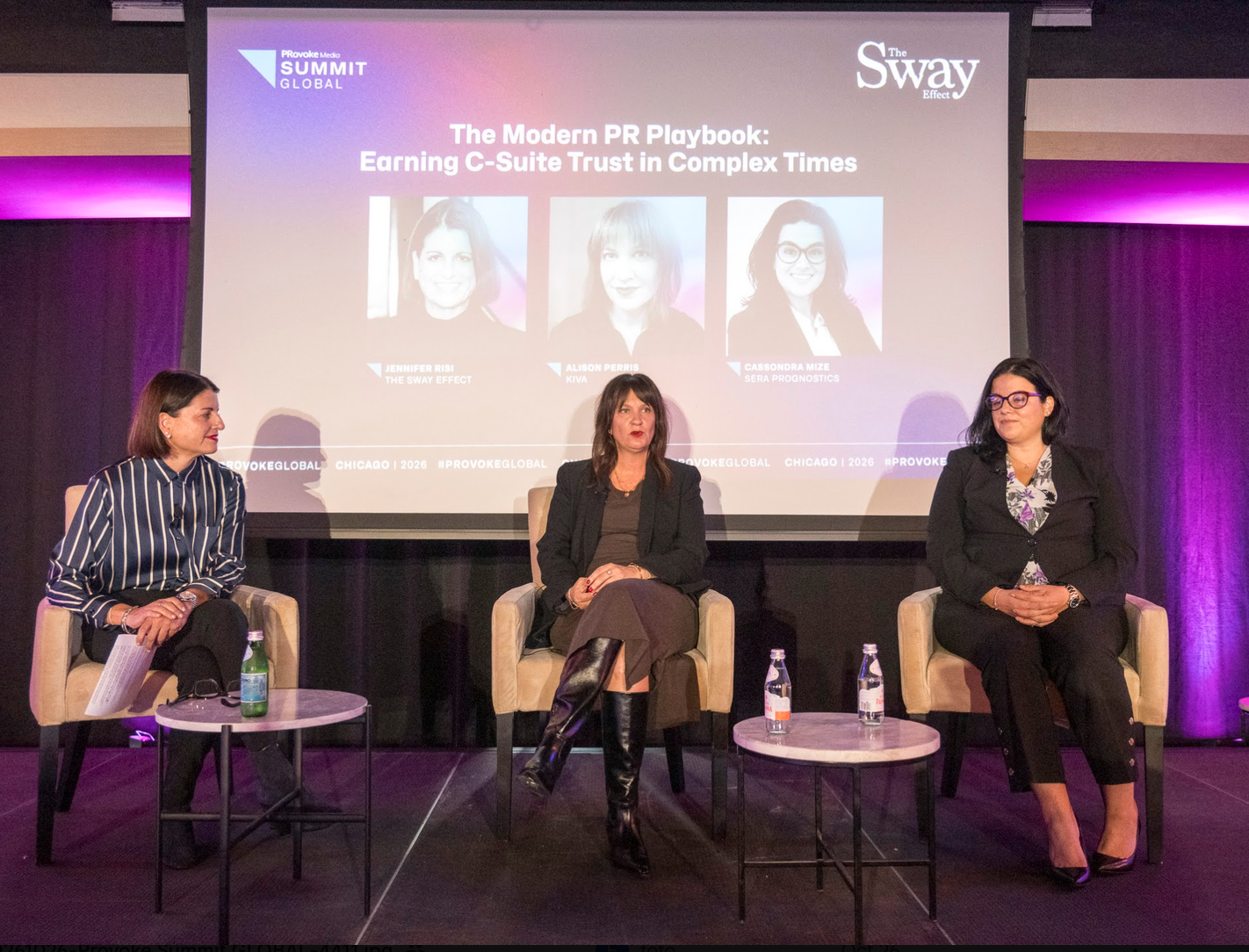
That was a central message from a discussion at PRovoke Media's Global Summit, where Cassondra Mize, head of marketing at Sera Prognostics, and Alison Perris, VP of marketing at Kiva, described how they have worked to establish themselves as strategic partners to executive leadership.
The discussion, moderated by Jennifer Risi, founder and president of The Sway Effect, explored what it takes for communications leaders to gain influence across the C-suite, and maintain it once they get it.
Both speakers arrived at their current organizations to find marketing responsibilities spread across different functions, requiring them to establish more coordinated approaches to communications and business strategy.
Perris said she joined Kiva, the nonprofit microfinance organization, expecting to focus on rebuilding awareness of a brand that had attracted considerable attention in its early years but had become less visible. Instead, she found that marketing had been decentralized and without consistent leadership for roughly five years.
Her initial work involved bringing together teams, establishing shared goals and creating a structure that connected marketing with product development and partnerships.
"Sometimes to get a seat at the table, you have to actually build the system that creates those decisions," Perris said.
Mize described a similar experience at Sera Prognostics, which is commercializing a test that helps identify pregnancies at higher risk of preterm birth. After moving from medical technology company BD, where established processes and teams supported marketing, she found that Sera's marketing responsibilities were distributed across functions without a central approach to messaging.
Much of her first 90 days, she said, was spent listening, understanding the organization and identifying the processes needed to support its growth.
For both executives, building credibility has meant demonstrating that communications can contribute to decisions well beyond publicity.
Perris described a recent discussion at Kiva about using AI to alter photographs of borrowers to protect their identities, a proposal that raised concerns about manipulating images and the potential for public backlash.
Rather than presenting the issue solely as a reputational risk, Perris approached the conversation by asking what the organization was trying to accomplish and how the decision would affect its relationship with lenders. She said the discussion centered on preserving the emotional connection between lenders and borrowers while considering the risks of altering the photographs.
Perris said that approach also requires communications leaders to move beyond presenting executives with a range of choices and instead offer a recommendation supported by evidence.
"I think what I found is that it's better to bring a recommendation," she said. "It's better to say, like, hey, if I was in your shoes, here's what I would do, and this is why."
Mize agreed, saying that arriving with a recommendation - and alternatives if needed - demonstrates strategic thinking and helps build executive confidence.
Perris offered another example from her time at eBay, where a product team wanted to remove a charitable donation option from the checkout process.
The change threatened a program that generated substantial donations for nonprofits, but Perris said she knew a reputational argument alone might not persuade the engineers making the decision.
Instead, she examined the behavior of customers who donated at checkout and found that they were among eBay's most valuable users, purchasing more and returning more frequently.
She used that data to make the case that the feature represented a business opportunity rather than an impediment to checkout. According to Perris, the company subsequently expanded its use.
"Sometimes the best way to protect the brand is not even bring the brand into the conversation, bring the data," she said.
Mize drew on her previous experience at medical technology company BD, describing how she helped influence a business decision during the Covid pandemic. When BD discontinued a diagnostic test offered through a partnership, she said the initial plan would have allowed customers to move elsewhere.
Instead, Mize said her team helped persuade executives to support a campaign encouraging customers to transition to BD's own product. Mize said the effort retained 75% of the business that otherwise could have been lost.
The discussion also highlighted the continuing challenge of demonstrating the financial value of communications, particularly when executives are accustomed to the immediate performance measures available through digital marketing.
Perris said communications professionals need to speak in terms that matter to business leaders, connecting brand awareness and reputation to outcomes such as customer acquisition and growth.
At Sera Prognostics, Mize said her CFO has been among the most challenging executives to persuade as the company works toward broader commercialization of its PreTRM test. Raising awareness among physicians and patients requires investment, but the return on PR spending is not always immediately apparent.
She said the CFO's questions nevertheless help sharpen the connection between marketing expenditures andbusiness objectives.
Both executives questioned the usefulness of relying too heavily on traditional communications metrics.
Perris singled out impressions, noting that even when campaigns generated billions of them, executives rarely asked about the figure. Mize said reporting email volumes and click-through rates is of limited value without demonstrating whether those activities contributed to business results.
AI is also changing the value of earned media as people increasingly turn to generative search for information. Risi raised the implications for PR budgets, while Perris said communications teams are only beginning to develop ways to measure how their work influences AI-generated responses.
Beyond measurement, the panelists emphasized the importance of relationships throughout an organization, particularly in situations where communications, legal, regulatory and business priorities overlap.
Mize recalled instances at BD when marketing learned late about product recalls, underscoring the need to establish relationships across functions before problems arise.
She also encouraged communications professionals to understand what she called the organization's "secret org chart" - the informal relationships and lines of influence that can determine who has access to senior leadership and whose advice carries weight.
Understanding those dynamics, she said, can help communications leaders identify opportunities to contribute to decisions before they are finalized.
Perris similarly stressed the importance of executive trust, saying that leaders do not want to be surprised by problems and that honesty is essential, even when communications professionals do not immediately have an answer.
She also encouraged them to become more curious about the issues executives are trying to solve rather than assuming they need to arrive with every solution.
"If you got a seat at the table, they know you can do the tactical side," Mize said. "It's how do you do the strategic side that matters?"

Legal Disclaimer:
MENAFN provides the
information “as is” without warranty of any kind. We do not accept
any responsibility or liability for the accuracy, content, images,
videos, licenses, completeness, legality, or reliability of the information
contained in this article. If you have any complaints or copyright
issues related to this article, kindly contact the provider above.


Comments
No comment