


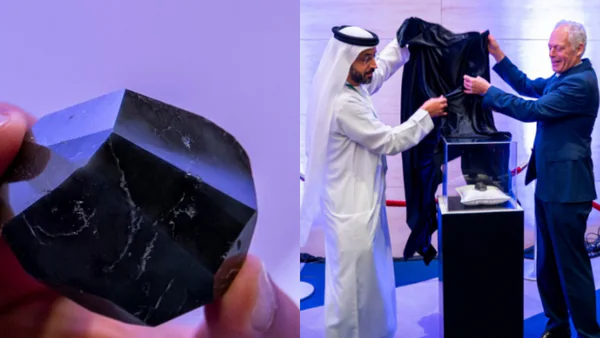
Rare 888.88-Carat Natural Black Diamond 'Infinity' Unveiled In Dubai Here's Its Decades-Long Journey


Based in Antwerp, Belgium, Diamond Trading NV specialises in sourcing, trading and distributing rough diamonds across international markets.
History of the Infinity diamondThe diamond was discovered in the Democratic Republic of the Congo and initially weighed 1,138 carats in its rough form. Andrew Coxon acquired the stone on behalf of De Beers in 1975.
The Gemological Institute of America (GIA) examined the rough crystal and recorded it in 2013 as the largest single-crystal natural diamond it had examined and reported on at the time, Gulf News reported.
The rough stone was cut and polished between 2022 and 2024, eventually becoming the finished 888.88-carat Infinity diamond. It is currently owned by Antwerp-based Diamond Trading NV.
Also Read | How cables and wire stocks will perform in Q2 results 2026 | ExpectationsAlmost five decades elapsed between its acquisition in 1975 and the completion of the polished diamond.
Diamond retains traces of its journey from deep within the EarthSpeaking at the Dubai Diamond Conference, Daniel de Belder of Diamond Trading NV explained how the stone's natural characteristics influenced the cutting and polishing process.
“It is a black diamond. It carries features that are witnesses of the eruptive process, when it came from 150 kilometres deep down to the surface,” Daniel de Belder of Diamond Trading NV told the audience at Dubai Diamond Conference.
He also explained that the team sought to preserve the diamond's natural features rather than remove the marks associated with its formation and journey towards the Earth's surface.
Also Read | Weak monsoon unlikely to dent rural demand, Crisil says“We adapted the plan and the manner in which we shape it to what nature is. We did not try to erase the traces of this very dramatic and fast transit from deep in the earth.”
What are natural black diamonds?Black diamonds, also called carbonado diamonds, are natural diamonds that appear black or dark grey. Their colour is associated with numerous tiny mineral inclusions, fractures and structural irregularities that absorb or scatter light.
Unlike colourless diamonds, which are valued for their brilliance and ability to reflect light, black diamonds generally have an opaque appearance. Inclusions of minerals such as graphite, pyrite and hematite can contribute to their dark colour.
Natural black diamonds are rare and occur in different parts of the world. However, not every black diamond available in jewellery is naturally coloured. Some undergo treatments to achieve their appearance, while others are manufactured synthetically in laboratories.
According to the Gemological Institute of America (GIA), natural black diamonds form deep within the Earth's mantle, at depths ranging from 150 to 800 kilometres beneath the surface.
How are black diamonds graded?The conventional diamond grading system evaluates four key characteristics, commonly known as the 4Cs: colour, cut, clarity and carat weight. However, the standard approach to grading transparent diamonds does not apply in the same way to black diamonds.
The GIA explains that the opaque appearance and extensive inclusions in black diamonds make traditional clarity grading unsuitable. Their colour is also assessed differently from that of coloured diamonds such as pink, blue or yellow stones.
“Because black diamonds are typically opaque and heavily included, they aren't given traditional clarity grades, which applies to transparent stones. And since black diamonds don't show tonal or saturation differences like pink, blue or yellow diamonds, they're simply assigned a single color grade: Fancy Black,” GIA explains on its website.

Legal Disclaimer:
MENAFN provides the
information “as is” without warranty of any kind. We do not accept
any responsibility or liability for the accuracy, content, images,
videos, licenses, completeness, legality, or reliability of the information
contained in this article. If you have any complaints or copyright
issues related to this article, kindly contact the provider above.


Comments
No comment