


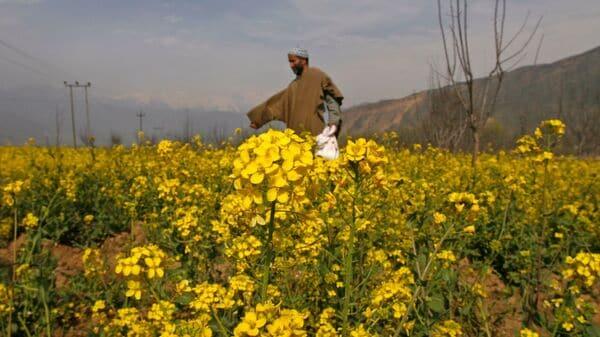
Higher Support Prices, Strong Edible Oil Demand To Drive Mustard Area Expansion


The mustard area under cultivation in the ongoing 2026-27 rabi season is projected to touch 9.50 million hectares, against 9.42 million a year before, said Vijay Veer Singh, director at the ICAR-Indian Institute of Rapeseed-Mustard Research in Bharatpur, Rajasthan, the country's biggest mustard-producing state. Better seeds and hybrid varieties should help farmers grow more on each hectare.
The timing is important as India buys about 60% of its edible oil from other countries, and the war in West Asia has made those imports costlier and harder to ship.
Also Read | Wheat crop area unlikely to shrink, raising hopes of bumper harvest: officialEven if yields stay where they were, the extra area could take mustard output to 13.9 million tonnes this season, up from 13.77 million last year, assuming productivity remains at 1,460 kg per hectare.
Key Takeaways- Higher support prices continue attracting farmers towards mustard cultivation nationwide. Growth in edible oil demand is supporting the expansion of mustard acreage. Improved seed varieties could help raise output and farm incomes. Rice-fallow land offers significant untapped potential for mustard expansion. Moisture shortages remain the biggest risk to acreage growth.
Meanwhile, edible oil demand is projected to rise to 26.5 million tonnes in FY27 from 25.7 million tonnes a year before, Mint reported on 22 October.
However, experts advise constant monitoring of the crop situation. According to Singh, moisture availability is likely to be a major constraint on mustard acreage in 2026–27, while favourable prices and the crop's relatively lower irrigation requirement compared with wheat could support planting where conditions permit.
Rajasthan, Uttar Pradesh, Madhya Pradesh, West Bengal and Haryana are the top five major mustard-growing areas in the country. Other states include Jharkhand, Assam, Gujarat, Bihar, Punjab, Chhattisgarh, Maharashtra, Uttarakhand, Himachal Pradesh, and Andhra Pradesh.
Higher support pricesThe Minimum Support Price (MSP) for rapeseed and mustard is ₹6,613 per quintal for the current rabi marketing season, approved by the Cabinet on 30 September 2026, reflecting an increase of ₹413 per quintal over the previous year, which experts feel will drive area under cultivation.
According to data from CCS Haryana Agricultural University, Hisar, the highest area of 9.42 million hectares was achieved in 2025-26, and the highest productivity of 1,524 kg per hectare was achieved in the year 2020-21. Area under mustard has increased from 6.70 million hectares in 2020-21 to 9.42 million hectares in 2025-26. This represents an increase of 40.6% over five years. The crop is at a saturation stage in some states, while in some states it is increasing.
Also Read | Yellow Revolution 2.0: India's ₹11,000-crore bet on domestic palm oil“We are expecting mustard acreage to remain healthy this rabi season, supported by favourable prices and steady demand. If weather conditions remain favourable, acreage could see a further increase over last year,” said Namit Singla, a trader in Delhi.
"The mustard crop has become an attractive crop because of reasonably good yield, consistent increase in MSP and market price over and above MSP. Area has shifted to mustard from wheat and other location-specific rabi crops," said Baldev Raj Kamboj, vice chancellor, CCS Haryana Agricultural University, Hisar (Haryana).
The mustard crop has emerged as a good alternative to wheat in the core area of the rice-wheat cropping system because of at-par or higher returns.
As far as Haryana is concerned, according to Kamboj, the mustard crop was cultivated on an area of 649,000 hectares, with production and productivity of 1.46 million tonnes and 2,255 kg per hectare, respectively (2025-26). "Mustard acreage in Haryana is likely to increase by 6-10% in the upcoming rabi season, supported by the availability of high-yielding seed varieties and a favourable minimum support price," added Kamboj.“Farmers are expected to expand sowing as improved seeds promise better productivity, while remunerative support prices strengthen the crop's economic appeal.”
Also Read | Centre considers ₹1,150 crore scheme to curb industrial pollution in NCRSuitable short-duration mustard varieties can help bring additional rice-fallow land under oilseed cultivation, particularly in eastern India. Rice fallow land is cropland where a kharif season rice crop is harvested, and the land is left uncultivated or 'fallow' during the following rabi season).
According to Singh, efforts to expand mustard cultivation in rice-fallow areas are gaining attention across several states, with region-specific strategies being considered to boost oilseed production. ICAR's Vision 2050 for the Directorate of Rapeseed–Mustard Research estimated that there were approximately 11.65 million hectares of rice-fallow land in the eastern and northeastern states. It suggested that bringing even 10% of this area under rapeseed–mustard could increase oilseed production by at least 1 million tonnes.

Legal Disclaimer:
MENAFN provides the
information “as is” without warranty of any kind. We do not accept
any responsibility or liability for the accuracy, content, images,
videos, licenses, completeness, legality, or reliability of the information
contained in this article. If you have any complaints or copyright
issues related to this article, kindly contact the provider above.


Comments
No comment