


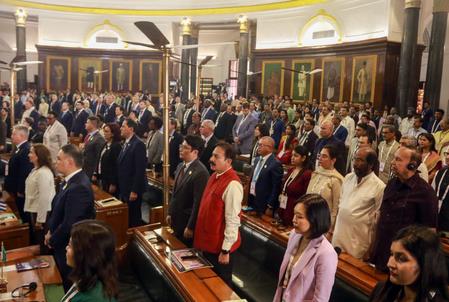
BRICS Members Condemn Unilateral Economic Sanctions, Stress Urgency For UN Reforms


“We condemn the imposition of unilateral coercive measures that are contrary to international law, and reiterate that such measures, inter alia in the form of unilateral economic sanctions and secondary sanctions, have far reaching negative implications on human rights, including the right to development, health and food security of the general population of targeted states,” read the Joint Declaration following the conclusion of the 12th BRICS Parliamentary Forum held in New Delhi.
The declaration was adopted by the Presiding Officers and representatives of the parliaments of Brazil, China, Egypt, Ethiopia, India, Indonesia, Iran, Russia, South Africa and the UAE at the two-day forum.
“We call for the elimination of such unlawful measures which undermine international law and the principles and purposes of the UN Charter,” it added.
Stressing the urgency of reforming the current international peace and security architecture, the parliaments said the reform of the UN and its Security Council should make it more just, equitable, democratic, representative, effective and efficient, and better reflect contemporary realities.
They also underlined the importance of the Global South as a driver for positive change and reaffirmed the role of BRICS in voicing its concerns and priorities.
On climate change, the declaration said developed countries“shall provide additional, adequate, predictable, accessible financial resources, capacity building support, technology development and transfer to developing countries on mutually agreed terms for adaptation”.
The parliaments further took note of Russia's initiative to consider establishing a BRICS Plus geopolitical group within the Inter-Parliamentary Union (IPU) to amplify the voice of the Global South.
They agreed to reconvene in 2027 under China's BRICS Chairship.
In September, the BRICS members unanimously adopted the New Delhi Declaration, in which the leaders reaffirmed their commitment to reforming and improving global governance by promoting a more just, equitable, agile, effective, efficient, responsive, representative, legitimate, democratic and accountable international and multilateral system in the spirit of extensive consultation, joint contribution and shared benefits.
The leaders of BRICS nations also stressed the importance of the Global South as a driver for positive change, particularly in the face of international challenges, including deepening geopolitical tensions, rapid economic downturns and technological changes, protectionist measures, migratory challenges, and climate change.

Legal Disclaimer:
MENAFN provides the
information “as is” without warranty of any kind. We do not accept
any responsibility or liability for the accuracy, content, images,
videos, licenses, completeness, legality, or reliability of the information
contained in this article. If you have any complaints or copyright
issues related to this article, kindly contact the provider above.


Comments
No comment