


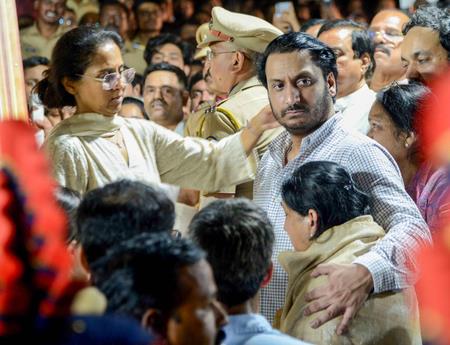
No Merger With NCP(SP) Ahead: Ruling NCP Reaffirms Alliance Autonomy


The refusal to share control or merge signals that the era of tactical ambiguity between the two NCP factions is officially over. Both outfits are now set on divergent trajectories, setting up a long-term electoral contest for the legacy of the party's original mandate.
By firmly ruling out a merger or power-sharing agreement, the ruling NCP faction after its core committee meeting held on Sunday, reinforces its commitment to the Mahayuti alliance alongside the Bharatiya Janata Party (BJP) and Shiv Sena.
Having secured official recognition and symbol rights from the Election Commission, the ruling NCP seeks to establish itself not as a temporary breakaway group, but as the sole legitimate vehicle of the party's administrative future.
Retaining full structural autonomy allows the party to maintain its bargaining power within Cabinet portfolios and regional seat-sharing negotiations without the threat of internal ideological dilution.
The trigger for Sunday's core committee meeting was NCP(SP) MP, Supriya Sule's reported discussion with late Deputy Chief Minister Ajit Pawar's sons Parth and Jay Pawar, advocating for an early decision on reunification or a merger, subject to conditions regarding leadership and Cabinet berths.
The core committee decisively rejected the merger proposal, refusing to cede party control to Sharad Pawar and Supriya Sule while deciding to remain steadfast within the Mahayuti alliance.
The core committee's rejection highlighted a fundamental power struggle. Supriya Sule's proposal - demanding top-level organisational control for Sharad Pawar and herself, alongside three ministerial berths (Jayant Patil, Rohit Pawar, Jitendra Awhad) - offered little clarity, especially on NCP President and Deputy CM Sunetra Pawar's standing and equality of partnership.
The core committee, therefore, reiterated there will be no reunification or merger between the two NCP factions and also signaled that it will not capitulate to NCP(SP) on terms that strip away its operational autonomy.
Veteran NCP leader and Minister Chhagan Bhujbal said, "The merger was not on the cards and it won't be in future too."
For Sharad Pawar and the NCP(SP), the definitive rejection of unified control solidifies their position within the Opposition Maha Vikas Aghadi (MVA) coalition. Operating as a distinct entity prevents narrative confusion among voters, it can draw a sharp line between those aligned with the ruling government and those offering an alternative ideological platform.
Without the prospect of internal compromises or dual-headed leadership, the NCP(SP) can focus exclusively on grassroots cadre building and regional anti-incumbency campaigns.
Despite taking a firm stance against the merger, the Sunetra Pawar-led NCP however, faces crucial unaddressed internal challenges. The conflict between the youth wing and seasoned veterans remains unmanaged, threatening cohesion.
The lack of alignment between NCP office-bearers and government representatives leaves the cadre without clear direction.
Political observers said that post-Ajit Pawar, leadership structures remain fluid, which could be exploited by rivals if internal restructuring is delayed.
In a nutshell, the current outcome preserves the status quo within the Mahayuti, closing the door on an immediate or unconditional merger.
Unless a comprehensive, mutually beneficial formula is presented from the top-resolving both Cabinet quotas and internal hierarchy-the NCP will continue to chart its independent course inside the ruling coalition.
(Sanjay Jog can be contacted on...)

Legal Disclaimer:
MENAFN provides the
information “as is” without warranty of any kind. We do not accept
any responsibility or liability for the accuracy, content, images,
videos, licenses, completeness, legality, or reliability of the information
contained in this article. If you have any complaints or copyright
issues related to this article, kindly contact the provider above.


Comments
No comment