


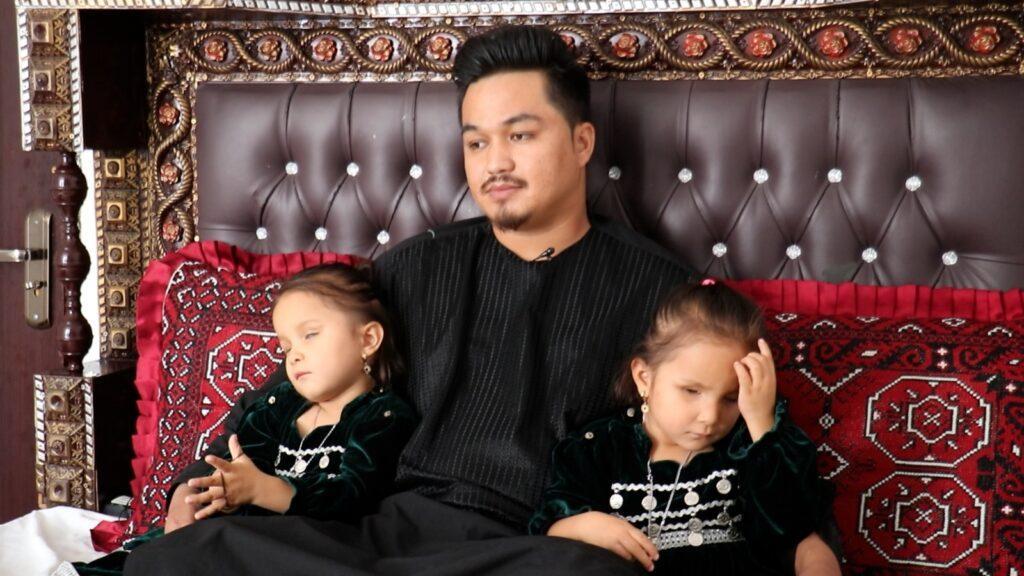
Blind Twin Sisters, Parents Cling To Hope Of Restored Sight


Eye specialists stress the importance of early diagnosis of eye diseases in children and recommend eye examinations after birth, during the first three months of life and before they start school.
Originally from Daikundi province, Samar and Samaranwere born in Herat city four and a half years ago. They were their parents' first children.
Arman Ahmadi, their father, who has travelled to Kabul for his daughters' treatment, told Pajhwok Afghan News that he had been overjoyed to learn he was going to become a father, particularly when he discovered that he was expecting twins.
He said he had eagerly counted the days until their birth, looking forward to holding his daughters in his arms.
Parents' joy turns to concern
Ahmadi said he and his wife were delighted after Samar and Samaran were born, unaware that their daughters had vision problems. A few days after the birth, they noticed that the girls' eyes were not moving. After consulting a doctor, they learnt that their daughters were blind.
“At first, I hoped my daughters' vision problems would be resolved. I did not imagine they were completely blind, but over time I realised that my daughters could not see,” he said.
Ahmadi said it had been difficult for the family to accept the situation. They consulted various doctors to determine the cause of their daughters' blindness but received no clear answers in Herat about whether their condition could be treated.
He added that around two months ago, during a trip to Iran, he had also taken his daughters to several doctors but had again received no definitive answers about their eye conditions.
Nevertheless, Ahmadi said he and his wife had not given up hope of improving their daughters' sight and continued to hope that one day the girls would be able to see.
Blindness a challenge for the couple
Ahmadi said he and his wife were doing their best to fulfiltheir responsibilities towards their daughters by providing them with love and care.
“I believe this is a test from God, given to us to see whether we can take good care of these two angels and serve them. We are grateful to God,” he said.
He said he would do everything within his means to ensure his daughters received an education, adding that they were highly intelligent and talented. Sometimes, he said, the girls made remarks that surprised both him and their mother.
Samar and Samaran: Twins with different personalities
Ahmadi said that despite being twins, Samar and Samaranhad distinct personalities. Samar was more talkative and cheerful, while Samaran was quieter.
He said the sisters shared a close bond and were always concerned about each other. Whenever Ahmadi bought something for Samar, she would ask him to buy something for her sister as well.
Early diagnosis key to preventing childhood vision impairment
Eye specialist Dr Noorullah Ramoz said examinations of Samar and Samaran had revealed abnormalities in the normal development of their eyes. The condition, he said, had begun during pregnancy and could be associated with genetic factors or certain conditions during pregnancy, including high blood pressure, diabetes and infections.
Ramoz said that in some cases, the structures of the eyes and the neural pathways that transmit visual information to the brain did not develop properly. The severity of the condition and the possibility of treatment depended on the type of disorder and the extent of the damage, he added. Research into new methods of diagnosing and treating eye diseases was continuing.
The specialist advised families to have their children's eyes examined after birth, during the first three months of life and before they start school.
“Unfortunately, parents pay more attention to the appearance of their children's eyes than to their function. If children have refractive errors, poor vision or various eye diseases, they should receive treatment at that stage. Otherwise, these problems can lead to amblyopia, or lazy eye, and impaired vision. By the time the child grows older, the condition may no longer be treatable,” he said.
Public Health Ministry officials also say that around 90 per cent of blindness cases are preventable or treatable and that early diagnosis of eye diseases can prevent them from progressing.
Dr Agha Mohammad Abid Totakhil, head of eye health care coordination, estimated that more than 600,000 people in Afghanistan were blind, while another 1.5 million suffered from visual impairment.
He said around 25,000 people lost sight in one eye each year, adding that 80 per cent of these cases were preventable or treatable. He expressed hope that trachoma would be completely eradicated in Afghanistan by 2030.
hz/sa

Legal Disclaimer:
MENAFN provides the
information “as is” without warranty of any kind. We do not accept
any responsibility or liability for the accuracy, content, images,
videos, licenses, completeness, legality, or reliability of the information
contained in this article. If you have any complaints or copyright
issues related to this article, kindly contact the provider above.


Comments
No comment