


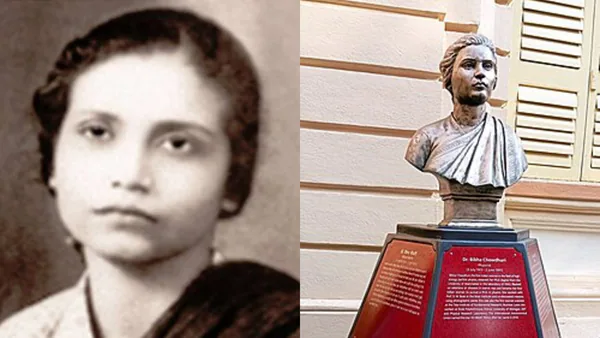
Who Is Bibha Chowdhuri? Indian Physicist Who Studied Cosmic Rays And Had A Star Named In Her Honour


Her academic journey stood out early. When Chowdhuri completed her master's degree in physics at the University of Calcutta in 1936, she was reportedly the only woman in a class of 24 students. At a time when opportunities for women in scientific research were limited, she continued to pursue a field that demanded years of specialised study and experimentation.
Also Read | International Women's Day 2025: Google Doodle honours women in STEM fieldsAccording to Down To Earth and the Council of the Cherenkov Telescope Array Observatory, Chowdhuri's education was supported by her progressive family. Her father was a doctor, while her family background was associated with the Brahmo Samaj, a reform movement that encouraged education, including for women.
Bibha Chowdhuri's research on cosmic rays and publishing NatureAfter completing her master's degree, Chowdhuri began research under physicist Debendra Mohan Bose. At the Bose Institute, the pair investigated cosmic rays, high-energy particles that travel through space and interact with the Earth's atmosphere.
Their research involved photographic emulsions, which helped scientists identify the tracks left by subatomic particles. Between 1938 and the early 1940s, Chowdhuri and Bose published their findings in Nature, one of the world's leading scientific journals. Their work contributed to early investigations into mesons, a family of subatomic particles.
Also Read | Women in STEM: The times they are a-changingThe research was significant, but the team eventually faced a shortage of sensitive photographic plates during the Second World War, limiting further experiments. Chowdhuri subsequently travelled to the University of Manchester in Britain, where she pursued a PhD under physicist Patrick Maynard Stuart Blackett, who later received the Nobel Prize in Physics.
Her career continued across several major research institutions. In 1949, she became the first woman researcher at the Tata Institute of Fundamental Research (TIFR), founded by Homi Jehangir Bhabha.
She later worked at the Physical Research Laboratory (PRL) in Ahmedabad, contributing to cosmic-ray research and investigations involving high-energy particles.
Why was a star named after Bibha Chowdhuri?Despite her contributions, Chowdhuri received limited recognition during her lifetime. She continued researching until her death on 2 June 1991, leaving behind a body of work that was not widely celebrated outside scientific circles.
That began to change decades later. In 2019, the International Astronomical Union honoured her by naming the star HD 86081 Bibha. The star is located in the constellation Sextans.
Also Read | India Inc. leads industry-wide movement for more women in STEMThe recognition gave her name a lasting place in the night sky. As the Council of the Cherenkov Telescope Array Observatory has noted, Bibha means“ray of light” in Bengali, a fitting association for a physicist whose work helped illuminate the invisible world of cosmic particles.
Her story is also a reminder that scientific achievement and public recognition do not always arrive together.

Legal Disclaimer:
MENAFN provides the
information “as is” without warranty of any kind. We do not accept
any responsibility or liability for the accuracy, content, images,
videos, licenses, completeness, legality, or reliability of the information
contained in this article. If you have any complaints or copyright
issues related to this article, kindly contact the provider above.


Comments
No comment