


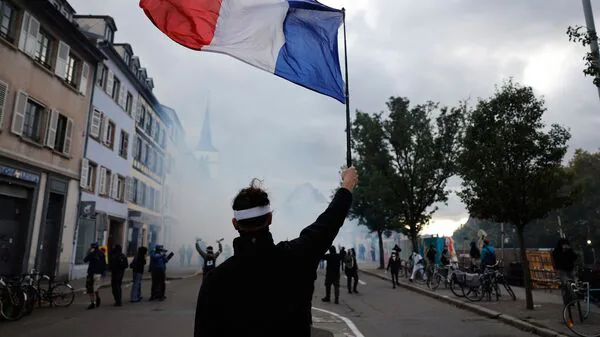
From The French Revolution To Yellow Vests: Why Protest Is Embedded In France's Political History Amid Nationwide Unrest


France's Ministry of the Interior said 410,000 people protested nationwide on Saturday, including 110,000 in Paris.
In central Paris, businesses remained shuttered and shop windows were covered with protective panels, while some retailers hired private security. At least 24 metro stations were closed at police request.
Quick answers to key questions
.5 QUESTIONS1Why is protest considered central to France's political history?⌵From the French Revolution and the Paris Commune to May 1968 and the Yellow Vests, protests have repeatedly turned public grievances into national political issues. They have also sometimes led to confrontation with the state.
2What are the recent protests in France about?⌵Demonstrators have protested deteriorating school conditions and the rising cost of living. The movement has also reflected concerns about education funding and inequality.
3How did the May 1968 protests affect France?⌵Student demonstrations grew into a nationwide labour movement, with millions of workers joining strikes. The crisis led to the Grenelle agreements, which included wage increases and improved labour conditions.
4What did the Yellow Vest protests achieve in France?⌵The movement pressured President Emmanuel Macron's government to cancel planned fuel tax increases and introduce measures to ease household pressures. These included economic relief and an increase in the national minimum wage.
5How many people joined the recent protests in France?⌵France's Interior Ministry estimated that 410,000 people protested nationwide, including 110,000 in Paris.
Major cultural institutions, including the Louvre and the Musée d'Orsay, also shut for the day, while Art Basel Paris cancelled its weekend programme.
Authorities deployed more than 70,000 police officers and gendarmes across France, seeking to prevent a repeat of the violence that marred demonstrations on 17 October. What began largely peacefully escalated into looting, vandalism, and clashes, leaving thousands of businesses damaged or ransacked. More than 2,000 people were taken into police custody, according to official figures cited by agencies.
From the French Revolution to the Paris CommuneThe roots of this tradition stretch back to the French Revolution of 1789, when popular unrest helped bring down the old order. The storming of the Bastille on 14 July became a defining symbol of resistance to royal authority and the power of ordinary people to challenge an entrenched political system.
The 19th century saw repeated uprisings in Paris, including the June Rebellion of 1832, later immortalised in Victor Hugo's Les Misérables. The Paris Commune of 1871, a radical revolutionary government that emerged after the Franco-Prussian War, was violently suppressed by government forces. Its defeat left a lasting imprint on the country's labour movement and revolutionary tradition.
These episodes reinforced the central place of protest in French political history, even as they exposed the risks of confrontation between demonstrators and the state.
May 1968: When protests forced concessionsOne of the most consequential modern examples came in May 1968, when student demonstrations against university conditions and wider social constraints escalated into a nationwide labour movement.
Also Read | France protest: Louvre shut, hotel bookings decline as demonstrations continueMillions of workers joined strikes, bringing much of the country to a standstill and posing a major challenge to President Charles de Gaulle's government. The crisis eventually led to the Grenelle agreements, which included significant wage increases and improved labour conditions.
May 1968 became a reference point for subsequent generations of protesters, reinforcing the belief that sustained collective action could reshape public policy.
From Yellow Vests to today's unrestThe Yellow Vests movement of 2018-19 offered a more recent illustration of the power of street mobilisation. Initially triggered by fuel tax increases, the protests broadened into a revolt against the cost of living, economic inequality and the perception that political decision-making favoured urban elites over people in smaller towns and rural areas.
The movement put pressure on President Emmanuel Macron 's government and prompted concessions, including the cancellation of planned fuel tax increases and additional measures aimed at easing household pressures.
Also Read | Why is France 'burning'? Is Yellow Vest movement back amid looting and clashes?Like earlier protests, the Yellow Vests movement showed how a specific policy grievance could become a wider expression of distrust in political institutions.
As France confronts rising living costs and concerns about public services, the demonstrations draw on a long historical legacy.
From the Bastille to May 1968 and the Yellow Vests, protest has repeatedly served as a mechanism through which grievances become national political questions in France.

Legal Disclaimer:
MENAFN provides the
information “as is” without warranty of any kind. We do not accept
any responsibility or liability for the accuracy, content, images,
videos, licenses, completeness, legality, or reliability of the information
contained in this article. If you have any complaints or copyright
issues related to this article, kindly contact the provider above.


Comments
No comment