


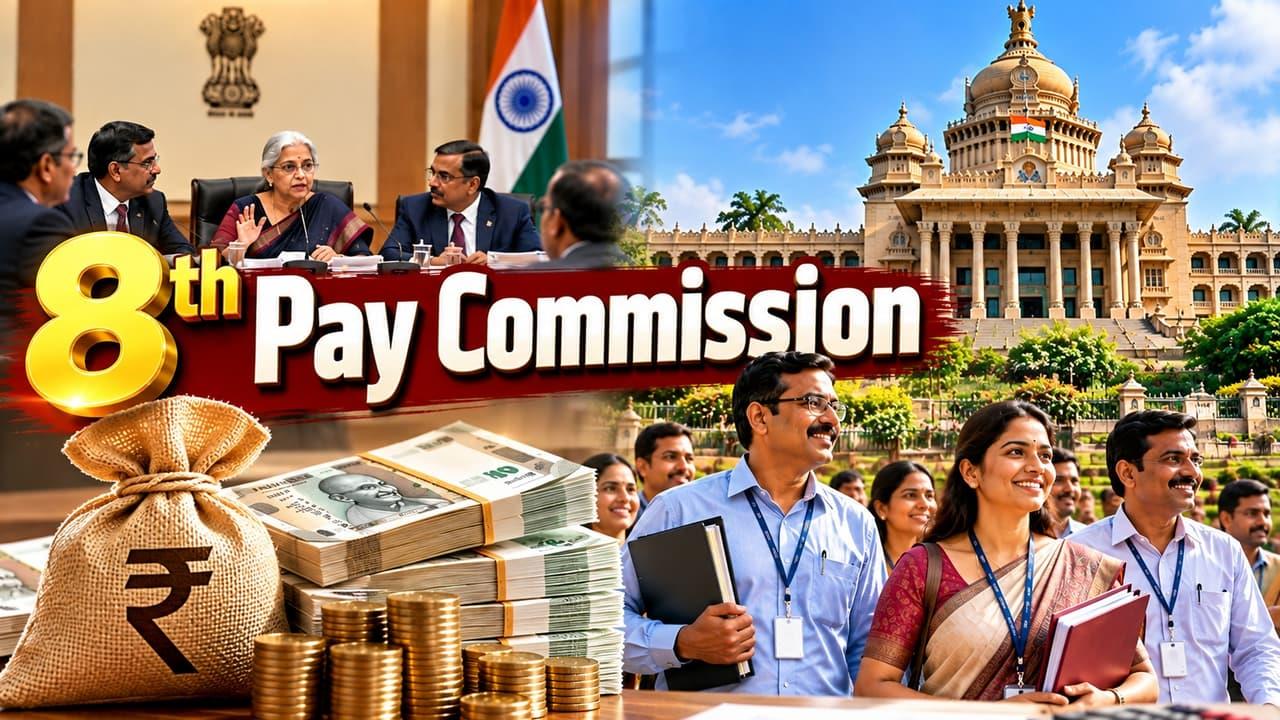
8Th Pay Commission: Tor On DA Merger And Government Response


8th Pay Commission: The 8th Central Pay Commission is currently gathering feedback on the new salary structure and Dearness Allowance (DA) for government employees and pensioners.
8th Pay Commission: The 8th CPC is in the consultation phase. Before submitting final recommendations next May, it is gathering feedback from employees and unions.
Former SC Judge Ranjana Prakash Desai chairs the commission. Other members include Member-Secretary Pankaj Jain and Professor Pulak Ghosh from the PM Economic Advisory Council.
The commission's decisions will benefit over 1 crore people, including about 50 lakh central government employees and 65 lakh pensioners from defense and railway ministries.
Dearness Allowance (DA) is a part of basic pay linked to inflation. It impacts the monthly salary of government, defense, and bank employees, aiming to ease inflation effects.
As per 7th CPC guidelines, DA is revised twice a year based on the All-India Consumer Price Index (AICPI). Announcements are usually made in March and October.
The 8th Pay Commission ToR outlines what central government employees and pensioners can expect. Approved by the Union Cabinet, it specifies the scope of their recommendations.
The commission will recommend realistic changes in remuneration, allowances like DA and HRA, and benefits like increments, considering current work needs and special demands.
Employee unions demand merging DA with basic pay. As per 7th CPC rules, if DA exceeds 50% of basic pay, it can be merged. Currently, the DA has reached 60% of the basic pay.
The government hasn't officially announced merging DA with basic pay yet. It is crucial as basic pay determines PF contributions, pensions, gratuity, and other allowances.
Under the 8th CPC, unions demand merging DA with basic pay and increasing the fitment factor. The central government clarified that no such proposal is currently considered.
The All India Defence Employees Federation (AIDEF) demanded a salary structure aligned with inflation. They also proposed increasing the minimum monthly salary to Rs 69,000.
The Maharashtra Old Pension Organization suggested a 4% DA hike and merging 50% DA with basic pay. They also proposed raising the minimum monthly salary to Rs 65,000.
The NC-JCM demanded including DA in an inflation-linked salary structure. They also proposed increasing the minimum monthly salary from Rs 18,000 to Rs 69,000.
AIDEF demanded a change in DA calculation, arguing the current method favors stable expenses, while lower-paid employees spend more on food, education, healthcare, and rent.
As per the ToR, recommendations are to be announced within 18 months of the panel's formation (November 3, 2025). Thus, the final deadline for the report is May 2027.
After the recommendations, full implementation may take two to three years. This means the salary hike announced in 2027 might be fully implemented by 2029 or 2030.

Legal Disclaimer:
MENAFN provides the
information “as is” without warranty of any kind. We do not accept
any responsibility or liability for the accuracy, content, images,
videos, licenses, completeness, legality, or reliability of the information
contained in this article. If you have any complaints or copyright
issues related to this article, kindly contact the provider above.


Comments
No comment