


Trypillia Settlement Discovered Above Verteba Cave In Ternopil Region


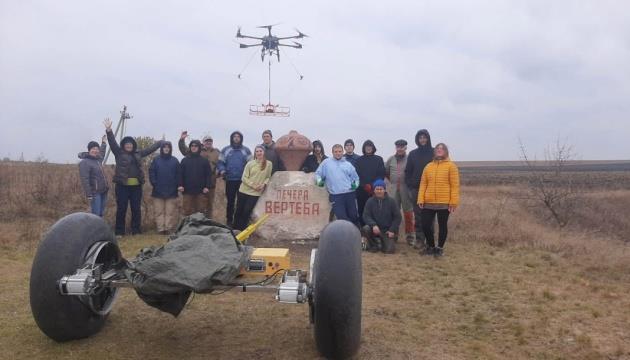
"A team of scientists from the S. I. Subbotin Institute of Geophysics of the National Academy of Sciences of Ukraine, the Institute of Geophysics of the Polish Academy of Sciences, and Taras Shevchenko National University of Kyiv studied Trypillia sites using high-resolution magnetometry with unmanned aerial vehicles. This method makes it possible to detect underground objects and soil features by identifying changes in the magnetic field," Sokhatskyi said.
According to him, modern equipment enabled specialists to conduct a successful archaeological survey without excavation at three Trypillia settlements: one on the surface above Verteba Cave and others near the village of Hlybochok, covering an area of about 60 hectares.
"We were able to see the clear outlines of the remains of Trypillia houses and record a fairly accurate plan of these prehistoric settlements. For example, there turned out to be far more dwellings in Hlybochok than we had expected. We could see how people arranged their houses in accordance with the landscape, orienting them toward the sunny side," the archaeologist added.
Read also: Two Trypillia settlements in Ternopil region added to UNESCO Tentative ListThe research findings are still being analyzed. However, the data obtained so far indicate that Trypillia settlements existed not only inside Verteba Cave but also above it.
"Verteba is unique because it is the only place where a Trypillia settlement existed underground. Moreover, it did so for a long time – about 750 years. We decided to find out whether people had also settled on the surface above it. We carried out small-scale exploratory excavations, digging test pits, and found that people had lived above the cave as well. Since large-scale excavations were not possible, we used equipment to 'see through' the ground above Verteba and discovered archaeological features in the form of dwellings. This means Verteba has taken on new significance. There is the underground Verteba, but there is also a cultural heritage site above ground. We will now determine its parameters – the extent of the settlement, its boundaries, where it was located and how it relates to the cave's karst sinkholes. Perhaps, there were other entrances to Verteba, or another cave nearby. The equipment allows us to see all this, so we are eagerly awaiting the final research results," Sokhatskyi said.
The research will provide an important basis for preparing the documentation needed to nominate two Trypillia culture sites – Verteba Cave and Hlybochok – for inclusion on the UNESCO World Heritage List.
Photo credit: Borshchiv Regional Local History Museum

Legal Disclaimer:
MENAFN provides the
information “as is” without warranty of any kind. We do not accept
any responsibility or liability for the accuracy, content, images,
videos, licenses, completeness, legality, or reliability of the information
contained in this article. If you have any complaints or copyright
issues related to this article, kindly contact the provider above.


Comments
No comment