


More Water, Less Maintenance: UAE Researchers Target 20-Year Desalination Membranes


- By: Haneen Dajani
A desalination technology being developed in Abu Dhabi could extend the life of membranes used in reverse-osmosis plants from around three to four years to as long as 20 years, potentially reducing replacement and maintenance costs.
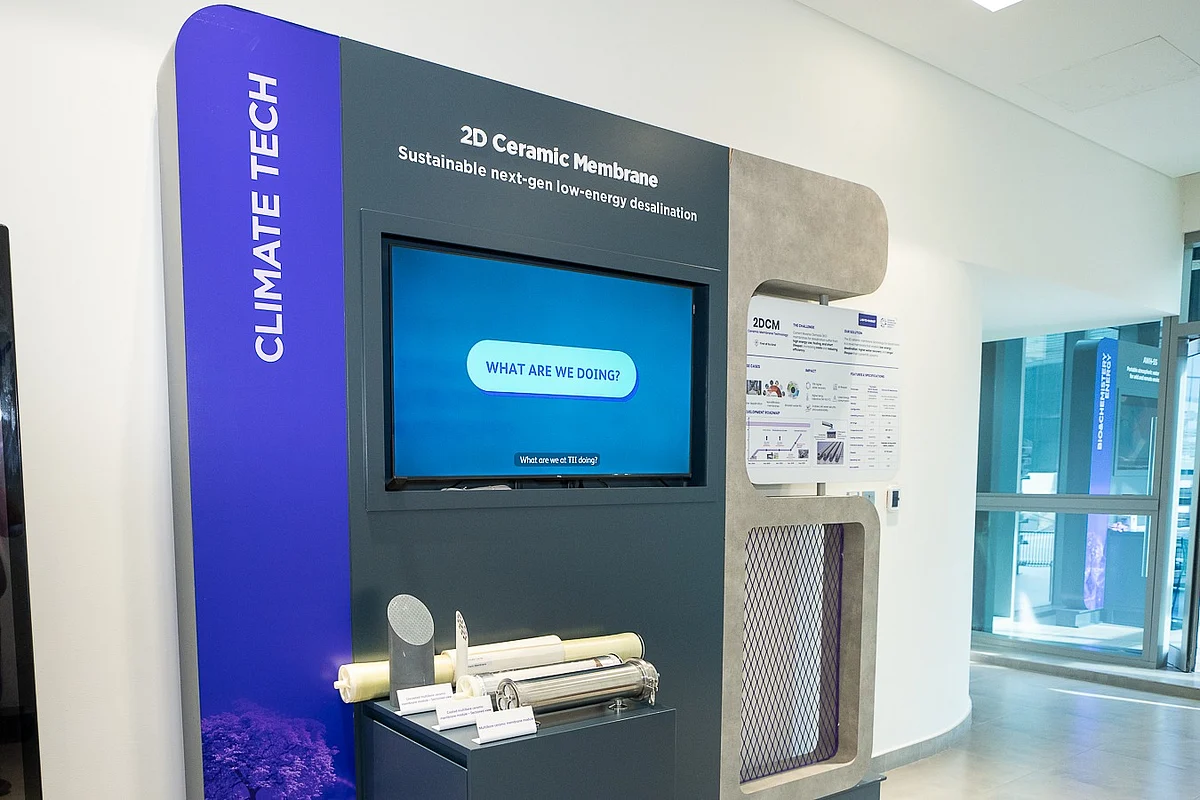
During a visit to the Technology Innovation Institute's (TII) Renewable and Sustainable Energy Research Centre, a laboratory demonstration showed the desalination process in action as researchers worked on a more durable alternative to the polymer membranes commonly used in water treatment.
Recommended For YouThe ceramic material does not desalinate water by itself. A special internal coating performs the salt separation, while the ceramic structure is designed to withstand the pressures and cleaning processes involved in desalination.
Stay up to date with the latest news. Follow KT on WhatsApp Channels.
Reverse osmosis works by applying pressure to seawater as it passes over a membrane. Water molecules can pass through the membrane, while salt is left behind. Desalination plants use tens of thousands of these membranes.
Because conventional membranes are made from polymers, they can wear out and need to be replaced every three to four years. They also have limits on the pressure they can withstand, and harsher cleaning chemicals can affect their material.
“If plastic is the problem, what can we build it with?” asked Professor Phil Hart, Chief Researcher and Head of TII's Renewable and Sustainable Energy Research Centre, describing the thinking behind the project.
The team is developing ceramic membranes that are stronger, more resistant to abrasion and less prone to clogging. They can also tolerate harsher cleaning chemicals and potentially higher operating pressures.
The researchers expect the membranes could last about 20 years, compared with three to four years for conventional polymer alternatives. That lifespan remains a projection, however, and will need to be validated through extended testing under operating conditions.
The technology could also improve water recovery. Hart said conventional systems typically recover about 40 to 45 per cent of the water, and the team expects the new membranes could increase that by a further 10 to 20 percentage points. The improvement has yet to be demonstrated at scale.
The initial cost of each membrane may be higher, but Hart said the team had analysed whether the technology could make financial sense over its lifetime.
“It will pay for itself rather quickly,” he said, pointing to the potential for more water recovery and less maintenance.“Each membrane will cost more, but you'll get more water, less maintenance.”
The team was targeting a pilot test in a real-world rig by the end of 2026, followed by scale-up and testing over several months in 2027. Hart said the membranes would need to be tested in connected units for at least six months before industry could be expected to adopt them.
The team aims to prepare the technology for handover to a company within the TII group for manufacturing and commercialisation in 2027.
Cold box offers a different approach to air conditioningIn another laboratory, researchers demonstrated a cooling technology designed to work alongside conventional air conditioning and reduce the load it has to carry.
The cooling unit's box was cold to the touch during the visit. The system uses a different thermodynamic principle, with carefully arranged heat exchangers and specific gases circulating in a loop to produce cooling.
Rather than immediately replacing an existing air conditioner, the technology is designed to operate alongside it. The new unit would take on part of the cooling load, allowing the conventional air conditioner to work less hard while remaining available if the new system stops working.
Hart said the approach could eventually take a substantial share of energy demand away from traditional air conditioning.
“If you can arrange the materials in those heat exchangers really carefully, and you use exactly the right gas, you can use that cold in the room,” he said, explaining the process.
The system is designed to use heat to drive part of the cycle, with the team looking at how the UAE's abundant solar energy could support its operation. Hart said there was an opportunity to take“the majority of the energy needs away from the traditional air conditioner”, potentially delivering very significant energy savings.
The system has so far been demonstrated in the laboratory, and the team has not provided a verified percentage for the energy it could save.
The researcher also explained that the design would use two pairs of units. While one pair regenerates the cooling process, the other pair would take over, allowing cooling to continue rather than pause during regeneration.
The team plans to demonstrate a pilot-scale unit at the start of 2027. If that succeeds, it hopes to move to a much larger unit later in the year.
Hart said the group would not consider the technology a success simply because it was more sustainable. It would have to compete with existing air conditioning on performance and cost.
“If it's not at least as good and at least the same price, then we've failed,” he said. Ideally, he added, the system would be cheaper to run or perform better than the conventional alternative.

Legal Disclaimer:
MENAFN provides the
information “as is” without warranty of any kind. We do not accept
any responsibility or liability for the accuracy, content, images,
videos, licenses, completeness, legality, or reliability of the information
contained in this article. If you have any complaints or copyright
issues related to this article, kindly contact the provider above.


Comments
No comment