


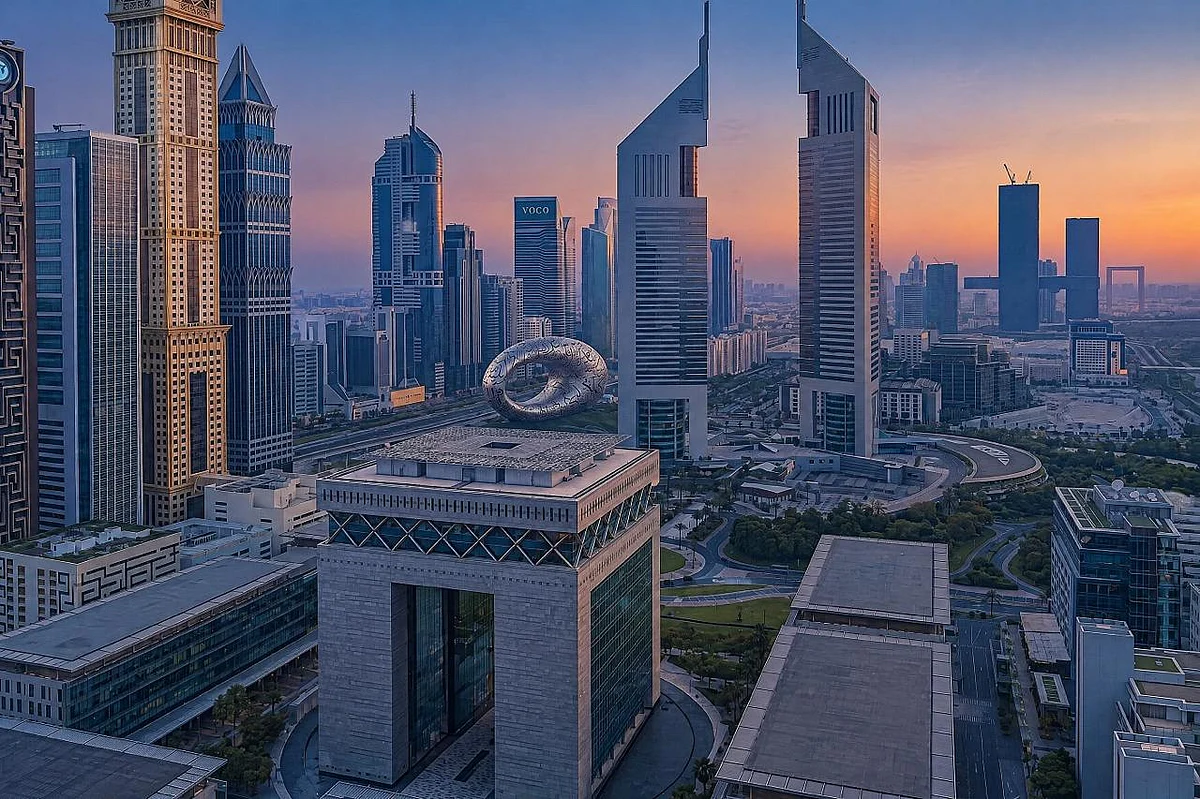
Commentary: Dubai Financial Hub's $3.5 Billion Bet On Everything AI


Artificial intelligence (AI) is beginning to change how financial services are delivered. The next frontier is the financial centre itself. For financial centres, becoming AI-native means going beyond using technology to improve individual processes and instead embedding intelligence across the environment in which firms establish, operate, connect and grow.
Recommended For YouIn Dubai, we are building a financial centre designed for that AI era.
We recently announced our ambition to become the world's first AI-native international financial centre. That means rebuilding the foundation that connects legal and regulatory frameworks, business operations, talent, ecosystem infrastructure and the physical district so that each strengthens the others. We are creating an environment where trusted adoption can be translated into institutional competitiveness, capital attraction and economic value. This approach supports the Dubai Economic Agenda D33 and Dubai's ambition to rank among the world's top four financial centres.
Trust is where this work begins. Organisations need clarity about how AI can be used, who is accountable and what protections apply. In 2023, we launched a five-year AI strategy. We have also introduced provisions under Regulation 10 of the DIFC Data Protection Regulations governing the processing of personal data by autonomous and semi-autonomous systems, including artificial intelligence and machine learning technologies. As AI agents and robotics become more widely used, rules and safeguards must keep pace with the technology.
But governance matters only if it works in practice. We are using AI to support client compliance and relationship management, while specialised AI agents assist employees. These are early applications, not an endpoint. The wider opportunity is to use AI across workflows and services in ways that help organisations serve clients, manage risk and make better use of their people's time.
The next step is connecting that expertise to companies, capital and infrastructure.
We have been introducing smart district initiatives for over half a decade at DIFC. By 2030, the existing Gate District and the upcoming Zabeel District expansion will incorporate more intelligent buildings, autonomous mobility, service robotics, digital twins and smart utilities. Sensors and connected management systems can help the physical environment operate more intelligently. This is one way to bring digital and physical AI together in everyday use.
We have a significant environment in which to put these ideas into practice: 10,000 active companies, including 327 banks and capital markets entities, almost 600 wealth and asset management firms, and more than 1,900 AI, FinTech and innovation companies. That scale brings a responsibility to keep our approach practical and responsive to the needs of institutions operating under different supervisory regimes.
As the technology becomes more deeply embedded across financial services, firms will need access to technical expertise alongside leaders and professionals who understand how to apply and govern AI effectively. We plan to help build that AI talent base through executive education, regulatory training, technical certification and programmes designed for the evolving needs of the industry.
The transformation is projected to generate $3.5 billion in economic value and 25,000 jobs. Those outcomes depend on trusted governance, capable people and organisations that can turn experimentation into lasting value.
AI will not make a financial centre competitive simply because it uses more technology. Governance creates trust for adoption, which allows skilled people to apply AI-based frameworks. In turn, the ecosystem connects capability with capital, and embedded operations convert that capability into institutional value. Together, this intelligent infrastructure extends across the district. The combined effect is a financial centre designed to compete, attract investment and influence how AI is embedded in global finance.
At DIFC, we are building that future today, creating the world's first jurisdiction where humans, AI agents, and robotics collaborate seamlessly within a trusted governance infrastructure.

Legal Disclaimer:
MENAFN provides the
information “as is” without warranty of any kind. We do not accept
any responsibility or liability for the accuracy, content, images,
videos, licenses, completeness, legality, or reliability of the information
contained in this article. If you have any complaints or copyright
issues related to this article, kindly contact the provider above.


Comments
No comment