


Production Technologies For Disease-Free, Cloned Planting Stock Of Ornamental-Foliage And Flowering Shrubs


(MENAFN- RCTT)
The Central Botanical Garden offers cunsumers the technologies for the production of disease-free, cloned planting stock specifically ornamental-foliage and flowering shrubs for landscaping purposes under a commercial agreement with technical assistance and/or license agreement and is looking for partners to conclude a technical cooperation agreement.
Description
Technologies for the production of disease-free, cloned planting stock specifically ornamental-foliage and flowering shrubs are of great importance and relevance to Belarus, particularly in the context of developing urban green spaces and landscaping.
Importance and Relevance:
1. Development of Urban Green Spaces:
- Belarus is actively pursuing projects to improve urban and suburban areas, including the creation of parks, public gardens, avenues, and other green zones. The use of ornamental-foliage and flowering shrubs enhances the aesthetic appearance of cities and improves the quality of life for the population.
2. Environmental Benefits:
- Green spaces contribute to better air quality, noise reduction, and the creation of a favorable microclimate within the urban environment. Ornamental shrubs play a key role in stabilizing soil, preventing erosion, and enhancing the urban ecosystem.
3. Disease-Free Planting Stock:
- The production of disease-free, cloned planting stock ensures the absence of pathogens and pests, which increases plant survival rates and reduces maintenance costs. Such material also ensures that the shrubs retain their high ornamental value-a crucial factor for landscaping projects.
4. Cloning and Its Advantages:
- Cloning allows for the preservation of a shrub's unique ornamental traits, such as its specific form or the color of its foliage or blossoms. It also ensures genetic uniformity, which is essential for creating harmonious landscape compositions.
5. Economic Benefits:
- Utilizing cloning and disease-elimination technologies helps reduce reliance on imported planting stock by fostering domestic production. This, in turn, supports the creation of new jobs and the development of small and medium-sized enterprises within the ornamental plant industry. 6. International Prospects:
- Belarus has the potential to become an exporter of high-quality planting stock, opening up new markets within the EAEU and the EU. - Modern production technologies for ornamental shrubs are in demand globally for landscape design and construction projects.
The Central Botanical Garden has developed technologies for producing disease-free, cloned planting stock-comprising both ornamental-foliage and flowering shrubs-tailored for urban landscaping. The selection of these plants was based on criteria such as aesthetic appeal, hardiness, low maintenance requirements, ecological plasticity, and resilience to the adverse conditions of urban environments. Other factors considered included their relevance to contemporary landscaping trends and the labor-intensive nature of propagating these plants using traditional methods.
This information is featured in the catalog "100 Best Developments of the National Academy of Sciences of Belarus for the National Economy (2022–2023), published in 2024 (pp. 189–191).(in Russian) Advantages and Innovations The planting stock (seedlings) of ornamental-foliage and flowering shrubs is highly competitive compared to similar products available on both domestic and international markets, owing to superior technical and economic indicators specifically regarding the absence of pathogenic or opportunistic microorganisms, high viability during adaptation to local climatic conditions, and cost-effectiveness. The introduction of high-quality planting stock comprising taxa with strong potential for urban landscaping will allow for the expansion and renewal of the existing assortment. It will also reduce urban greening costs by replacing annual ornamental plants with perennials, while simultaneously addressing the need to substitute imported products in the market. Given sufficient production volumes, this high-quality, competitive planting stock could also be exported.
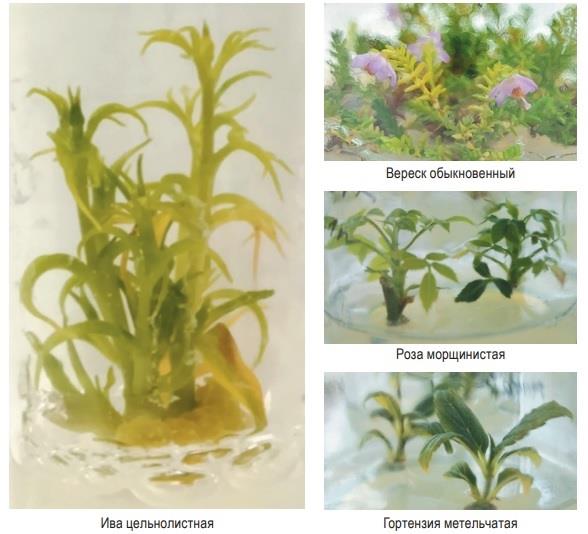
The "in vitro" production technologies for ornamental-foliage and flowering shrubs utilize a carefully selected range of taxa including members of the Rosaceae, Ericaceae, and Hydrangeaceae families that are in high demand for urban landscaping, employing micropropagation (cloning) for mass production. This process yields disease-free, cloned planting stock. There are no equivalent domestic technologies; the development is on par with the best global standards. The production of competitive seedlings including varieties developed by the Central Botanical Garden that have no foreign counterparts will facilitate the active promotion of Belarusian products both within the Republic of Belarus and abroad. Using perennial ornamental plants instead of annuals will reduce the labor and material costs associated with creating, maintaining, and consistently showcasing attractive floral compositions within the urban landscape. Stage of development Already on the market Comments regarding stage of development The following have been developed and approved in accordance with established procedures:
- An improved technology for the production of disease-free, cloned planting stock of ornamental-foliage and flowering shrubs (members of the "Ericaceae" family that grow in acidic to slightly acidic soils); an improved technology for the production of disease-free, cloned planting stock of ornamental-foliage and flowering shrubs (members of the "Hydrangeaceae" family that grow in slightly acidic soils);
- Technical specifications for "Erica carnea" (winter-flowering heather) micro-seedlings and nursery-grown plants (cultivars);
- Technical specifications for "Hydrangea paniculata" (panicle hydrangea) micro-seedlings and nursery-grown plants (cultivars); technical specifications for "Andromeda polifolia" (bog-rosemary) micro-seedlings and nursery-grown plants (cultivars);
- A technological protocol for the "in vitro" production of ornamental-foliage and flowering shrubs;
- A technological protocol for the "ex vitro* acclimatization and subsequent cultivation of ornamental-foliage and flowering shrubs. Funding source State budged
Internal
IPR status Exclusive rights
Secret know-how
Comments regarding IPS status At the Central Botanical Garden, a R&D project was carried out titled "Improving and Implementing Production Technologies for Disease-Free, Cloned Planting Material of Ornamental-Foliage and Flowering Shrubs for the Needs of Urban Greening in Minsk." The results of this research were utilized in the development of these technologies. Sector group Agrofood
Environment
Tourism and Cultural Heritage
Client information Type R&D institution Year established 1932 NACE keywords A.01.19 - Growing of other non-perennial crops
A.01.29 - Growing of other perennial crops
A.01.30 - Plant propagation
M.72.11 - Research and experimental development on biotechnology
M.74.90 - Other professional, scientific and technical activities n.e.c.
Turnover (in EUR) 10-20M Already engaged in transnational cooperation Yes Additional comments The Central Botanical Garden of the National Academy of Sciences of Belarus is the country's leading and largest center for the conservation of plant biodiversity. It serves as a premier scientific institution specializing in plant introduction, acclimatization, physiology, molecular biology, biotechnology, biochemistry, and ecology. Research and practical efforts in the field of plant introduction have resulted in the creation of a gene pool comprising over 15,000 varieties of ornamental and economically useful introduced plants.
In accordance with its Charter, the primary objective of the Central Botanical Garden is to conduct scientific research in areas including plant introduction, botany, physiology, biochemistry, biotechnology, ecology, landscape architecture, and phytodesign. It also focuses on the sustainable use and conservation of plant resources, as well as the preservation of the gene pool of the world's flora.
The Central Botanical Garden is one of the oldest botanical institutions in Belarus. In 1999, by a decision of the Government of the Republic of Belarus, it was granted the status of a scientific site of national heritage. It is designated as a botanical natural monument of national significance and a site of historical and cultural value. Today, it stands as a unique landscape and garden site, serving both as a major landmark in the capital and as a vital center for cultural enrichment, environmental awareness, and education.
Key areas of scientific and technical activity include:
- The effective use, renewal, and conservation of plant resources;
- The identification of physiological and biochemical patterns and mechanisms that determine plant resilience and productivity;
- The development of scientific foundations for plant introduction, protection, and breeding, as well as the management of acclimatization processes and the biological productivity of economically useful plants-utilizing both traditional methods and modern techniques in biotechnology and genetic engineering. - biological monitoring, ecology;
- industrial botany;
- landscape gardening and phytodesign;
- utilization of plant resources in industry, agriculture, and medicine;
- addressing biosafety issues related to biological methods and technologies.
Key areas of focus for the Central Botanical Garden (CBG):
- developing scientific foundations and practical measures for the effective, sustainable use of plant resources within the nation's economy and social sphere, as well as for the conservation of the gene pool of rare and endangered species and the habitats of the Belarusian flora.
- creating new, competitive varieties of ornamental, medicinal, aromatic, and bioenergy plants, along with original landscape design concepts for various settings, including interior spaces.
- developing efficient methods for the accelerated production of planting stock via *in vitro* culture, as well as techniques for identifying and protecting against bacterial and viral infections to ensure the production of disease-free (healthy) planting material.
- researching the genetic diversity of plants and plant communities, their habitats, and ecosystems, while addressing questions of systematics and taxonomy through both traditional and molecular-genetic approaches.
Official website of the Central Botanical Garden of the National Academy of Sciences of Belarus. Languages spoken English
Russian
Information about partnership Type of partnership considered Commercial agreement with technical assistance
License agreement
Technical cooperation agreement
Type and role of partner sought Consumers interested in purchasing technologies for the production of disease-free, cloned planting stock specifically ornamental-foliage and flowering shrubs for landscaping and urban greening under a commercial agreement with technical assistamce and/or a license agreement.
Partners interested in the development and implementation of technologies for the production of disease-free, cloned planting stock specifically ornamental-foliage and flowering shrubs for landscaping and urban greening under a technical cooperation agreement. Type and size of partner sought > 500
251-500
SME 51-250
SME 11-50
SME <= 10
R&D Institution
University
Sole proprietor

Legal Disclaimer:
MENAFN provides the
information “as is” without warranty of any kind. We do not accept
any responsibility or liability for the accuracy, content, images,
videos, licenses, completeness, legality, or reliability of the information
contained in this article. If you have any complaints or copyright
issues related to this article, kindly contact the provider above.


Comments
No comment