


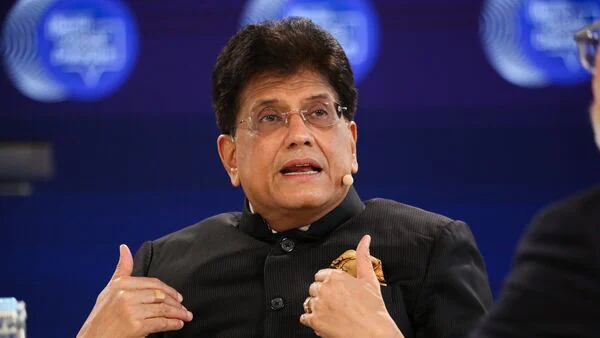
EU Carbon Tax Is 'Inviting Disaster', Says Piyush Goyal


Speaking at the Berlin Global Dialogue 2026, Goyal said,“If you have put a CBAM on yourself, you put a 50% import duty to bring steel into your country, you are inviting disaster. Your cost of living will go up. Your people will be unhappy. Your industry will be out-priced.”
For its part, New Delhi has secured commitments from the EU, including a forward-looking most-favoured-nation assurance that any flexibilities granted to third countries under CBAM regulations will also be extended to India.
Speaking separately at the inauguration of the India Centre at German Council on Foreign Relations (DGAP), Goyal said the India-European Union (EU) free trade agreement (FTA ) may become operational within four to five months. He added that the proposed FTA with the 27-member EU is expected to be signed at the end of the calendar year.
Also Read | NIIF plans $600 mn e-mobility platform Avega: MD and CEO Sanjiv Aggarwal“It will move very rapidly towards signature. And I want to thank all the countries of the European Union. Because this is one agreement and I urge you to reflect on the past: whether you have seen an agreement move with this alacrity,” Goyal said, adding,“the sense of urgency, the mutual commitment to make this happen was truly remarkable”.
The development is significant as India and the EU account for a quarter of the world's gross domestic product and a third of its trade. India and the EU wrapped up talks for an FTA in January 2026, capping negotiations that were first launched in 2007, paused in 2013, and again revived in 2022.
Tariff cutsUnder the FTA, formally known as the Broad-based Trade and Investment Agreement, over 99% of Indian exports by value and 97% of tariff lines will gain preferential entry into the EU, unlocking opportunities for the country's micro, small and medium enterprises (MSMEs ) and creating jobs for women, artisans, young people and professionals.
According to the European Commission, the FTA will eliminate or cut tariffs on more than 96% of the EU's goods exports to India, saving European exporters around €4 billion a year in duties. The EU has committed to remove duties on about 70.4% of tariff lines immediately, covering almost 90.7% of India's export value, with another 20.3% of products subject to phased elimination, and the rest seeing liberalization via duty concessions or tariff quotas. Immediate duty-free access to the EU will apply to all textiles, apparel, leather, and footwear; 94.4% of marine products; and 96.6% of gems and jewellery, with chemicals and base metals split between immediate and phased cuts.
Also Read | Avaada Electro files for ₹10,000-crore IPO via confidential routeFor its part, India has promised immediate duty-free access on about 49.6% of EU tariff lines covering 30.6% of trade value, with 39.5% of lines covering 63.1% of value under phased elimination over five, seven or 10 years. India's total offer covers around 92.1% of EU tariff lines and 97.5% of trade value.
The conclusion of the FTA was jointly announced by Prime Minister Narendra Modi and European Commission President Ursula von der Leyen at the 16th India-EU Summit in New Delhi on 27 January 2026. India-EU merchandise trade stood at €118.4 billion in 2025, with the bloc importing goods worth €69.5 billion from India and exporting €48.9 billion to India. The total annual bilateral trade in both goods and services was worth €180 billion.
'Promising future'“To my mind Germany's precision engineering, your Mittelstand (medium-sized companies), commitment to quality with our desire to upgrade Indian infrastructure, our digital capabilities, our youthful, skilled and talented people, I think we can together shape an outstanding future to this evolving global order,” said Goyal, who is on an official visit to Germany and the Netherlands to deepen strategic economic partnerships, expand bilateral trade, and advance industrial and technological collaboration.
Germany is India's largest trading partner in the EU. Total bilateral trade reached $31 billion in FY26, up 4.83% from $29.57 billion in FY25, according to commerce ministry data.
Also Read | Coal India plans ₹1 trillion investment in coal evacuation, gasification“Our ambition should not stop at Made in India or Made in Germany. We should look at [goods] co-created by us. We should look at becoming collaborators, to become competitive for the world. And towards that end, to turn that ambition into reality, we must connect trade with investment, manufacturing with research, and our industries with our academic institutions, so that we can truly bring the FTA to factories,” Goyal added.
Experts said India and Germany share a special relationship.“Germany is the strongest economy in the EU. We have a special relationship with it. Trade and investment linkages are the strongest in the EU. For Germany India- EU FTA is of immense interest,” said Dammu Ravi, India's former economic relations secretary in the ministry of external affairs. He added that Germany's Mittelstand, or medium-sized businesses, offer vital opportunities for Indian MSMEs to partner and build global competitiveness.
The writer is in Berlin as the guest of Confederation of Indian Industry.

Legal Disclaimer:
MENAFN provides the
information “as is” without warranty of any kind. We do not accept
any responsibility or liability for the accuracy, content, images,
videos, licenses, completeness, legality, or reliability of the information
contained in this article. If you have any complaints or copyright
issues related to this article, kindly contact the provider above.


Comments
No comment