


Oncology Market Forecast To Reach USD 748.17 Billion By 2035 As Precision Medicine, Immunotherapy And Cancer Innovation Accelerate


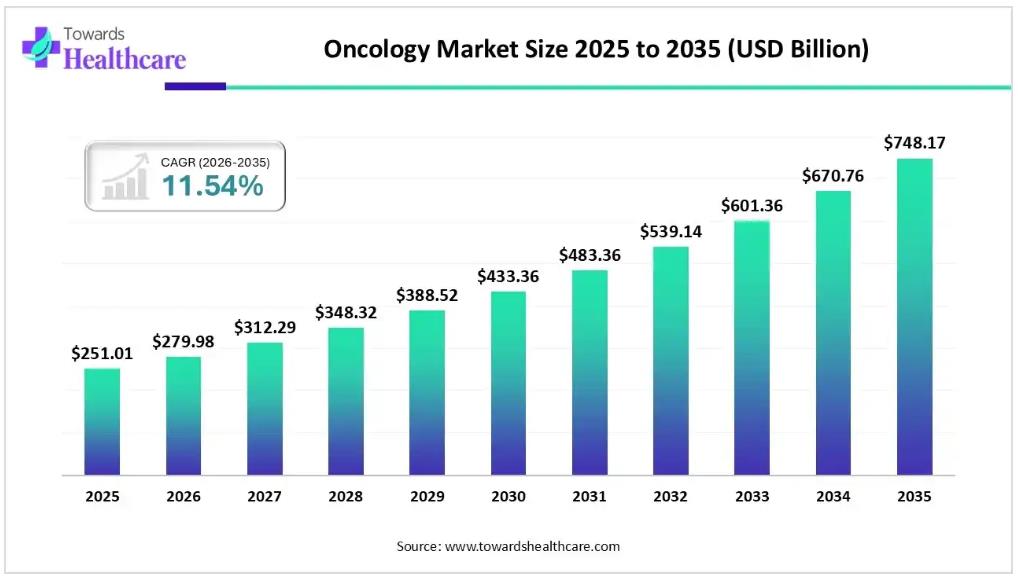
| Market indicator | Towards Healthcare estimate | |
| Global market size, 2025 | USD 251.01 billion | |
| Global market size, 2026 | USD 279.98 billion | |
| Projected market size, 2035 | USD 748.17 billion | |
| CAGR, 2026–2035 | 11.54 | % |
| Leading region, 2025 | North America | |
| North American market share, 2025 | Approximately 43% | |
| U.S. oncology market, 2025 | USD 81.34 billion | |
| U.S. oncology market forecast, 2034 | USD 211.78 billion | |
| Fastest-growing regional market | Asia Pacific | |
| Leading therapy category, 2025 | Pharmacological/drug-based therapy | |
| Leading cancer type, 2025 | Breast cancer |
Source: Towards Healthcare Research & Consulting, Oncology Market Report.
The estimates reflect the scope and methodology of the cited Towards Healthcare market study. Other industry estimates may differ because of variations in market definitions, pricing conventions, included products, and geographic coverage.
Connect with Towards Healthcare to request customized oncology datasets, case studies, market-entry analysis, due diligence support, and competitive intelligence @ Email: ...Clinical innovation and cancer incidence strengthen market demand
Cancer incidence, the growing need for effective treatment, and continued investment in research remain fundamental drivers of oncology demand. The market includes pharmaceutical therapies, radiation and surgical oncology, cancer diagnosticsAs treatment pathways become more specialized, commercial opportunities are increasingly determined by the cancer subtype, biomarker profile, disease stage, line of therapy, and treatment setting. These factors influence the addressable patient population, clinical development requirements, pricing potential, reimbursement, and the competitive position of individual products.
Towards Healthcare estimates that pharmacological and drug-based therapies accounted for approximately 68% of the oncology market in 2025. Therapeutic oncology represented around 72% of the market, while hospitals and cancer institutes accounted for approximately 60% by end user. Monoclonal antibodies
These figures highlight the central role of drug development and treatment delivery in oncology. However, the next phase of growth is also creating opportunities in diagnostics, specialized clinics, molecular testing, and technologies that help clinicians select and monitor treatments.
Recent regulatory developments reinforce the pace of oncology innovation
Cancer drug development continues to expand across solid tumors and hematological malignancies, with regulatory decisions increasingly reflecting molecular characteristics, treatment history, and combination approaches.
In October 2026, the U.S. Food and Drug Administration announced several important oncology decisions. These included approval of atezolizumab with chemotherapy for specified patients with stage III mismatch repair-deficient colon cancer on October 8, and approval of tucatinib with trastuzumab and pertuzumab for the maintenance treatment of certain patients with HER2-positive breast cancer on October 7. These developments illustrate the continuing movement toward more differentiated treatment pathways and biomarker-informed care.
The American Association for Cancer Research's 2026 Cancer Progress Report also highlighted 11 new anticancer therapeutics approved by the FDA during the 12-month period from July 2025 through June 2026. The approvals included advances in molecularly targeted treatment and immune-based approaches, demonstrating the breadth of innovation across cancer indications.
For pharmaceutical and biotechnology companies, these developments create commercial opportunities but also increase the importance of monitoring clinical evidence, eligibility criteria, competing therapies, and the potential impact of new indications on established treatment pathways.
The business implication is clear: a promising molecule or new approval does not automatically translate into market leadership. Companies need to understand how a treatment compares with existing standards of care, which patient populations are eligible, what evidence is available, and how clinicians and healthcare systems may adopt it.
Schedule a meeting with our expert team to discuss your oncology market research requirements, competitive intelligence priorities, and business objectives @Precision medicine, immunotherapy and targeted biologics reshape competition
Precision medicine is changing oncology development next-generation sequencingFor manufacturers, this creates opportunities to develop differentiated products for molecularly defined indications. It also introduces additional commercial dependencies: access to testing, clinical laboratory capabilities, diagnostic turnaround times, reimbursement policies, and the availability of specialists can influence treatment uptake.
Immunotherapy is another important growth area. Immune checkpoint inhibitors, cellular therapies, and combination regimens are expanding the range of treatment approaches being investigated across malignancies. Towards Healthcare identifies immunotherapy, including immune checkpoint inhibitors and CAR-T approaches, as a high-growth area within its therapy segmentation.
Nevertheless, commercial opportunities vary considerably by indication. Clinical effectiveness, adverse-event management, manufacturing complexity, treatment capacity, patient selection, and total cost of care all affect adoption.
Targeted biologics and monoclonal antibodies remain important components of the oncology landscape. Competition in these categories increasingly depends on differentiation in efficacy, safety, dosing convenience, combinations, and the ability to secure access across treatment settings.
For decision-makers, market intelligence must therefore move beyond tracking headline market growth. It should connect pipeline developments and clinical milestones with indication-level opportunity, patient populations, treatment sequencing, competitor positioning, and commercial access.
Cancer diagnostics and artificial intelligence open adjacent growth opportunities
Cancer diagnostics is becoming increasingly important as healthcare systems seek earlier detection, more precise disease classification, and better treatment monitoring. Imaging, pathology, molecular diagnostics, liquid biopsy Towards Healthcare estimates that diagnostic oncology is expected to be the fastest-growing modality category in the overall oncology market. This creates opportunities for diagnostic manufacturers, laboratory service providers, digital pathology companiesArtificial intelligence is also expanding its role in cancer imaging, pathology, genomic analysis, clinical research, and treatment planning. Potential applications include identifying patterns in complex medical data, supporting workflow prioritization, improving research efficiency, and helping clinicians evaluate disease characteristics.
The commercial outlook for AI in oncology
For investors and strategic planners, the opportunity extends across the oncology ecosystem: diagnostic platforms, specialized software, laboratory services, data infrastructure, and technologies supporting precision treatment may complement traditional pharmaceutical investment.
Access the Towards Healthcare dashboard to explore available intelligence solutions and discuss a dashboard tailored to your oncology market monitoring needs @Regional analysis: North America leads as Asia Pacific expands
North America accounted for approximately 43% of the global oncology market in 2025, according to Towards Healthcare. The region benefits from advanced healthcare infrastructure, established cancer centers, pharmaceutical research capabilities, specialized clinical networks, and investment in innovative treatment approaches.
The U.S. oncology market was valued at USD 81.34 billion in 2025
For businesses entering or expanding in the U.S., market assessment requires attention to regulatory pathways, treatment guidelines, payer coverage, provider networks, specialty pharmacy channels, clinical trial activity, and competition within individual indications. National market estimates alone may not capture differences in access and adoption between patient populations or treatment settings.
Asia Pacific is projected to be the fastest-growing regional market over the forecast period. Expansion opportunities are supported by evolving healthcare infrastructure, greater demand for cancer diagnosis and treatment, pharmaceutical investment, and efforts to improve access to advanced care.
However, the region is not a single uniform market. Companies need to evaluate country-specific disease burden, local regulatory processes, reimbursement arrangements, hospital capabilities, diagnostic access, pricing expectations, and domestic competition.
Europe, Latin America, and the Middle East and Africa also offer opportunities, but market-entry decisions must account for differences in healthcare financing, specialist capacity, treatment availability, and regulatory requirements.
A region-by-region strategy supported by country-level data can help organizations prioritize investment, estimate addressable demand, and select appropriate commercialization and partnership models.
Competitive intelligence and oncology investment strategies
The oncology market includes multinational pharmaceutical companies, biotechnology innovators, diagnostics providers, technology developers, research organizations, and specialized treatment networks. Major participants identified in the Towards Healthcare report include Roche, Merck & Co., Bristol Myers Squibb, Pfizer, Novartis, AstraZeneca, Johnson & Johnson, Amgen, Gilead Sciences, Eli Lilly, Sanofi, Takeda, AbbVie, Daiichi Sankyo, and Regeneron, alongside diagnostic and imaging companies.
Competitive advantage increasingly depends on pipeline quality, clinical differentiation, regulatory execution, manufacturing capability, partnerships, and access to specialized healthcare networks. Established companies are pursuing external innovation to strengthen pipelines and address anticipated competitive pressure as major products approach loss of exclusivity.
Investment activity also illustrates the strategic importance of oncology. In June 2026, industry analysis from IQVIA highlighted more than USD 53 billion in oncology-targeted merger and acquisition deal value during the first half of 2026, representing approximately 41% of aggregate biopharma M&A deal value under its analysis. The figure reflects a particular period and transaction scope rather than a full-year total.
On October 21, 2026, Cencora announced an agreement to acquire the remaining equity in American Oncology Network in a transaction valued at up to USD 2.4 billion. The proposed acquisition reflects ongoing consolidation in U.S. community oncology and the strategic importance of provider networks, care delivery, and oncology services.
These developments demonstrate that oncology competition extends beyond drug discoveryFor business development teams, investment firms, and corporate strategy leaders, identifying the right opportunity requires structured assessment of target assets, commercial positioning, market access, pipeline risk, financial performance, and potential synergies.
Key opportunities and market challenges
Several areas warrant close attention as oncology investment and commercialization strategies evolve.
- Immunotherapy and targeted treatments: Differentiated mechanisms, combination regimens, and biomarker-defined populations can create new opportunities, but clinical outcomes and competitive standards must be assessed indication by indication. Diagnostics and precision medicine: Molecular testing, liquid biopsy, companion diagnostics, and advanced imaging can support treatment selection and monitoring, while adoption depends on clinical utility, reimbursement, and infrastructure. AI-enabled oncology: Digital tools may improve workflows and research efficiency, but evidence, data governance, validation, and integration into clinical practice remain important considerations. Asia Pacific expansion: Demand growth creates opportunities for local partnerships and market entry, while country-level differences in access, affordability, and regulation require tailored strategies. M&A and licensing: Acquisitions and partnerships can accelerate access to assets, technologies, and networks, but require rigorous assessment of clinical, regulatory, commercial, and integration risks. Pricing and access: High treatment costs, uneven diagnostic availability, payer requirements, and differences in healthcare capacity may constrain adoption even when clinical innovation is strong. Development and manufacturing risk: Long clinical timelines, complex production requirements, trial outcomes, and regulatory uncertainty can affect the value and timing of oncology investments.
The ability to connect these factors to market sizing, competitor intelligence, and realistic commercial scenarios will be critical to making informed decisions.
How Towards Healthcare supports oncology market decisions
Towards Healthcare Research & Consulting provides market research and strategic intelligence to pharmaceutical companies, biotechnology developers, diagnostics businesses, healthcare providers, investors, and other organizations operating across oncology.
Its oncology research framework is designed to help decision-makers understand market size, forecast growth, assess competitors, identify unmet needs, evaluate opportunities, and develop market-entry or expansion strategies.
| Intelligence solution | Oncology-specific business value |
| Master Dataset | Structured data on oncology markets, companies, products, treatment categories, clinical programs, indications, geographic markets, and relevant commercial indicators, subject to project scope. |
| Towards Healthcare Quadrant | Comparative positioning of selected oncology companies, technologies, products, or service providers using agreed evaluation criteria such as innovation, market presence, capabilities, and strategic positioning. |
| Interactive Dashboard | A centralized view of selected oncology market indicators, company activity, segment performance, geographic opportunities, and competitive developments, with the scope and refresh frequency defined for the engagement. |
| Quality & Manufacturing Intelligence | Assessment of relevant manufacturing capabilities, supply-chain considerations, quality requirements, production capacity, and operational factors affecting oncology products and technologies. |
| Customized Research | Tailored market sizing, forecasting, TAM/SAM/SOM analysis, competitive benchmarking, pipeline assessment, pricing research, market-entry strategy, due diligence, and partnership evaluation. |
Towards Healthcare can tailor research to the specific decision, geography, product category, and level of analytical detail required.
Continuously updated oncology market intelligence
Oncology is a rapidly evolving market in which regulatory decisions, clinical trial readouts, product launches, licensing agreements, manufacturing changes, and acquisitions can alter the competitive landscape.
Towards Healthcare can structure intelligence updates according to client requirements, including monthly, quarterly, six-monthly, and annual review cycles.
Depending on the agreed scope, updates may cover:
- New clinical trial starts, completions, readouts, and changes in development status. Regulatory approvals, label expansions, safety updates, and relevant policy changes. Competitor product launches, pipeline additions, licensing agreements, and strategic partnerships. M&A announcements, financing rounds, and changes in company ownership or investment priorities. Market forecasts, segment trends, geographic developments, and shifts in commercial positioning. Relevant manufacturing, supply-chain, quality, and capacity developments. Changes in diagnostic technologies, biomarker strategies, and AI-enabled oncology solutions.
The objective is to give organizations a structured view of changes that may affect their strategic priorities, rather than relying solely on disconnected news updates.
Fill out the form for relevant samples, case studies, and examples.
Buy the Oncology Market report to access the full analysis, forecasts, segmentation, and strategic market intelligence @
Schedule a meeting with our expert team to discuss your oncology market research requirements, competitive intelligence priorities, and business objectives @
Access the Towards Healthcare dashboard to explore available intelligence solutions and discuss a dashboard tailored to your oncology market monitoring needs @
Connect with Towards Healthcare to request customized oncology datasets, case studies, market-entry analysis, due diligence support, and competitive intelligence @ Email: ...
Related Reports
AI in Oncology Market: U.S. Oncology Market: U.S. Oncology Drugs Market: Cancer Diagnostics Market: Pre-Dx Oncology Market: Next-Generation CAR-T Therapy Market: Autologous CAR-T Cell Therapy Market: U.S. Liquid Biopsy Market: Radiopharmaceutical Market:About Towards Healthcare Research & Consulting
Towards Healthcare Research & Consulting provides healthcare market research, industry intelligence, and consulting services across pharmaceuticals, biotechnology, medical technology, diagnostics, digital health, and life sciences. Its services support market sizing, forecasting, competitive and customer intelligence, commercialization, market entry, growth strategy, and investment-related decisions.
Website:
Partner organizations:
- Precedence Research: Towards Packaging: Towards Chemical & Materials:
Contact Towards Healthcare Research & Consulting
USA: +1 804 441 9344
APAC: +61 485 981 310 or +91 87933 22019
Singapore: +65 3105 1271
Europe: +44 7383 092 044
Email: ...
LinkedIn:
X:
Instagram:


Legal Disclaimer:
MENAFN provides the
information “as is” without warranty of any kind. We do not accept
any responsibility or liability for the accuracy, content, images,
videos, licenses, completeness, legality, or reliability of the information
contained in this article. If you have any complaints or copyright
issues related to this article, kindly contact the provider above.


Comments
No comment