


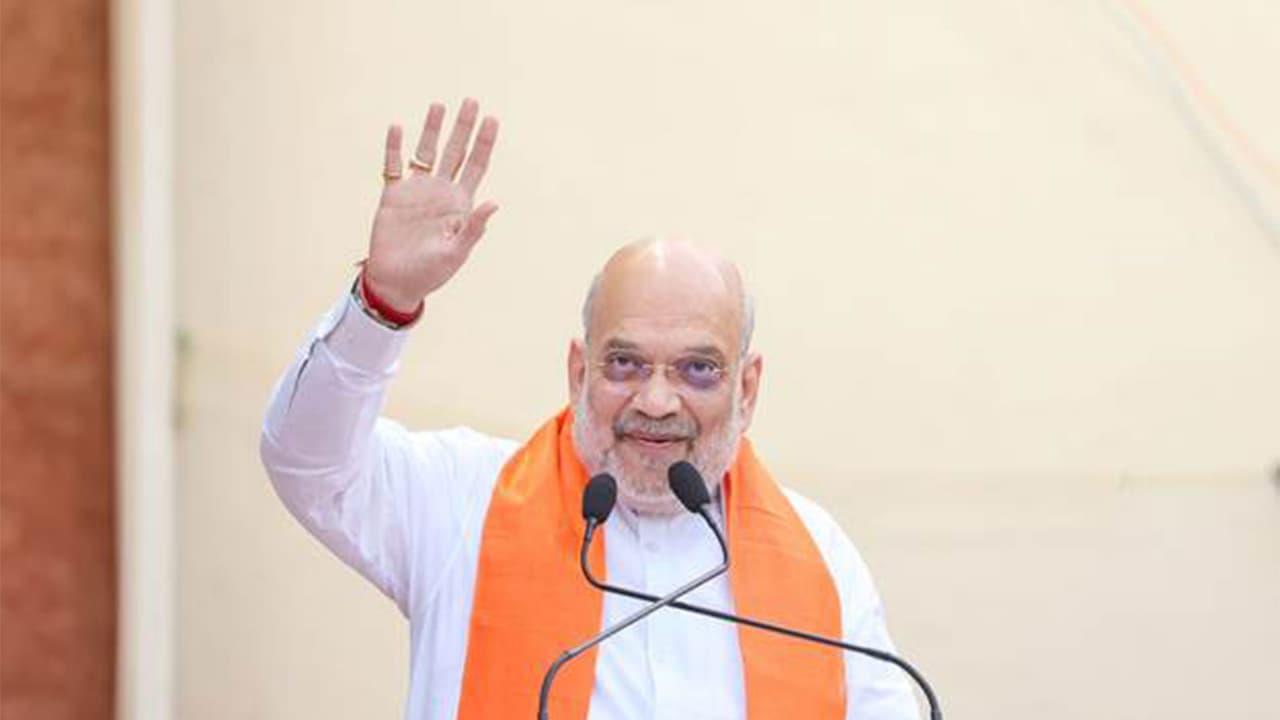
Amit Shah At 62: A Look At His Influential 12-Year Political Journey


Known in bureaucratic and political circles as a "man of commitment", Union Home Minister Amit Shah, who turns 62 on October 22, has emerged as one of the most influential figures in Indian politics in his past 12-year career by expanding the BJP's political footprint across India since taking over the party's command as its President in 2014. Soon after he was appointed the country's home minister, he took decisive historical decisions to enhance India's national security during the tenure of the Modi 2.0 govt in 2019.
Political Rise and BJP Presidency
Born to Kusumben and Anilchandra Shah in an affluent Gujarati family on October 22, 1964, Shah has been remarkably successful in expanding the Bharatiya Janata Party's organisational footprint by leading the party from the front and securing one electoral victory after the other in state assembly elections. During his tenure as BJP President, the BJP became the world's largest political party with over 10 crore registered members.
Shah, who joined the Rashtriya Swayamsevak Sangh and later became an active member of the Akhil Bharatiya Vidyarthi Parishad (ABVP) during his youth, has risen to head the ruling Party of India literally from the grassroots. His dedication, dexterity and above all result-oriented performance made Shah in-charge of several election campaigns of the national leaders, including that of LK Advani in 1991, late Atal Bihari Vajpayee in 1996, both in the Gandhinagar Parliamentary constituency in Gujarat.
In 2013, Shah was appointed as National General Secretary of the BJP and in-charge of Uttar Pradesh. His painstakingly carried out efforts earned the BJP a historic success in the Parliamentary elections of 2014. He took over as BJP National President in July 2014, and from there onwards there is literally no looking back. By May 2018, in the direction of Shah, the BJP and its alliance partners were in government in 21 states, reflecting the scale of the party's electoral expansion
Tenure as Union Home Minister
Shah, who assumed charge as Union Home Minister in the Modi 2.0 government on June 1, 2019, took one of the most consequential and historical decisions within two months in office. It was the abrogation of Article 370, which had granted special status to the erstwhile state of Jammu and Kashmir. Later, in August 2019, the government moved to end the region's special constitutional status and reorganised the state into the Union Territories of Jammu and Kashmir and Ladakh. The move represented a major departure in the Centre's approach to Jammu and Kashmir and became one of the defining policy decisions of Shah's tenure. The government maintained that the changes would facilitate integration, development and improved security in the region. The decision also generated substantial political and legal debate, making it one of the most significant constitutional developments of the period.
Major Legislative Reforms
Shah's tenure has also been marked by major legislative changes like the Citizenship (Amendment) Act, 2019, which was passed by Parliament during the first year of his tenure. The legislation provides an expedited route to Indian citizenship for eligible Hindu, Sikh, Buddhist, Jain, Parsi and Christian migrants from Afghanistan, Bangladesh and Pakistan who entered India by December 31, 2014, subject to the Act's conditions and applicable exclusions. The government subsequently notified the rules for implementing the legislation in March 2024.
Another major initiative was the introduction of three new criminal laws: the Bharatiya Nyaya Sanhita, the Bharatiya Nagarik Suraksha Sanhita and the Bharatiya Sakshya Adhiniyam. They replaced the Indian Penal Code, the Code of Criminal Procedure and the Indian Evidence Act, respectively, and came into force on July 1, 2024, with specified exceptions. The government presented the new codes as an effort to modernise criminal justice, strengthen provisions relating to crimes and technology, and place greater emphasis on investigation and time-bound judicial processes.
Shah also pursued prison administration reforms. The Model Prisons Act, 2023, was prepared as a framework for states and Union Territories to modernise prison management and replace the colonial-era approach represented by the Prisons Act, 1894. Its adoption rests with the respective jurisdictions.
Counterterrorism and Internal Security
Counterterrorism has remained a central priority of Shah's tenure. In September 2022, the Centre declared the Popular Front of India (PFI) and its associated organisations unlawful for five years under the Unlawful Activities (Prevention) Act (UAPA).
Amendments to the UAPA and the National Investigation Agency Act, enacted in 2019, expanded the legal framework for tackling terrorism. The changes included provisions enabling the designation of individuals as terrorists under the UAPA and widening the NIA's investigative jurisdiction and powers.
The Home Minister's focus has also emphasised coordination among central agencies, state police forces and international partners to pursue terror networks, investigate financial links and bring fugitives back to India.
Peace Initiatives in the Northeast
Shah's tenure has seen continued efforts to address insurgency and longstanding conflicts in the Northeast through negotiations with different groups. In his direction, the Ministry of Home Affairs has signed multiple peace agreements involving insurgent organisations and representatives of communities in the region.
These agreements have sought to reduce violence, facilitate the surrender or rehabilitation of cadres, address political and developmental demands, and create conditions for stability. The government has presented these agreements as part of a broader strategy combining security operations with dialogue and development. More than a dozen peace and conflict-resolution agreements have been highlighted in official accounts of the government's security initiatives.
Modernising Criminal Investigation
Shah has advocated greater use of scientific evidence in criminal investigations. The expansion of the National Forensic Sciences University (NFSU), including the development of additional campuses, forms part of efforts to strengthen forensic education and investigative capacity.
The new criminal laws have also placed greater emphasis on forensic investigation in serious offences, with the government seeking to improve evidence collection, laboratory capacity and the use of technology in policing. These measures are intended to support more scientific investigations and improve the quality of evidence presented in courts, although their effectiveness will depend on implementation, staffing and infrastructure across states.
Tackling Left-Wing Extremism
The campaign against Left-Wing Extremism (LWE) or Naxalism has been another major component of Shah's security agenda. Under Shah's direction, the MHA pursued a combination of security operations, intelligence coordination, infrastructure development and efforts to improve governance in affected areas.
Security forces have established forward operating bases, expanded their presence in previously inaccessible locations and targeted the organisational and logistical networks of Maoist groups. First ever, Shah, as a Home Minister, set March 31, 2026, as his target for eliminating Naxalism and it was achieved.
Cracking Down on Drugs and Fugitives
Under Shah's leadership, the Centre has now intensified its campaign against drug trafficking, seeking to dismantle entire networks by December 2029. The approach combines investigations into suppliers and distributors with efforts to identify financial networks, interstate links and international trafficking routes.
Shah has also focused on returning fugitives accused of serious offences to India. The NIA and other agencies coordinate with Interpol and foreign law-enforcement authorities, subject to applicable legal processes and international cooperation arrangements.
Enhancing Border Security
The Home Minister's another priority is the development of smart border systems. The proposed approach combines technology, surveillance and intelligence with coordination among the Army, Central Armed Police Forces (CAPFs), local administration and border-area residents. The objective is to strengthen surveillance, prevent infiltration and improve responses to cross-border threats.
In his guidance, the Centre has also stepped up action against alleged illegal infiltration, with agencies examining suspected illegal activities, documentation and associated financial networks in accordance with the law.
A Continuing Legacy
In June 2024, Shah returned to the Union Cabinet following the BJP-led NDA's victory in the general election and continued as Home Minister. He also retained responsibility for the newly established Ministry of Cooperation, a portfolio he had held since 2021.
His record combines major constitutional and legislative changes, an expanded focus on counterterrorism, peace negotiations in insurgency-affected regions, and efforts to modernise criminal investigation and border security. From his early years as a party worker in Gujarat to his present role in the Union government, Shah's political trajectory reflects the growing importance of organisational strategy and internal security in national policymaking. (ANI)
(Except for the headline, this story has not been edited by Asianet Newsable English staff and is published from a syndicated feed.)
Legal Disclaimer:
MENAFN provides the
information “as is” without warranty of any kind. We do not accept
any responsibility or liability for the accuracy, content, images,
videos, licenses, completeness, legality, or reliability of the information
contained in this article. If you have any complaints or copyright
issues related to this article, kindly contact the provider above.


Comments
No comment