


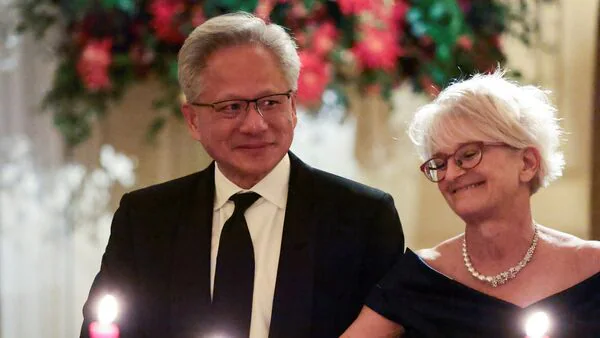
Nvidia CEO Jensen Huang, Wife Donate $75 Million To Vanderbilt University For New Design College


Announced on July 21, 2026, the contribution is intended to bring creative disciplines together with technology, engineering and entrepreneurship. According to the university, the donation has helped attract additional philanthropic commitments, taking total support for the San Francisco campus beyond $100 million.
The new institution will be named the Jen-Hsun and Lori Huang College of Art, Architecture and Design. The campus is expected to open in 2027, subject to regulatory approvals, and will build on the legacy of the California College of the Arts (CCA).
Also Read | Musk loses trillionaire status; Jensen Huang, Larry Ellison lose $15 billion Matching gift attracts additional contributionsThe Huang family's donation is structured as a matching gift designed to encourage other donors to support Vanderbilt's expansion in San Francisco.
The university said alumni and other supporters had made additional commitments following the announcement. Early contributors include Katie and Matt Paige, Jeff and Marieke Rothschild, and Leah and Ben Spero. The fundraising effort has also received commitments from anonymous donors and members of the Bay Area's arts and creative communities.
Vanderbilt said it had secured more than 40% of the funding required to fulfil the full matching commitment by December 31, 2028. The funds will support the establishment and operation of the new college, alongside other academic programmes planned for the campus.
College to combine creative and technical educationThe proposed college will integrate studio practice and design laboratories with technical education, engineering and entrepreneurship. Vanderbilt plans to offer undergraduate and graduate degrees, as well as community arts programmes, pre-collegiate courses and lifelong-learning opportunities.
The programmes will be subject to the necessary academic reviews and regulatory approvals.
Explaining the rationale behind the contribution, Huang said in Vanderbilt's announcement:“Technology expands what we can build. Art and design determine why we build it. Together they shape civilization.”
The initiative reflects the couple's stated belief that artistic creativity and design can contribute to technological progress, business innovation and the cultural development of cities.
Vanderbilt expects the San Francisco campus to accommodate approximately 1,000 undergraduate and graduate students, alongside full-time faculty and staff. The project forms part of the university's broader expansion beyond its main campus in Nashville, Tennessee.
Vanderbilt plans to preserve California College of the Arts legacyThe San Francisco project will build on CCA's nearly 120-year history. Vanderbilt and CCA have agreed that CCA will contribute its campus to Vanderbilt after its operations wind down, subject to customary regulatory and other transaction requirements.
Vanderbilt also plans to establish the California College of the Arts Institute to preserve and extend the institution's artistic and cultural legacy.
The proposed institute will include the Wattis Institute for Contemporary Arts, preserve and digitise CCA's archives, and support artists, designers, architects, curators and scholars through fellowships and residencies.
The university has begun a national search for the founding dean of the new college. Its opening remains contingent on the required approvals, with the first students expected in 2027.
Also Read | 'Pay dividend to community': Trump tells companies amid data center backlash Separate initiative supports AI and scientific researchThe Vanderbilt donation is separate from another philanthropic initiative involving the Huang family.
In May 2026, Reuters reported that the foundation run by Jensen and Lori Huang had purchased computing time from CoreWeave and donated it to universities and nonprofit organisations for scientific and artificial intelligence research. A regulatory filing valued the donated computing resources at $108.3 million. Nvidia also planned to provide free engineering services to some recipients.
CoreWeave uses Nvidia-designed graphics processing units for AI workloads. Reuters noted that Nvidia had invested $2 billion in CoreWeave and agreed to purchase $6.3 billion in cloud capacity from the company, relationships that had raised investor concerns about potential circular financing.
While the computing initiative focuses on research infrastructure, the Vanderbilt contribution is aimed at creating an academic institution that connects art, design and technology.

Legal Disclaimer:
MENAFN provides the
information “as is” without warranty of any kind. We do not accept
any responsibility or liability for the accuracy, content, images,
videos, licenses, completeness, legality, or reliability of the information
contained in this article. If you have any complaints or copyright
issues related to this article, kindly contact the provider above.


Comments
No comment