


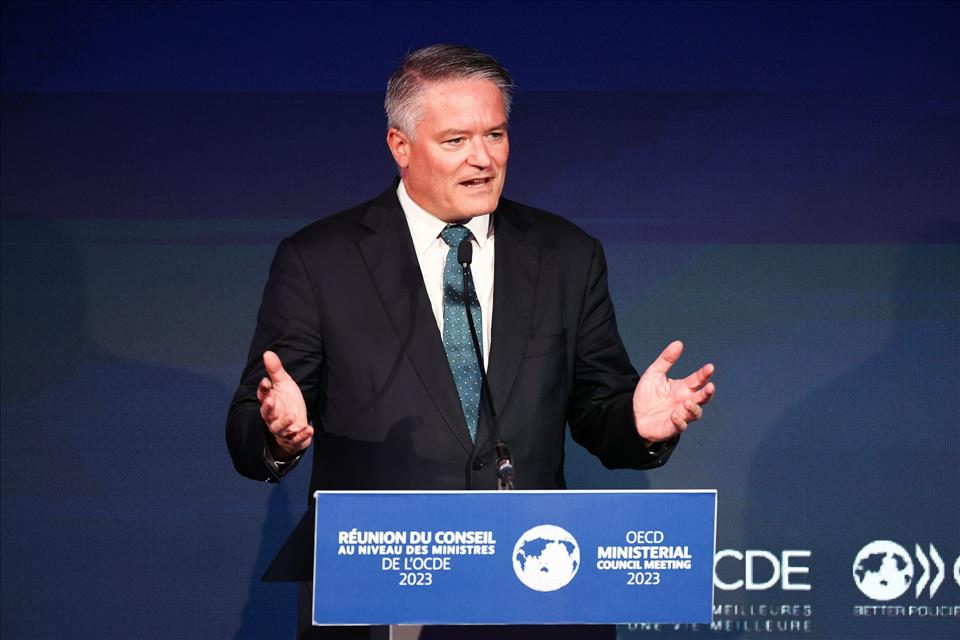
View From The Hill: Mathias Cormann Offers Blunt Advice On Countering Populism And Reforming The Economy


In a weekend speech Cormann delivered a sharp message into an environment of surging populism – a message both sides of politics, but especially the Coalition, would do well to take to heart.
Cormann warned that“we all need to engage” with what was being offered by populism“because it is winning an audience it did not have even five years ago”.
Addressing the Centre for Independent Studies, Cormann said the grievances populism spoke to were real. They included real incomes having gone backwards, a generation locked out of the housing market, high energy bills, infrastructure failing to keep up with need and communities feeling they weren't consulted about decisions.
“Anyone who dismisses those grievances as ignorance has not understood what the data is clearly telling us,” Cormann said.
“But a correct diagnosis of the symptoms does not validate the prescription seemingly getting traction.”
For instance, a return to protectionist policies would be counterproductive, he said.“Regional Australians whose support the populists court are the ones who paid most for the old tariff wall.”
Similarly, arbitrary caps on migration, regardless of their effect on business, hospitals, aged care and the universities, would be harmful.
Rather, the answer was to fix the issues concerning people about migration – housing supply, infrastructure, services and the composition of the intake –“not to shrink the country”.
“Because the evidence is clear. OECD research across Australia's regions finds that where more migrants arrived, employment among Australian-born workers grew faster, not slower, with no measurable effect on their wages.
"Migrants to Australia in aggregate are better educated than migrants to any other OECD country. That is a policy choice that Australia has made. By international comparison Australia actually runs a highly successful and economically beneficial migration programme.”
Cormann warned:
He said the evidence was extensive, across Britain, France, Germany and elsewhere.
Cormann said he wanted to put his message plainly.
“There is no shortcut to a lower cost of living. There is no populist shortcut, through tariffs, caps and state banks. There is no interventionist shortcut, through subsidies and regulation and handouts.
"A government that tries to re-regulate its way to higher wages, or to subsidise its way to a manufacturing renaissance, is making the same error as the populist, even if cloaked in a more respectable vocabulary.”
He said the only way round was the long way. That was an economy producing more, competing harder and growing faster than its costs.
“It is the only agenda that has ever worked in this country. It is the only agenda that will work again. And anyone offering you a quicker route is offering you a poorer country.
"And notice where populism of the left and populism of the right both end up: different grievances, different language, but the same economics. A problem that presents on both flanks of politics can only be solved by rebuilding, in the centre, the consensus for reform that both sides once shared.”
Cormann set out a detailed reform program he called“the only cost-of-living agenda there is”. It is one that most observers would see as unlikely to be implemented any time soon. But it does chime with ideas put by former Liberal deputy leader Josh Frydenberg in his just released autobiography A Grateful Son.
Cormann argued for comprehensive tax reform, including an overhaul of the GST, as part of a switch from our excessive reliance on taxing income.
“Taxes on income supply more than 60% of Australia's revenue, against an OECD average of about 36%. The GST rate is half the OECD average, on barely half the base. And stamp duty is the most damaging tax in the federation.
"End the reliance on bracket creep by indexing thresholds and fund it honestly through a broader consumption base and more efficient taxation of land and property.”
Liberals criticised Frydenberg for daring to be radical about the GST; they will be hoping no one focuses too much on the fact that Cormann is on the same page as his former ministerial colleague.
There's much more besides on Cormann's agenda. He advocates maximising the use of AI – which he sees as“the biggest productivity lift of our lifetime” – by taking a light touch approach, a position that will be contested by many.


Legal Disclaimer:
MENAFN provides the
information “as is” without warranty of any kind. We do not accept
any responsibility or liability for the accuracy, content, images,
videos, licenses, completeness, legality, or reliability of the information
contained in this article. If you have any complaints or copyright
issues related to this article, kindly contact the provider above.


Comments
No comment