


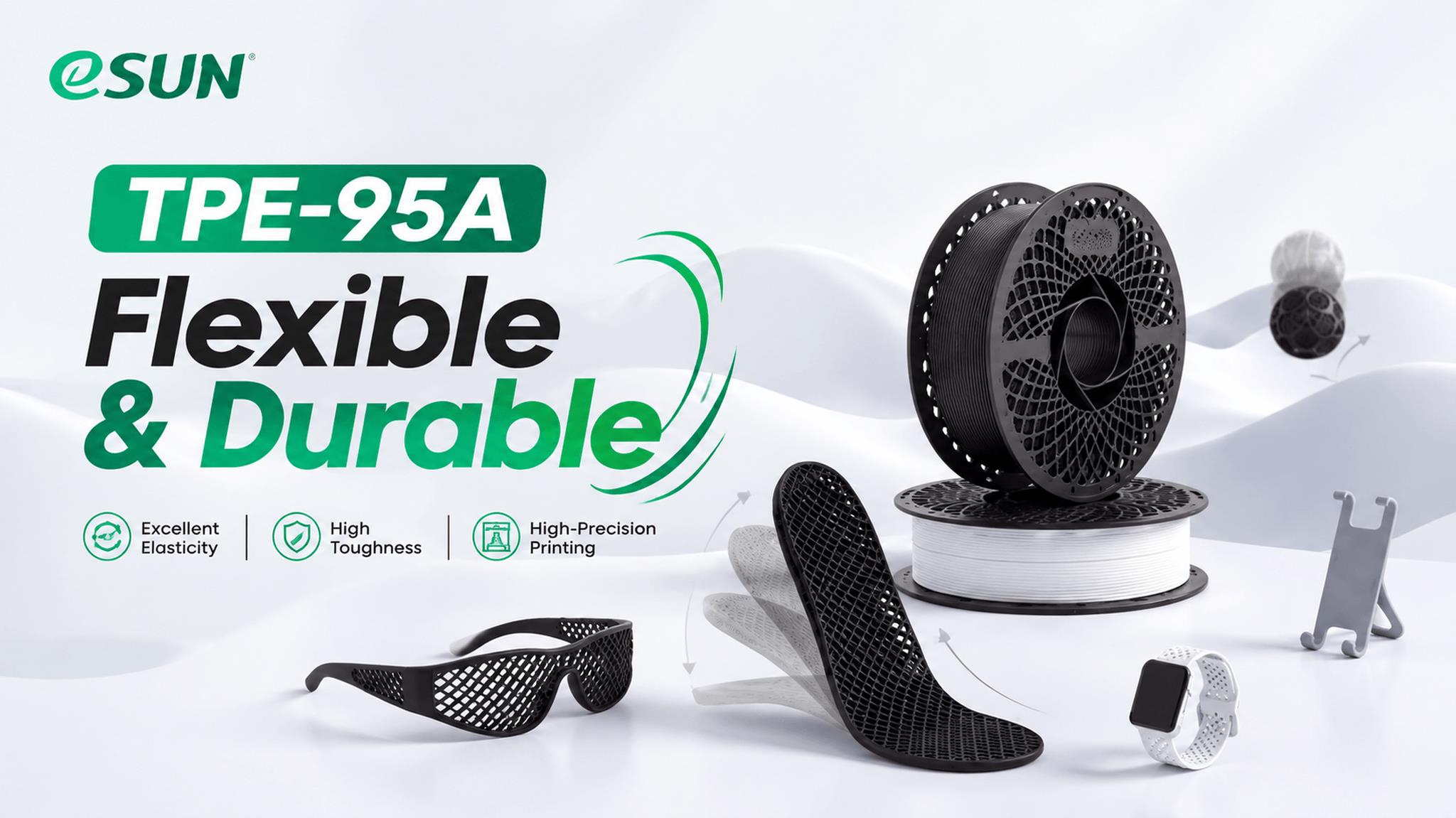
Esun Unveils TPE-95A: High-Rebound 3D Printing Filament With Up To 58% Rebound


According to eSUN, compared with conventional TPU-95A, TPE-95A delivers up to 93% higher rebound, increases printing speed by up to 137%, and reduces abrasion by nearly 30%. Its balanced combination of elasticity, durability, and printability makes it suitable for applications including phone cases, watch bands, cushioning structures, anti-slip components, and flexible functional parts.
TPU vs. TPE: Understanding the Difference
TPE, or thermoplastic elastomer, refers to a broad family of materials that combine rubber-like elasticity with thermoplastic processing characteristics. TPU, or thermoplastic polyurethane, is one specific type of TPE commonly used in 3D printing.
Although both materials offer flexibility, their performance varies according to chemical composition and formulation. TPU is widely valued for its tensile strength, tear resistance, and abrasion resistance, making it suitable for parts exposed to repeated mechanical stress and friction. Different TPE formulations can offer alternative combinations of softness, elastic recovery, and processing efficiency.
eSUN TPE-95A is designed to balance these properties, with a particular focus on rebound, wear resistance, and printing speed. Its 95A hardness provides a balance between flexibility and structural support, helping printed components maintain their shape while offering elastic cushioning.
Durability and Printing Convenience
Beyond rebound and printing efficiency, TPE-95A features fatigue resistance, low compression set, and resistance to yellowing. These characteristics can benefit components subjected to repeated bending or compression. According to eSUN, the material also maintains toughness and rebound performance at temperatures as low as -30°C, expanding its potential for outdoor and cold-environment applications.
For printing convenience, users of Bambu Lab printers can start with the built-in TPU“Generic” or“Bambu” presets and adjust nozzle temperature and flow ratio according to their specific setup. Proper filament drying and stable, low-resistance feeding are also important for achieving consistent extrusion and print quality.
With TPE-95A, eSUN continues to expand its flexible filament portfolio, giving makers, designers, and manufacturers another option for functional prototypes and everyday products that demand elasticity, durability, and efficient production.
CONTACT: Oliver Walker eSUN...

Legal Disclaimer:
MENAFN provides the
information “as is” without warranty of any kind. We do not accept
any responsibility or liability for the accuracy, content, images,
videos, licenses, completeness, legality, or reliability of the information
contained in this article. If you have any complaints or copyright
issues related to this article, kindly contact the provider above.


Comments
No comment