


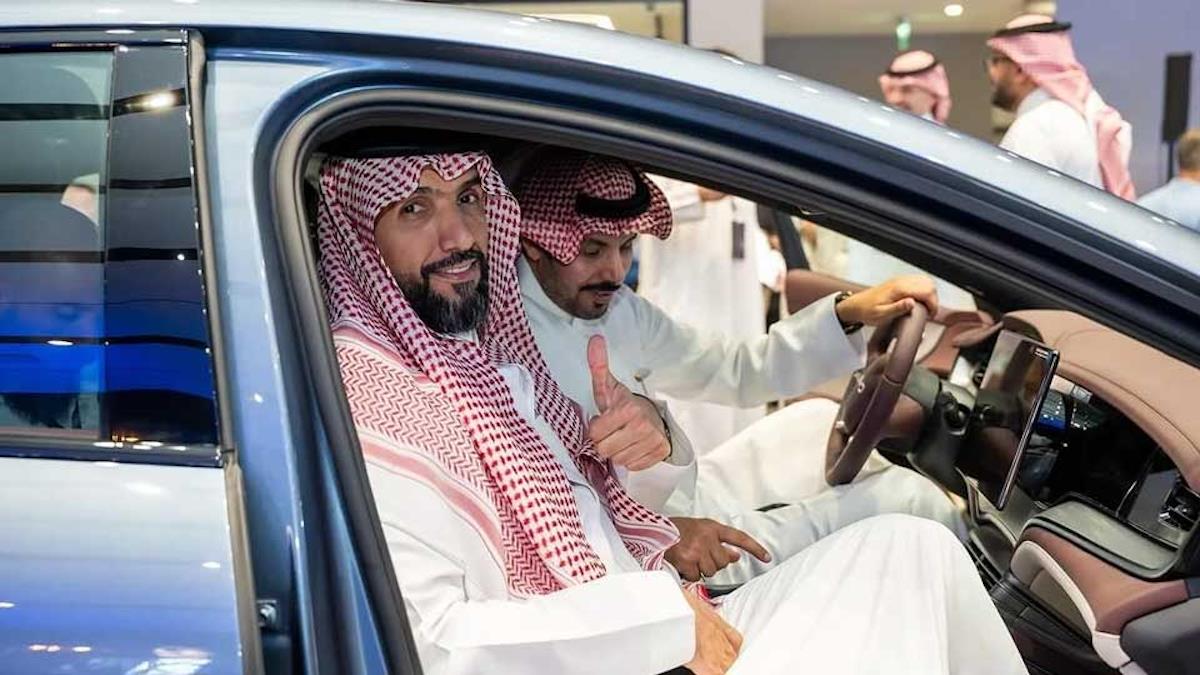
Chinese Evs Racing Into Gulf's Oil-Rich Car Market


Saudi Arabia, the United Arab Emirates, Qatar, Kuwait, Bahrain and Oman are diversifying toward alternative energy, embracing environmental goals and upgrading their transportation infrastructure.
At the same time, Chinese automakers are no longer selling only cheap, basic cars. Rather, they are building distribution networks, forming partnerships and bringing advanced battery technology to a region that Japanese, American, South Korean and European brands have long dominated.
BYD, Geely, Chery, Changan, MG and Li Auto are all motoring in, though not every model they sell is fully electric. Their lineups include battery-electric, plug-in hybrid and extended-range vehicles, so Chinese brands' growing share of the Gulf's overall car market should not be mistaken for a share of only its EV market.
And the shift is about more than commerce. It reflects a changing economic relationship between China and the Arab world, with major implications for the region's industrial development, technological dependence and future transportation.
To be sure, the GCC's EV market is still small next to those of China, Europe and the United States. But its potential is substantial.
In Arthur D. Little's 2026 Global Electric Mobility Readiness Index, the UAE ranked 22nd of 31 countries, the highest in the Gulf. EVs, including battery-electric and plug-in hybrid models, accounted for about 9% of new-vehicle sales there in 2025.
The country had roughly 2,800 charging points, among them about 1,250 DC chargers and 350 high-power units. The rollout is uneven, however, and remote, sparsely populated areas still have far fewer charging options.
Saudi Arabia offers a different kind of opportunity for China's EV makers. Its larger population, more extensive road network and bigger car market give Chinese manufacturers considerable long-term upside.
Industry estimates put the UAE at about 42% of the GCC's EV market in 2025, with Saudi Arabia potentially among the fastest-growing. Those figures, however, require caution, as several GCC countries lack comprehensive, independent EV sales data.
Competitive pricing, advanced techChinese manufacturers are entering the Gulf with competitive pricing, advanced technology, varied product ranges and partnerships with established regional distributors.
BYD has emerged as a particularly prominent competitor to established brands. In September 2026, its Saudi distributor, Al-Futtaim, announced new showrooms in Riyadh and Al-Qassim, bringing its Saudi network to 10.
The expansion points to a strategy built on after-sales service, spare parts and customer trust as much as on vehicle sales. BYD's emphasis on hybrids also reflects the realities of a market where drivers cover long distances and upcountry charging remains sparse.
Others are following similar paths. Geely is building its position with conventional cars, electric models and premium brands, while Chery and Changan compete on price across several segments.
Latest stories Indonesia primed to lead a Global South forest protection bloc US racing to field drone wingmen to close fighter gap with China Trump protects Putin from Graham-Blumenthal billIn April 2026, Li Auto signed distribution agreements with Al Fahim Motors in the UAE and Mohamed Yousuf Naghi Motors in Saudi Arabia. Its extended-range vehicles pair an electric drivetrain with an onboard gasoline generator, which may ease concerns about finding a charger.
All in all, the moves show that Chinese automakers are adapting to local infrastructure and consumer preferences rather than betting solely on battery-electric cars.
Strategic Saudi b attlegroundSaudi Arabia is central to China's Gulf ambitions. Under Vision 2030, Riyadh aims to diversify its economy and build advanced manufacturing to reduce its dependence on oil revenue.
Electric mobility fits that agenda, but the kingdom's industrial strategy goes well beyond importing foreign cars. It is developing domestic vehicle manufacturing and encouraging investment in batteries, charging networks and related supply chains.
Chinese automakers therefore face competition as well as opportunity. Their relatively inexpensive vehicles could appeal to middle-income households, commercial fleets and younger buyers. But the Saudi government also expects foreign companies to contribute to local employment, technology transfer and industrial development.
Charging infrastructure remains pivotal. The Electric Vehicle Infrastructure Company (EVIQ, the kingdom's state-backed charging operator, has partnered with BYD's local distributor to expand fast-charging and customer-charging services, an arrangement that could build consumer confidence over time.
Still, Saudi Arabia's long distances, punishing summer heat and preference for large vehicles will test battery durability, cooling systems and servicing. But Chinese EV manufacturers that get these basics right stand to build lasting, profitable positions.
UAE: China's regional gatewayThe UAE gives Chinese EV makers a foothold in the wider Middle East. Its cities have well-developed infrastructure, international logistics links and customers accustomed to advanced automotive technology. Its business environment also supports regional distribution, vehicle testing, financing and brand building.
Chinese brands increasingly compete on more than price, offering digital connectivity, interior design, driver-assistance features and battery technology. The change is most striking in premium segments, long the preserve of Western and Japanese marques.
The UAE's EV push complements its drive to diversify its economy, but it also illustrates a limit: buying EVs does not create a domestic auto industry. The long-term gains depend on whether imported technology fosters local engineering, skilled jobs, maintenance services and regional manufacturing.
China's strongest advantage is its maturing EV ecosystem. Its companies have invested heavily in battery chemistry, electric motors, software and large-scale manufacturing, and the technological race is intensifying.
In September 2026, Geely announced an ultra-fast charging system that it says can take a compatible battery from 10% to 70% in about 4.5 minutes under specific conditions. BYD has also demonstrated fast-charging systems that sharply cut charging times. Such advances could eventually reshape what Gulf drivers expect.
But laboratory demonstrations and manufacturer specifications are not the same as real-world performance on the Gulf's existing grid. Ultra-fast charging requires compatible vehicles, specialized batteries, large amounts of electricity and sophisticated thermal management. The Gulf's extreme heat compounds that engineering challenge.
The commercial value of China's charging breakthroughs will depend on whether Gulf countries can build the necessary infrastructure economically and safely. That means China's EV technological superiority alone may not secure market leadership.
Chinese EVs have benefited from low manufacturing costs and a compelling mix of technology and affordability. Their widening product ranges threaten established Gulf players such as Toyota, Hyundai, Kia, Tesla, BMW and Mercedes-Benz.
Price, of course, is not the whole story. Gulf buyers place a high value on reliability, resale value, maintenance costs, warranties and the availability of spare parts. Japanese automakers have earned decades of trust, especially in punishing conditions, and Chinese brands must build comparable reputations.
The difference between officially distributed vehicles and parallel imports also matters: Chinese EVs brought in outside authorized channels can run into problems with software updates, warranty claims, spare parts and regional specifications.
Chinese manufacturers' growing investment in authorized dealerships and service networks suggests they understand this.
High geopolitical stakesChina's push into the Gulf's lucrative auto market has implications beyond transportation. The Gulf has traditionally sold crude oil and petrochemicals to China and bought manufactured goods in return. EVs add a technological dimension to that exchange.
Chinese automakers could conceivably collaborate with the GCC on industrial diversification, battery development, renewable energy and smart transportation.
For Beijing, the Gulf offers relatively wealthy consumers and strategic access to further markets. For Gulf governments, Chinese investment is another source of new-age technology and a counterweight to the pricing and terms of established suppliers.
Yet a full embrace of Chinese EVs also carries risks. Reliance on imported batteries, proprietary software and foreign supply chains could create new vulnerabilities while geopolitical tensions, trade restrictions and shipping disruptions could raise costs and delay deliveries.
Gulf governments must choose between simply importing competitively priced Chinese vehicles and forging deeper industrial partnerships that strengthen domestic capabilities and deliver lasting economic benefits.
Sign up for one of our free newsletters-
The Daily Report
Start your day right with Asia Times' top stories
AT Weekly Report
A weekly roundup of Asia Times' most-read stories
EVs can improve urban air quality and cut transport emissions, though the benefit depends partly on how the electricity used to charge them is generated. Where power still comes largely from fossil fuels, the emissions advantage is smaller than in countries with more renewable energy. Battery production, mineral mining and recycling carry environmental costs of their own.
To capture the full benefit, the Gulf must pair electric mobility with cleaner power generation, charging infrastructure and responsible battery disposal. Solar energy, with China a leading supplier of solar panels, offers an obvious opportunity for regional cooperation.
Motoring beyond 2026By all measures, the Gulf's shift to EVs looks set to accelerate, though at different speeds across the six members.
The UAE has an early lead, while Saudi Arabia offers greater scale and more scope for local manufacturing. Qatar, Oman, Kuwait and Bahrain are smaller markets but potentially attractive ones, where government policy and charging investment will strongly shape adoption.
Chinese manufacturers are well placed to benefit, but their success will ultimately hinge on product reliability, ownership costs, distribution networks and responsiveness to local needs.
For Gulf governments, the central challenge is to ensure that EV adoption advances broader economic change rather than merely swapping one set of imported cars for another.
In sum, the rise of Chinese EVs in the Gulf marks a significant shift in the region's commercial and technological ties with China. Beijing is becoming not just an exporter of cars but a potential partner in the Gulf's move toward more advanced mobility.
China's market gains, while growing fast, are not guaranteed. Established automakers retain real advantages, while infrastructure and consumer tastes will continue to shape the contest.
The true measure of the Gulf's transition will not be the number of Chinese EVs on the streets of Riyadh, Dubai or Doha. It will be whether Gulf economies can turn electric mobility into lasting technological independence, productive employment, environmental sustainability and broad economic prosperity.
Qazi Zaheer Ahmad is an international affairs analyst and former senior joint secretary for the government of Pakistan.
Sign up here to comment on Asia Times stories OrThank you for registering!
-
Share on X (Opens in new window)
Share on LinkedIn (Opens in new window)
LinkedI
Share on Facebook (Opens in new window)
Faceboo
Share on WhatsApp (Opens in new window)
WhatsAp
Share on Reddit (Opens in new window)
Reddi
Email a link to a friend (Opens in new window)
Emai
Print (Opens in new window)
Prin

Legal Disclaimer:
MENAFN provides the
information “as is” without warranty of any kind. We do not accept
any responsibility or liability for the accuracy, content, images,
videos, licenses, completeness, legality, or reliability of the information
contained in this article. If you have any complaints or copyright
issues related to this article, kindly contact the provider above.


Comments
No comment