


Al-Umma Party: Have The“Hawks” Won The Battle For Control Of The Institutions?


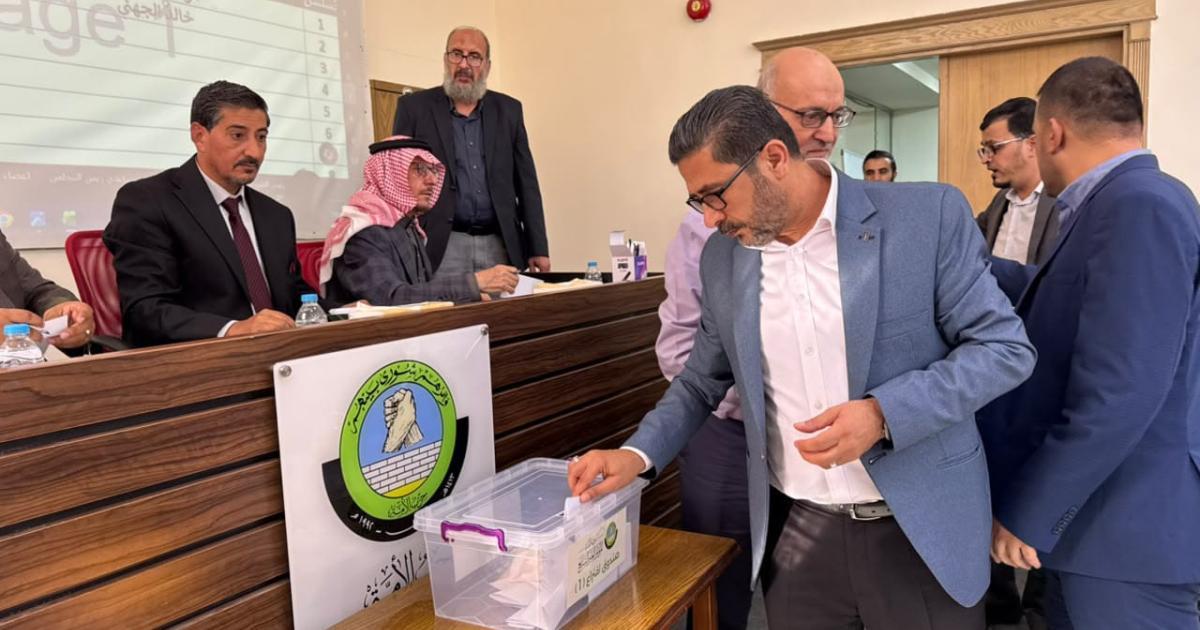
Weeks after Muath Al-Khawaldeh was elected secretary-general, MP Ahmad Al-Qatawneh was elected president of the Shura Council, while Dr Ghazi Al-Dweik became first deputy secretary-general. These appointments came alongside the completion of the executive bureau and the election of the party's central and supreme judicial committees. The resulting leadership structure deserves to be examined as a distribution of influence, rather than simply the completion of organisational procedures.
The paradox is that Al-Khawaldeh secured the secretary-generalship by a margin of just 13 votes over Al-Qatawneh, receiving 382 votes against 369. Al-Qatawneh subsequently withdrew from the run-off. At the time, the result could be interpreted as a victory for an approach more inclined towards flexibility in managing the party's next phase, in contrast to a figure associated with its hawkish current.
However, the subsequent appointments to the party's institutions suggest that winning the secretary-generalship does not necessarily mean controlling the mechanisms through which decisions are made.
If Al-Khawaldeh's election demonstrated that a current more inclined towards flexibility could compete for the party's leadership, Al-Qatawneh's election as president of the Shura Council raises a different question: who has the capacity to shape party decisions once the general conference has concluded?
According to publicly announced figures, the Shura Council comprises 103 members. It is a key arena for shaping internal balances, debating political and organisational options, and determining the party's direction. Al-Qatawneh's presidency gives him an influential position in managing discussions that will shape the party's course, particularly given that the contest for the secretary-generalship revealed a clear degree of convergence in the strength of the competing currents.
The election of Al-Dweik as first deputy secretary-general takes on additional significance when the appointments are considered collectively rather than individually. The secretary-general manages the party and leads its executive work, while the Shura Council plays an influential role in setting policies and overseeing the organisational process. The picture is completed by the election of the party's judicial bodies, which handle organisational and disciplinary matters within their respective jurisdictions.
This raises a question: are responsibilities being distributed among competing currents, or is one current consolidating its organisational advantage in a way that enables it to influence most of the party's decision-making centres?
The announced results alone are insufficient to establish that the hawkish current has achieved absolute control over all the party's institutions. Such a conclusion would require information about the political leanings of the remaining members of the executive bureau, the composition of the two judicial committees, the nature of alliances within the Shura Council, and the extent to which each body exercises independent decision-making authority. The labels“hawks” and“doves” also remain political descriptions of different tendencies within the Islamic movement, rather than formal organisational divisions with clearly defined boundaries.
The transformations facing Al-Umma Party are also difficult to understand without reference to 7 October 2023. The Al-Aqsa Flood attack, followed by Israel's devastating war on the Gaza Strip, reshaped Jordan's political landscape. The Palestinian cause moved to the forefront of public debate, while pressure on Islamist movements and their political and organisational networks across the region intensified.
In Jordan, public anger over the war on Gaza intersected with the Islamic movement's presence in the streets and parliament. The September 2024 elections exposed the extent of this overlap. The Islamic Action Front won 31 of the 138 seats in the House of Representatives, becoming the largest party in parliament.
Political analyses argued that this advance reflected not only organisational and electoral factors, but also the party's ability to articulate public anger over the war and the government's position towards it.
Yet electoral success brought a more complicated equation. The popular support that strengthened the party politically also placed it in a more sensitive position within the state's calculations, particularly as debate intensified over the Islamic movement's relationship with Hamas and the extent of the overlap between domestic party politics and regional ideological and political networks.
This overlap does not mean that Al-Umma Party's positions, or those of its voters, can be reduced to their views on Hamas. Nor is it accurate to treat different Islamist movements as a single, homogeneous bloc. It does, however, help explain why the relationship between political Islam, national security and domestic stability has assumed greater prominence in official and regional calculations since the war began.
On 23 April 2025, Jordanian authorities announced a ban on the activities of the Muslim Brotherhood. The move followed the authorities' announcement that they had uncovered alleged plots linked to individuals accused of preparing operations targeting national security. The decision included measures concerning the group's premises, assets and activities. The Brotherhood denied involvement in the alleged plots, while the decision triggered widespread debate over its political and social future in Jordan.
The ban had a direct impact on the environment in which the Islamic Action Front operates, even though the party remained a separately registered political entity. The legal distinction between the party and the Brotherhood does not automatically erase their shared history, ideological references or the social relationships that the Islamic movement has built over decades.
The significance of this distinction lies in the fact that the state is no longer approaching the issue solely through the lens of electoral competition. It is now part of a broader equation involving security, sovereignty and the boundaries of organisational activity. At the same time, the party faces the challenge of preserving its popular representation while adapting to this changing environment.
For decades, the party has been, and remains, the most prominent political force associated with the Islamic movement's ideological and political reference points in Jordan. Following the ban and the change of name, it faces a test that goes beyond legal compliance: how can it preserve its popular base and organisational networks while continuing to operate as a registered political party under a different legal and political reality?
The change does not mean that adopting a new name has automatically transformed the party's political culture or its approach to relations with the state. Organisational identity is shaped through practice, the nature of political discourse, the ability to build alliances, and a willingness to accept political compromises when national or party interests require them.
From this perspective, the struggle over leadership positions becomes particularly significant. The issue is not simply who will manage the party in the coming phase, but which political direction will shape the nature of its opposition, the limits of its openness towards the government, and its approach to participation in the political modernisation process.
The more hardline current may argue that preserving the party's independence requires avoiding political concessions, and that any engagement with the government without sufficient safeguards could weaken its standing among its electoral base.
Those favouring a more flexible approach, meanwhile, may believe that the new phase requires rebuilding relations with state institutions and political forces, presenting the party as a national actor capable of participating in the management of public affairs rather than merely continuing an earlier political confrontation.
This duality should not, however, be treated as inevitable. A leadership may adopt a hardline position on one issue while showing flexibility on another. Its calculations may also change in response to political circumstances and electoral considerations.
The most difficult test facing Al-Umma Party is the transition from a change in legal status to demonstrating the independence of its political decision-making. The party can retain its ideological and social roots, but it must explain how it intends to translate those foundations into a political programme that operates within the rules of multiparty pluralism.
This test is particularly important in its relationship with the government. Will the party seek to open broader channels of dialogue on economic and political reform, or will it maintain a confrontational discourse dominated by disputes with official policies? Will openness towards national political forces become a consistent strategy, or remain rhetoric accompanying an internal reorganisation?
Al-Khawaldeh's statements after his election, in which he spoke of unifying ranks and building national partnerships, signal a declared intention to expand the scope for cooperation. Assessing that intention, however, requires monitoring actual decisions, the party's positions on legislation and government policies, and its ability to reach understandings without abandoning the independence of its political stance.
Conversely, the presence of hawkish figures in influential leadership positions does not necessarily mean that the party will move towards confrontation with the government. Organisational influence and final political decision-making are two different things. The more hardline current may use its position to influence the limits of negotiation or ensure that concessions it considers fundamental are not made, without necessarily preventing agreements on specific issues.
The key issue is whether the new institutions will provide a framework for managing these differences or narrow the space for dissenting views within the party.
These appointments also matter in light of the 2024 parliamentary election results, when the Islamic Action Front, under its former name, won 31 of the 138 seats in the House of Representatives. This was a major electoral achievement that gave the party political and parliamentary weight that could not easily be ignored.
Repeating that achievement under a new name and within a different legal environment, however, is far from guaranteed. The party needs to retain its traditional support base, expand its ability to reach constituencies that do not necessarily share all its positions, and develop an electoral platform that addresses the economy, public services, unemployment and civil liberties, alongside regional issues, above all Palestine.
The secretary-general may be able to lead the party with flexibility despite the presence of hawkish figures in influential positions, provided its decision-making rules allow for consensus and prevent the concentration of power in the hands of a single current. The opposite could happen if differences between the executive leadership and other centres of authority become an obstacle to developing a unified strategy.
The distinction between these possibilities will not be determined by the names of elected officials alone. It will emerge through the party's decisions over the coming months, its dealings with the government, its position on political modernisation, and its ability to transform the organisational legacy of the Islamic Action Front into a sustainable party project under the new conditions.
Al-Umma Party faces a dual test. It must demonstrate that it can preserve its organisational structure and popular base amid the transformations that followed 7 October and the ban on the Muslim Brotherhood. At the same time, it must clarify what the change of name means in terms of political practice, rather than merely official documents.
The hawkish current may have strengthened its presence within the party's institutions, but the more important question concerns the limits of that influence and how it will be exercised. Will it be used to preserve organisational cohesion and manage the course of negotiations, or will it impose a political ceiling that limits the new leadership's ability to build the partnerships it has spoken about?
The answer will not be found in the names of those elected alone. It will emerge through the party's forthcoming decisions, its positions on the government, legislation and political reform, and the way it balances its positions on Palestine with the demands of managing its internal party affairs.
Only then will it become possible to determine whether the change of name has opened a different political chapter, or whether the legal change has so far preceded any clear transformation in the party's management or its relationship with the state.

Legal Disclaimer:
MENAFN provides the
information “as is” without warranty of any kind. We do not accept
any responsibility or liability for the accuracy, content, images,
videos, licenses, completeness, legality, or reliability of the information
contained in this article. If you have any complaints or copyright
issues related to this article, kindly contact the provider above.


Comments
No comment