


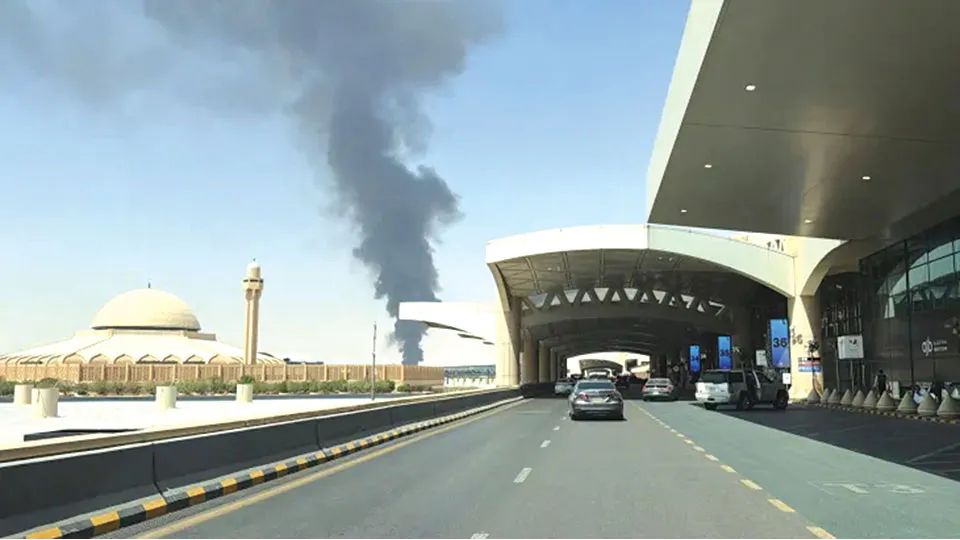
Saudi Airport Attacks Raise Stakes For Bangladesh's Workers, Pilgrims, Air Travel


Two Bangladeshis were killed and 24 injured in a missile attack on King Khalid International Airport in Riyadh on October 10, according to the Ministry of Expatriates' Welfare and Overseas Employment. The injured include 11 migrant workers and 13 Umrah pilgrims, underscoring how the security crisis has affected Bangladeshis traveling for different reasons.
The disruption has since extended beyond a single incident. Reports mentioned that another projectile struck a passenger terminal at Riyadh airport on October 11, killing one person and injuring 11. Attacks have also been reported near King Fahd International Airport in Dammam, raising concerns about the safety of alternative routes.
Workers, pilgrims face immediate uncertainty
The immediate impact is on passengers whose journeys have been canceled, diverted or delayed. Bangladesh's Civil Aviation Authority (CAAB) reported that 89 flights from Dhaka had been canceled, affecting 14,655 passengers, as disruptions followed the Riyadh airport closure.
Passengers wait outside Dhaka Airport with their luggage as several flights were cancelled to/from Saudi following attacks on King Khalid International Airport in Riyadh and its closure
Biman Bangladesh Airlines suspended its Dhaka-Riyadh services BG339 and BG340 until further notice after the airport halted operations. Other affected services included direct flights operated by Saudia, Riyadh Air and US-Bangla as well as transit flights by IndiGo, Emirates, Qatar Airways, flydubai, SalamAir and EgyptAir.
For migrant workers, a canceled flight can mean a delayed return to employment, uncertainty over joining dates and additional expenses for accommodation or rebooking. Workers returning from leave may also face complications if they cannot reach their workplaces on schedule. The actual financial consequences will depend on how long disruptions continue and what assistance airlines and employers provide.
Umrah pilgrims face different challenges, particularly when traveling through Riyadh before continuing to Jeddah or Madinah. Transit passengers can be left without onward connections, accommodation or clear information about revised itineraries.
The Bangladesh Embassy in Riyadh has assisted around 500 stranded Bangladeshi passengers, according to the expatriates' ministry. Arrangements included hotel accommodation and meals for some passengers, bus transfers to Jeddah for 67 pilgrims and alternative travel through Dammam for around 400 passengers affected by a canceled Saudia service.
Vital economic link under pressure
The implications extend beyond aviation. Saudi Arabia remains Bangladesh's largest source of remittances, with inflows reaching USD 5.85 billion in fiscal 2025-26, up from USD 4.26 billion a year earlier, according to figures disclosed by the government. More than 3.5 million Bangladeshis work in Saudi Arabia, this month's reports said.
Airport closures do not automatically interrupt remittance transfers, and there is no evidence that the attacks have reduced those inflows. However, prolonged instability could complicate workers' travel, recruitment and employment arrangements. Any sustained impact on employment or earnings would be relevant to families that depend on money sent from the kingdom.
The scale of the air link also matters. Bangladesh and Saudi Arabia agreed in August to raise permitted passenger flight frequencies from 49 to 84 per week for each side. The agreement reflected strong demand, particularly among Hajj and Umrah travelers.
Airspace risks could prolong disruption
The concern is not limited to airport terminals. On October 9, the European Union Aviation Safety Agency revised its Saudi airspace advisory, recommending that operators avoid two designated areas and exercise caution elsewhere in the Jeddah Flight Information Region. The advisory is valid until November 16 unless reviewed earlier. It cites risks associated with missile and drone activity, air-defense operations and falling debris.
For airlines serving Bangladesh, continued security concerns could require schedule changes, diversions and alternative operational arrangements. Such measures can increase fuel consumption and disrupt aircraft and crew schedules, potentially affecting subsequent flights as well.
Biman, Saudia, Riyadh Air and US-Bangla cancelled direct flights from Dhaka to Riyadh, while other airlines suspended transit services
Passengers should verify their flight status directly with their airline before leaving for the airport and keep contact details, booking records and essential travel documents accessible. Airlines and relevant authorities will also need to communicate cancellations, rebooking options and assistance arrangements clearly.
Longer-term question
The immediate priority is the safety of Bangladeshis in Saudi Arabia and support for injured passengers and affected families. The embassy's continuing coordination with hospitals and local authorities will be important as casualty information and travel arrangements develop.
For Bangla-desh, the wider challenge is maintaining a critical travel corridor during a period of heightened security risk. If disruptions remain temporary, the consequences may largely involve delayed journeys and additional costs. A prolonged crisis, however, would place greater pressure on airlines, workers, pilgrims and families connected to the kingdom.
The attacks have already demonstrated that instability at a major Saudi airport can have direct consequences for Bangladesh. How quickly safe operations and reliable connections can be restored will determine whether those effects remain limited or spread further.

Legal Disclaimer:
MENAFN provides the
information “as is” without warranty of any kind. We do not accept
any responsibility or liability for the accuracy, content, images,
videos, licenses, completeness, legality, or reliability of the information
contained in this article. If you have any complaints or copyright
issues related to this article, kindly contact the provider above.


Comments
No comment