


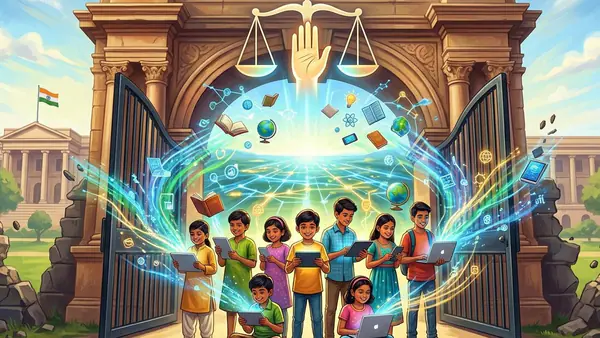
SC Says Internet Access Is A Fundamental Right, Rejects Blanket Ban For Children: 'Safety And Freedom Are Not At Odds'


A Bench of Justices JB Pardiwala and K Vinod Chandran noted,“We have no hesitation in saying that the right to access and use the internet is a fundamental right of every individual under Article 21 read with Article 19(1)(a) of the Constitution.”
“Our children, irrespective of their age enjoy the same rights, and to deny the same altogether would be as absurd as saying children below a certain age do not have a conscience worth protecting or a freedom of speech worth expressing,” it added.
“The safety of our children and their freedom are not at odds with each other. Our children are entitled to both,” the Bench said.
Also Read | Starlink says 'ready to connect India with high-speed internet' Why blanket bans may not workThe court observed that the internet, in its present form, is far from safe for children. However, it said that keeping children away from the internet because platforms fail to identify and remove harmful content would amount to“mistaking the victim for the problem”.
The Bench also warned that children could migrate to unregulated and potentially more dangerous websites if prohibited from using certain platforms.
“Any blanket restriction on the access of internet by children is nothing more than unproven measures of proven disproportionality,” the court said.
What safeguards can be introduced?While rejecting blanket bans, the Supreme Court said proportionate safeguards were necessary to protect children online.
The measures suggest parental consent and supervision, dedicated“child mode” accounts, private-by-default profiles, restrictions on messages from unknown adults, and stronger moderation of advertisements and content accessible to children.
The Bench also pointed out that the internet is particularly important for children in remote areas, for whom it may be the only source of learning and information.
Also Read | Yes Bank shares crash 10% afer this Supreme Court ruling on AT-1 bond write-offIt added that, for children with special needs, the internet was often the only place where they could find companionship with others like them.
The bench also noted that in the 2020 judgment in Anuradha Bhasin v. Union of India held that "the freedom of speech and expression and the freedom to carry on any trade or business through the medium of the internet is constitutionally protected as a fundamental right under Article 19(1)(a) and 19(1)(g) of the Constitution." It refrained from expressing any view on whether the right to access the internet is, by itself, a fundamental right.

Legal Disclaimer:
MENAFN provides the
information “as is” without warranty of any kind. We do not accept
any responsibility or liability for the accuracy, content, images,
videos, licenses, completeness, legality, or reliability of the information
contained in this article. If you have any complaints or copyright
issues related to this article, kindly contact the provider above.


Comments
No comment