


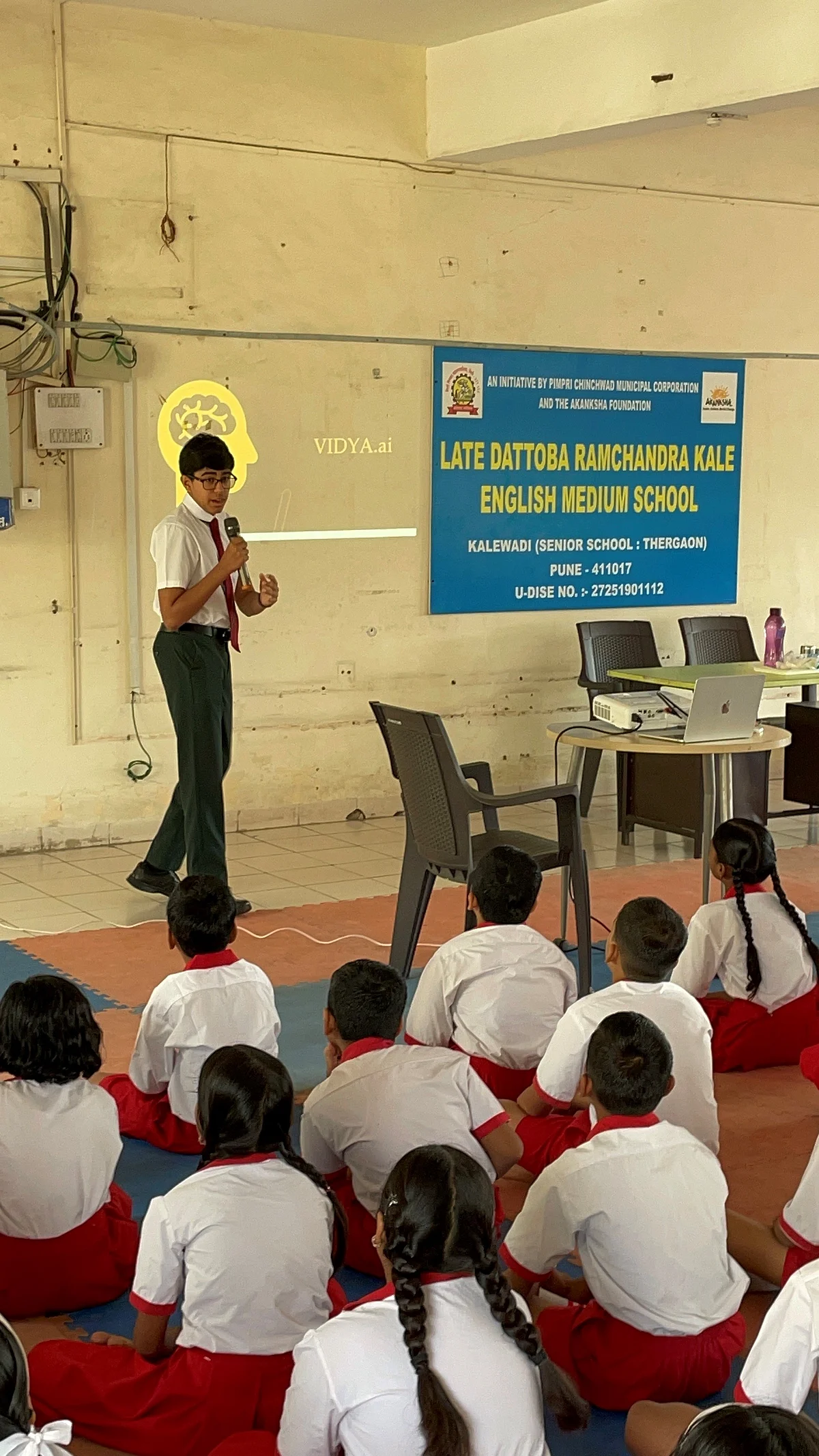
Dubai Student Builds AI Learning Platform For 5,000 Children In India's Overcrowded Schools


Ishaan Palicha, a Year 13 student at Jumeirah College, launched VIDYA in May 2024, when he was in Year 11, after visiting schools in Pune and Mumbai and witnessing the challenges faced by students and teachers.
Recommended For You UAE faced sleeper-cell threats during Iranian missile and drone attacks, says officialThe AI-powered education platform has reached around 5,000 students across Maharashtra, offering curriculum-aligned notes, summaries, flashcards, practice questions and progress tracking based on the National Council of Educational Research and Training (NCERT) and Balbharati curricula.
Stay up to date with the latest news. Follow KT on WhatsApp Channels.
“When I visited municipal schools in Pune and Mumbai in 2023, I saw classrooms with over 50 students and just one teacher. Giving every student individual attention in these conditions is difficult, especially when many cannot access private tutoring or other academic support,” Ishaan said.
The initiative aims to bridge the gap between classroom teaching and the individual attention students need to understand and retain lessons, without adding to teachers' workloads.
AI turns classroom lessons into personalised learning resourcesVIDYA uses speech-to-text technology and large language models to transform classroom recordings into structured learning materials. Students can revisit lessons at their own pace, practise questions and identify areas where they need more help.
The platform has also introduced a feature called 'Teach It Back', inspired by a school visit where Ishaan and teachers observed that some students could recall their notes but struggled to explain scientific concepts in their own words.
Developed with guidance from someone with a PhD in Education, the feature encourages students to explain concepts themselves, with AI identifying gaps in their understanding and providing feedback.
“I wanted students to have a way to actively practise difficult concepts, rather than simply reread notes,” he said.
His work on the platform has also drawn on research at IIT Madras into speech recognition and post-correction for Indian languages. This has helped him explore how AI tools can be adapted to different languages, accents and real classroom conditions.
“We're also working with speech recognition technology that can handle background noise and overlapping voices in classrooms. I believe AI should reflect how students are actually taught, including their language, curriculum and classroom conditions, rather than expecting every student to adapt to the same tool,” Ishaan said.
The student-facing platform is available on Google Play and the Apple App Store. The initiative has worked with the Udaan Foundation and attracted interest from organisations including Teach For India, P&G Shiksha and the Akanksha Foundation.
Dubai student hopes to reach 15,000 learners by year-endDespite its growing reach, Ishaan acknowledges that access to technology remains a challenge for the children the platform is designed to help. Students without reliable internet connections or smartphones may struggle to use it independently.
One option is for teachers to download and print AI-generated notes, allowing students to access the materials without a device. However, he recognises that this is only a partial solution.
“This isn't a complete solution, though. As we expand, I want to work with schools and community organisations to find better ways of reaching students in lower-resource environments,” he said.
He also sees the platform as a tool to support teachers, rather than replace them. Educators can turn recorded lessons into resources for students to revisit and use progress tracking to identify those who need additional help.
Teacher feedback has already influenced the platform's development, including the introduction of Teach It Back. Ishaan hopes partnerships with schools and community organisations will help bring the technology to more children who cannot afford additional academic support.
The team aims to reach 10,000 to 15,000 students by the end of 2026, with ambitions to expand VIDYA into a wider resource for under-resourced municipal schools across India.
For Ishaan, the project has also highlighted the contrast between his education in Dubai and the classrooms he has visited in India.
“Growing up in Dubai while working with schools in India has shown me how different learning environments can be. In Dubai, I've benefited from smaller classes, more individual attention and like-minded students who motivate me. In the Indian schools I visited, teachers were often responsible for more than 50 students at once,” he said.
Teachers at Jumeirah College helped him test early versions of the platform, reinforcing the importance of incorporating feedback from educators and students.
“It's also shown me that young people don't have to finish their education before starting to address problems they care about,” Ishaan said.
ALSO READ- UAE students reveal how they use ChatGPT for learning as schools lay down rules 'Human mentors', no timetable: Dubai school to test AI-powered personalised learning

Legal Disclaimer:
MENAFN provides the
information “as is” without warranty of any kind. We do not accept
any responsibility or liability for the accuracy, content, images,
videos, licenses, completeness, legality, or reliability of the information
contained in this article. If you have any complaints or copyright
issues related to this article, kindly contact the provider above.


Comments
No comment