


Escalator Vs Travelator: What Is The Difference Between These Two?


Escalator vs Travelator: When visiting shopping malls, railway stations or airports, you may have noticed escalators and travelators. Both help people move around easily, but they serve different purposes. Do you know what sets them apart?
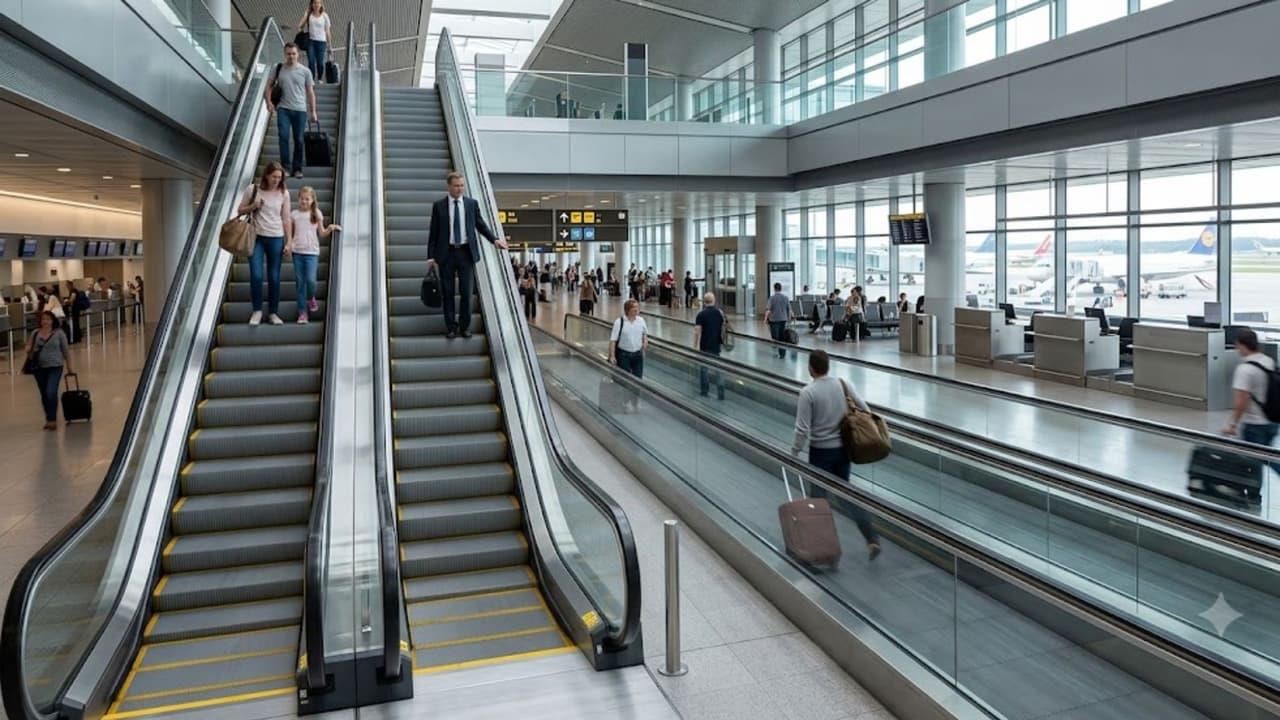
An escalator is a set of moving stairs that carries people from one floor to another. It can move upwards or downwards, making it easier to travel between different levels of a building. Escalators operate using an electric motor that moves the steps continuously along a loop. Passengers can stand on the steps or walk up and down them if they wish. A moving handrail on either side helps passengers maintain their balance while travelling. Escalators are commonly found in shopping malls, metro stations, railway stations, airports and large commercial buildings. They are particularly useful in places where large numbers of people need to move between floors.
A travelator, also known as a moving walkway or moving walk, is a moving platform with a flat surface. It carries people from one point to another, usually over a distance on the same floor. Unlike an escalator, a travelator does not have steps. Instead, it has a continuously moving flat belt that allows passengers to stand and move forward without much effort. People can also walk on it to reach their destination faster. Some travelators are completely horizontal, while others are installed at a slight incline to help people move between different levels. Travelators are commonly found at airports, large shopping malls and transport hubs. At airports, they help passengers cover long distances between terminals, boarding gates and other facilities without having to walk the entire way.
Although both are electrically powered systems designed to move people, they differ in their structure, direction of movement and purpose.
Design:An escalator has moving steps, while a travelator has a flat, moving belt.
Main purpose:Escalators help people move between floors. Travelators are mainly used to cover long distances on the same floor.
Direction of movement:Escalators generally move upwards or downwards. Travelators usually move horizontally, although some are installed at a slight incline.
Carrying luggage:Travelators can make it easier to move wheeled suitcases and luggage carts, especially at airports. However, not all travelators are designed to accommodate every type of trolley or cart. Taking shopping trolleys or other wheeled carts onto an escalator is generally unsafe unless the equipment is specifically designed and approved for that use.
Where they are used:Escalators are commonly seen in shopping malls, metro stations and railway stations. Travelators are more frequently used at airports, large shopping malls and certain transport facilities where people need to cover longer distances.
The length of a travelator depends on where it is installed, the distance people need to cover and the expected passenger traffic. Some travelators are only a few metres long, while those installed at airports can extend for several dozen metres. Specially designed systems can also exceed 100 metres in length.
For example, passengers at a large airport may need to walk a considerable distance from one boarding gate to another. Long travelators make these journeys easier and more comfortable by reducing the effort required to cover the distance.
In shopping malls, shorter travelators may be installed to help visitors move between different sections of the building.
Several factors are considered when deciding the length of a travelator, including available space, passenger volume, building design and safety requirements.
Ultimately, both escalators and travelators make travelling through large buildings more convenient. The main difference is simple.. an escalator helps you move between floors, while a travelator helps you cover longer distances with less walking.

Legal Disclaimer:
MENAFN provides the
information “as is” without warranty of any kind. We do not accept
any responsibility or liability for the accuracy, content, images,
videos, licenses, completeness, legality, or reliability of the information
contained in this article. If you have any complaints or copyright
issues related to this article, kindly contact the provider above.


Comments
No comment