


Dubai Police Summit: AI Can Help Close Surveillance Gaps, Detect Threats In Real Time


- By: Arwa Almazrouei
Artificial intelligence is changing how criminals operate, pushing police forces worldwide to rethink how they detect threats, share intelligence, and respond to increasingly sophisticated crimes.
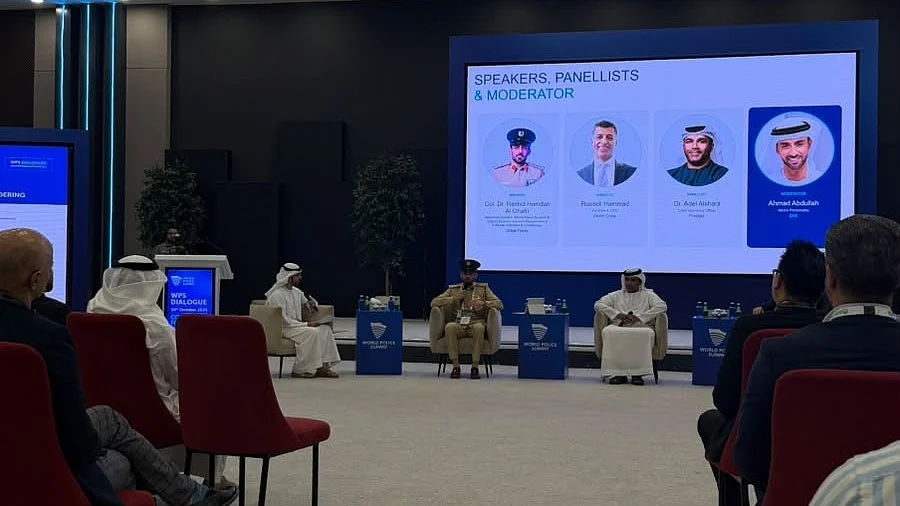
From cyberattacks and financial crime to cross-border criminal networks, law enforcement agencies must combine advanced technology with international cooperation to keep pace with rapidly evolving threats, experts said during a World Police Summit dialogue hosted by Dubai Police on Friday.
Recommended For YouThe discussion brought together international police leaders and technology specialists, including Col. Dr Rashid Hamdan Al Ghafri, the Deputy Director General of the General Department of Forensic Science and Criminology, Russell Hammad, the Founder and CEO of Zenith Group , and Dr Adel Alsharji, Chief Operating Officer (COO) of Presight, to examine how artificial intelligence, integrated security systems and real-time intelligence sharing can strengthen policing.
Stay up to date with the latest news. Follow KT on WhatsApp Channels.
The summit brings together more than 150 exhibitors and sponsors, along with over 220 speakers and experts, to discuss 14 topics shaped by the challenges facing police forces worldwide. The programme gives law enforcement agencies, government representatives and technology specialists a platform to exchange expertise and explore solutions to emerging security threats.
A central message from the dialogue was that no single country can tackle these challenges alone. Stronger cooperation between police forces, governments, technology companies and academic institutions will be essential to closing operational gaps and responding to threats that cross national borders.
Why global cooperation matters
Col. Dr Rashid Hamdan Al Ghafri highlighted the importance of bringing police leaders from different countries and sectors together to address shared security challenges.
International collaboration lets agencies exchange operational experience, share best practices, and develop solutions that can be adapted to different policing environments.
As criminals increasingly exploit digital platforms and international networks, connecting information held by different agencies can help investigators identify patterns and establish links between seemingly unrelated incidents.
The discussion emphasized that cooperation must extend beyond exchanging ideas. Police forces also need to integrate their systems, share relevant intelligence and coordinate responses to ensure that technological advances translate into practical security outcomes.
Partnerships between the public and private sectors are particularly important as technology companies develop tools that can support investigations, improve intelligence analysis and strengthen operational capabilities.
Connecting physical security and cyber intelligence
Panelists also focused on the convergence of physical security and cybersecurity, discussing how integrated surveillance systems and intelligence platforms can help police identify threats more effectively.
Russell Hammad highlighted the challenges of maintaining security across large geographical areas, particularly where conventional surveillance and communications infrastructure does not provide comprehensive coverage.
While urban centers may benefit from extensive surveillance networks, remote locations can present different operational challenges. Coverage gaps can make it harder for authorities to monitor activity and respond to potential threats.
Intelligent surveillance systems and connected patrol vehicles can help address these challenges by enabling officers to identify people, vehicles and locations while connecting information from different sources.
Such capabilities can help police build a more comprehensive picture of potential threats and identify relationships between individuals, vehicles and incidents that might otherwise go unnoticed.
The objective is to move beyond isolated systems to a connected security environment where information can be analyzed and acted on in real time.
The discussion also highlighted the importance of ensuring intelligence reaches personnel on the ground. Integrating information from physical surveillance and digital intelligence can help officers make better-informed decisions and respond more effectively to developing situations.
AI brings new opportunities and responsibilities
As artificial intelligence becomes increasingly integrated into law enforcement, speakers stressed that investment must extend beyond acquiring new technologies.
Police agencies must also develop the skills, organizational capabilities, and infrastructure needed to use AI effectively, while ensuring accountability and appropriate human oversight.
Dr Adel Alsharji was among the experts who participated in the discussion on the challenges facing law enforcement as technology advances and organizations adapt to new capabilities.
AI-powered systems can help process large volumes of information, identify patterns and support intelligence analysis. However, their effectiveness depends on the quality of available data, the reliability of the systems, and officers' ability to interpret and act on the information generated.
Police forces must also integrate new tools into existing operations and align them with practical security requirements.
The rapid pace of technological development presents an additional challenge, requiring agencies to continually assess their capabilities, train personnel and adapt to emerging methods used by criminals.
The discussion highlighted the importance of responsible technology adoption, with accountability and the human element remaining central to AI use in policing.
Real-time intelligence sharing a priority
When asked which operational gap should receive priority, panelists repeatedly highlighted integration and information sharing.
Connecting systems and strengthening cooperation between agencies can help law enforcement use available resources better, improve coordination, and respond more efficiently to cross-border crime.
Quick intelligence sharing is particularly important when threats develop across multiple jurisdictions or involve several forms of criminal activity.
Panelists also stressed that technology must deliver practical results, enabling decision-makers and officers on the ground to access relevant information when it matters most.
Fragmented systems and disconnected responses can limit the effectiveness of advanced security tools, even when individual agencies have invested heavily in technology.
The discussion concluded with a broader message: governments, police forces and technology partners must work as an integrated ecosystem, combining intelligence, expertise and operational capabilities to address emerging threats.
As artificial intelligence continues to reshape the security landscape, the future of policing will depend not only on technological innovation but also on agencies' ability to cooperate, share information responsibly, and turn intelligence into timely action.
ALSO READ- AI powers the next generation of policing and public safety UAE turns to AI to detect drug trafficking patterns, stresses international cooperation Abu Dhabi to host UN congress to discuss fighting digital crime, misuse of AI

Legal Disclaimer:
MENAFN provides the
information “as is” without warranty of any kind. We do not accept
any responsibility or liability for the accuracy, content, images,
videos, licenses, completeness, legality, or reliability of the information
contained in this article. If you have any complaints or copyright
issues related to this article, kindly contact the provider above.


Comments
No comment