


Japan's MMX Space Mission Probes How Mars Got Its Moons


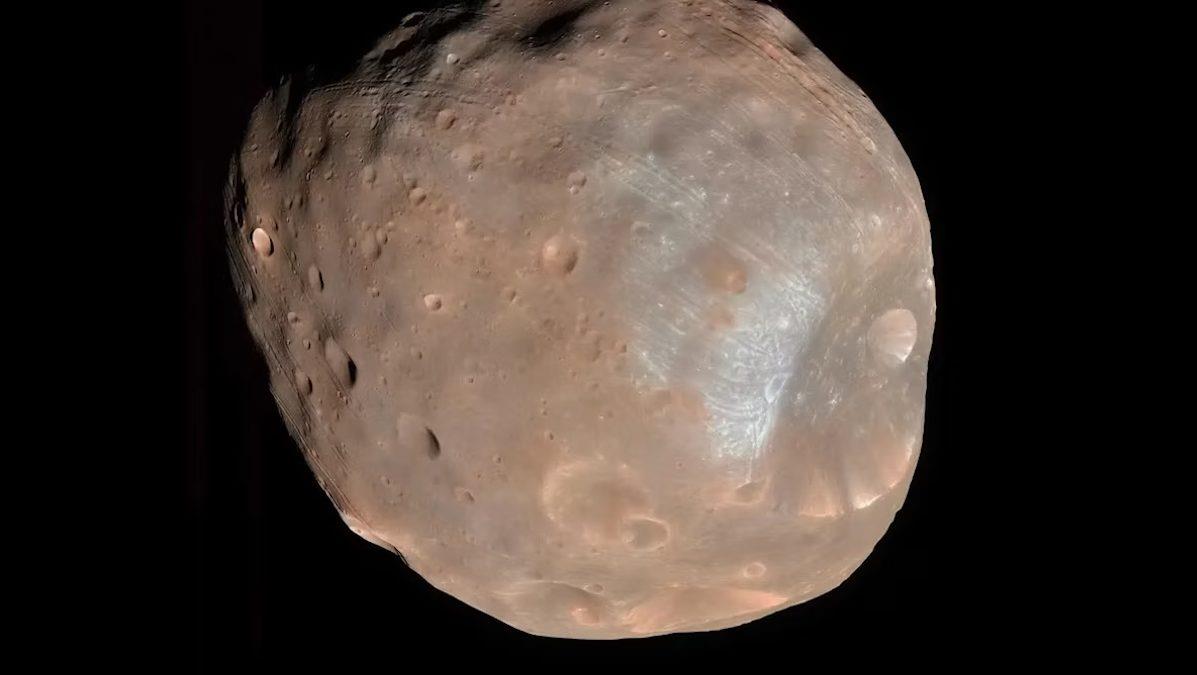
But what of our neighbor, Mars? The Red Planet has two small, irregularly shaped moons called Phobos and Deimos. There are several theories on how these natural satellites formed, but no clear front-runner. Soon, a Japanese-led space mission called Martian Moons Exploration (MMX) will begin its hunt for the answer.
On Monday October 19, MMX is due to lift off on an H3 rocket from Tanegashima Space Center in southern Japan. The mission will aim to land on Phobos and collect a sample of soil. The spacecraft will then send this precious payload to Earth, for study in laboratories.
Of the two Martian moons, Phobos is the largest and orbits closer to the planet. It has a mean diameter of 22.2 kilometers and a mass of 10,637 million million kilograms. Deimos has a mean diameter of 12.5km and a mass of 1,480 million million kg.
The moons were discovered during a six-day window in 1877 by the American astronomer Asaph Hall, who was working at the US Naval Observatory in Washington DC.
Two main hypotheses dominate discussions of how Mars got these moons.
The giant impact theory proposes that a celestial object a third of Mars' size hit the planet early in its history, ejecting material into space.

Legal Disclaimer:
MENAFN provides the
information “as is” without warranty of any kind. We do not accept
any responsibility or liability for the accuracy, content, images,
videos, licenses, completeness, legality, or reliability of the information
contained in this article. If you have any complaints or copyright
issues related to this article, kindly contact the provider above.


Comments
No comment