


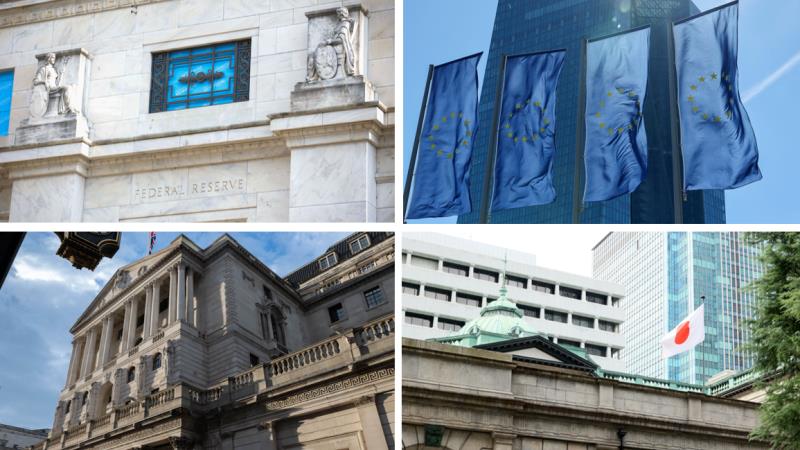
Our Latest Views On The Major Central Banks


When the Federal Reserve raised the policy rate 25bp at its September meeting, only two FOMC members expected no further hikes, while four of 18 thought they would need to raise rates at both the October and December meetings. The other 12 all expected one further rate rise this year.
Senior Fed officials have since suggested that they can take their time on rate hikes with no need for moves at consecutive meetings, which means October's FOMC meeting is widely expected to see policy left unchanged. We, like the market, expect a 25bp rate hike at the December meeting given inflation remains elevated and unemployment is low.
Nonetheless, the move higher in Treasury yields and the stronger dollar are contributing to tighter monetary conditions, which will weigh on growth. Given our inflation and jobs projections, we do not expect additional policy tightening in 2027, despite the market pricing in a further 50bp of hikes.
European Central BankA resilient eurozone economy and increasing headline inflation remain strong arguments for yet another ECB rate hike. Not necessarily at the October meeting, as the ECB prefers having the quarterly staff projections in its briefing notes when deciding on interest rates, but definitely at the December meeting. However, given that we still see hardly any pass-through from higher energy prices to the rest of the economy, there are also very few reasons for the ECB to become overly hawkish.
While the macro picture doesn't provide any new arguments for changing the monetary policy stance at the October meeting, the surge in bond yields and the fiscal situation in France will be top of mind at the ECB. Not so much because of any consideration of intervention. For that, the French government would first have to implement austerity measures before the ECB would ever consider starting any bond purchases.
However, beyond the question of restarting bond purchases, the rise in bond yields has already impacted eurozone growth and inflation. In fact, the surge in German bond yields since the September meeting has already had roughly the same impact on growth and inflation as an additional 25bp rate hike.
For France, it's closer to a 50bp hike. With bond markets doing the ECB's job, some central bank officials might be less keen to continue hiking than they were at the September meeting.
Bank of EnglandWe now expect two rate hikes from the Bank of England – in November and February. Until now, the Bank has cast its decision not to cut rates, as implicitly planned before the Iran War, as de facto tightening. But recent comments suggest it increasingly feels it needs to act.
The Bank's November inflation forecasts are likely to show CPI briefly above 4%, and that is likely to be the catalyst for a hike, citing previous research that inflation at these levels is historically more likely to trigger second-round effects.
But the case for hikes is still not compelling. With the jobs market still relatively cool, we're sceptical that wage growth is likely to react to higher energy prices anywhere near as much as it did four years ago. Interest rates are also more evidently restrictive than they are in the eurozone or the US. That still points to rate cuts from late 2027 and into 2028.
Bank of JapanThe market prices in very low chances of a back-to-back BoJ hike on 30 October following its 25bp hike to 1.25% last month. That move saw two dissenters, and the BoJ typically takes time to assess the impact of policy changes before further adjustments. Nonetheless, the central bank continues to see upside risks to inflation and seems intent on a terminal policy rate somewhere in the 1.75-2.00% area next year.
Most in the market are expecting the next hike to come in December, seeing the BoJ switching to a quarterly cycle from a six-monthly cycle of tightening policy. That faster pace of tightening would seemingly be in accord with Washington's desire for BoJ monetary policy to provide some credible macro support to July's joint US-Japan intervention in the yen.
We see risks that the next hike could be pushed back into January, however. This allows the BoJ a little more time to monitor the economy. Prime Minister Sanae Takaichi's government remains set on a domestic demand push, and we have a slight preference that the next two hikes are backloaded into January and April, right before the consumption tax rate on food is cut to 1% from 8%.

Legal Disclaimer:
MENAFN provides the
information “as is” without warranty of any kind. We do not accept
any responsibility or liability for the accuracy, content, images,
videos, licenses, completeness, legality, or reliability of the information
contained in this article. If you have any complaints or copyright
issues related to this article, kindly contact the provider above.


Comments
No comment