


Scientific Support For The Implementation Of A Strategy To Combat The Spread Of Invasive, Harmful Plant Species


(MENAFN- RCTT)
The V.F. Kuprevich Institute of Experimental Botany offers services for the scientific support of strategies to combat the spread of invasive harmful plant species under an outsourcing agreement and/or subcontracting and is looking for partners to conclude a distribution services agreement.
Description
Assessment of threats and risks posed by the introduction of invasive species into native plant communities. Evaluation of the invasive potential of plants and the development of methods to prevent their spread.
Monitoring of populations of invasive plant species that pose a threat to human life or health, biodiversity, or various sectors of the economy.
Establishment of a national early-warning system for invasive plant and animal species. Provision of services to test soil for the presence of viable seeds of Sosnowsky's hogweed and other invasive species, ensuring the suitability of soil for landscaping and lawn establishment.
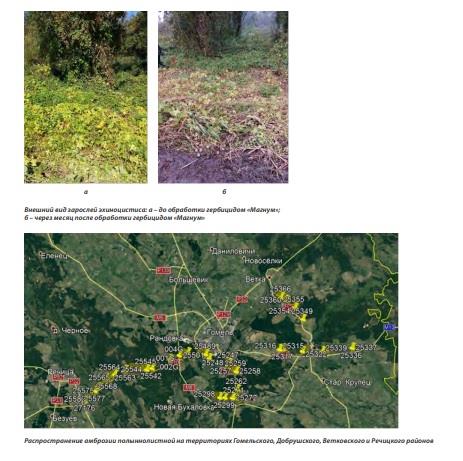
The V.F. Kuprevich Institute of Experimental Botany has developed scientific and practical foundations for controlling the spread of the most dangerous invasive plant species (Sosnowsky's hogweed, Canadian goldenrod, wild cucumber, boxelder maple, and black locust). A strategy and action plan for the control of Sosnowsky's hogweed and other highly dangerous invasive plant species within the Republic of Belarus have been developed. This strategy and action plan were approved by a resolution of the Ministry of Natural Resources and Environmental Protection of the Republic of Belarus on August 10, 2018. A range of scientific, practical, and organizational measures have been implemented as part of an action plan to control Sosnowsky's hogweed and other highly dangerous invasive plant species. These include scientific initiatives (developing new technologies for the application of selective-action agents; synthesizing new substances with potential for use in plant protection and pharmaceuticals, etc.); practical projects (assessing the topsoil removed from land designated for construction; conducting experiments on the implementation of new control technologies and methods in the cities of Minsk and Logoisk); and organizational activities (industry-specific training seminars on regulating the spread and population size of invasive plant species). Informational leaflets have been published, as well as a monograph titled "The Black Book of the Flora of Belarus," which details the biology, ecology, and geographical distribution of 52 of the most harmful non-native vascular plant species that have become widespread across both natural and disturbed ecosystems in the Republic of Belarus.
Scope of application (economic sector, potential end-users):
Natural resource management and environmental protection; forestry and ornamental horticulture (individuals, legal entities, and government institutions).
Sample application forms for these services can be found on the Institute's website here. (in Russian)
This information is featured in the Catalog "Brands of the National Academy of Sciences of Belarus 2021–2022: A List of Key Developments from the National Academy of Sciences of Belarus," on pages 187–189. (in Russian) Advantages and Innovations Improving services to enhance competitiveness.
Enhancing the parameters of work (services) performed and improving their quality through:
. the development of regulatory and technical documents specifying requirements for activities aimed at limiting the spread and population size of invasive plants, or for the practical utilization of raw materials derived fr om such species;
. the development of methods to lim it the spread of invasive plant species or to facilitate their practical use;
. the preparation of scientific, scholarly-methodological, and popular science publications;
. the intensification of scientific outreach and educational efforts;
. the expansion of the range of services offered. Stage of development Already on the market Funding source State budged
Internal
IPR status Exclusive rights
Secret know-how
Comments regarding IPS status Service-providing organization.
State Scientific Institution "V.F. Kuprevich Institute of Experimental Botany of the National Academy of Sciences of Belarus." Sector group Agrofood
BioChemTech
Environment
Tourism and Cultural Heritage
Client information Type R&D institution Year established 1931 NACE keywords A.01.11 - Growing of cereals (except rice), leguminous crops and oil seeds
A.01.61 - Support activities for crop production
M.72.11 - Research and experimental development on biotechnology
M.72.19 - Other research and experimental development on natural sciences and engineering
M.74.90 - Other professional, scientific and technical activities n.e.c.
Turnover (in EUR) 10-20M Already engaged in transnational cooperation Yes Additional comments The V.F. Kuprevich Institute of Experimental Botany of the National Academy of Sciences of Belarus is the oldest biological research institution in the country and a leading scientific center in the field of botany.
The Institute's core activities include:
* assessing the impact of new construction (or reconstruction) projects and economic activities on plant life;
* ecotourism and environmental education: designing and providing informational support for nature trails, visitor centers, and forest-based educational centers, as well as developing promotional materials;
* evaluating the extent to which fertile soil layers are contaminated with viable seeds of Sosnowsky's hogweed (*Heracleum sosnowskyi*) and developing methods to control this dangerous invasive species;
* developing and producing artificial substrates for plant propagation and cultivation;
* creating plant growth regulator compositions and plant protection products, along with technologies for their application;
* testing plant protection products undergoing state registration (for trees and shrubs in forests, protective plantings, urban green spaces, forest plantations, and nurseries, as well as for flax).
The Institute has conducted extensive research, which has led to the mapping of the distribution and stock of key medicinal plant species across the country. This work has identified trends in medicinal plant resources and provided recommendations for their sustainable use. Furthermore, the Institute has investigated the chorological (distributional) characteristics of the Belarusian flora, forming the basis for specific conservation measures for individual plant species and entire floristic complexes. The Institute has pioneered research into the patterns of flora formation, the ecology and biology of plant species, the structure and composition of plant populations in extreme growing conditions, and the taxonomic study of specific plant species and genera native to Belarus. The Institute studies the patterns of distribution and formation of Belarus's natural vegetation, the structure and productivity of plant communities, and the dynamics and direction of successional processes within the vegetation cover. It develops the scientific foundations for the rational use and conservation of plant resources; theoretical bases and principles for vegetation classification; a typological classification of forests in Belarus; forest-site and geobotanical zoning of the republic; and scientific principles for forest management based on zonal-typological approaches. A collection of pure cultures has been established, comprising 55 species (over 300 strains) of micromycetes and deuteromycetes, as well as 400 bacterial strains (identified to the genus level) isolated from the rhizosphere and phylloplane of legumes and potatoes.
The Institute conducts comprehensive research to establish the fundamental principles of modern, sustainable, and environmentally safe crop production. It evaluates the efficacy of new agricultural preparations, develops methods to curb the spread of invasive plant species, and creates environmentally safe and cost-effective technologies for utilizing biotechnological waste as secondary material resources. This work enables the successful identification of methods that combine the ecological focus of extensive agriculture with the advantages of knowledge-intensive, high-yield food production, while also proposing new ways to boost productivity.
The Institute maintains international ties through active agreements on scientific and technical cooperation, as well as memoranda of scientific and technical (collaborative) partnership with relevant organizations in various countries.
Official website of the V.F. Kuprevich Institute of Experimental Botany. Languages spoken English
Russian
Information about partnership Type of partnership considered Distribution services agreement
Outsourcing agreement
Subcontracting
Type and role of partner sought lients interested in purchasing scientific support services for the implementation of a strategy to combat the spread of invasive, harmful plant species under an outsourcing agreement and/or subcontracting.
Partners interested in purchasing scientific support services for the implementation of a strategy to combat the spread of invasive, harmful plant species under a distribution services agreement. Type and size of partner sought > 500
251-500
SME 51-250
SME 11-50
SME <= 10
R&D Institution
University
Sole proprietor
Monitoring of populations of invasive plant species that pose a threat to human life or health, biodiversity, or various sectors of the economy.
Establishment of a national early-warning system for invasive plant and animal species. Provision of services to test soil for the presence of viable seeds of Sosnowsky's hogweed and other invasive species, ensuring the suitability of soil for landscaping and lawn establishment.
The V.F. Kuprevich Institute of Experimental Botany has developed scientific and practical foundations for controlling the spread of the most dangerous invasive plant species (Sosnowsky's hogweed, Canadian goldenrod, wild cucumber, boxelder maple, and black locust). A strategy and action plan for the control of Sosnowsky's hogweed and other highly dangerous invasive plant species within the Republic of Belarus have been developed. This strategy and action plan were approved by a resolution of the Ministry of Natural Resources and Environmental Protection of the Republic of Belarus on August 10, 2018. A range of scientific, practical, and organizational measures have been implemented as part of an action plan to control Sosnowsky's hogweed and other highly dangerous invasive plant species. These include scientific initiatives (developing new technologies for the application of selective-action agents; synthesizing new substances with potential for use in plant protection and pharmaceuticals, etc.); practical projects (assessing the topsoil removed from land designated for construction; conducting experiments on the implementation of new control technologies and methods in the cities of Minsk and Logoisk); and organizational activities (industry-specific training seminars on regulating the spread and population size of invasive plant species). Informational leaflets have been published, as well as a monograph titled "The Black Book of the Flora of Belarus," which details the biology, ecology, and geographical distribution of 52 of the most harmful non-native vascular plant species that have become widespread across both natural and disturbed ecosystems in the Republic of Belarus.
Scope of application (economic sector, potential end-users):
Natural resource management and environmental protection; forestry and ornamental horticulture (individuals, legal entities, and government institutions).
Sample application forms for these services can be found on the Institute's website here. (in Russian)
This information is featured in the Catalog "Brands of the National Academy of Sciences of Belarus 2021–2022: A List of Key Developments from the National Academy of Sciences of Belarus," on pages 187–189. (in Russian) Advantages and Innovations Improving services to enhance competitiveness.
Enhancing the parameters of work (services) performed and improving their quality through:
. the development of regulatory and technical documents specifying requirements for activities aimed at limiting the spread and population size of invasive plants, or for the practical utilization of raw materials derived fr om such species;
. the development of methods to lim it the spread of invasive plant species or to facilitate their practical use;
. the preparation of scientific, scholarly-methodological, and popular science publications;
. the intensification of scientific outreach and educational efforts;
. the expansion of the range of services offered. Stage of development Already on the market Funding source State budged
Internal
IPR status Exclusive rights
Secret know-how
Comments regarding IPS status Service-providing organization.
State Scientific Institution "V.F. Kuprevich Institute of Experimental Botany of the National Academy of Sciences of Belarus." Sector group Agrofood
BioChemTech
Environment
Tourism and Cultural Heritage
Client information Type R&D institution Year established 1931 NACE keywords A.01.11 - Growing of cereals (except rice), leguminous crops and oil seeds
A.01.61 - Support activities for crop production
M.72.11 - Research and experimental development on biotechnology
M.72.19 - Other research and experimental development on natural sciences and engineering
M.74.90 - Other professional, scientific and technical activities n.e.c.
Turnover (in EUR) 10-20M Already engaged in transnational cooperation Yes Additional comments The V.F. Kuprevich Institute of Experimental Botany of the National Academy of Sciences of Belarus is the oldest biological research institution in the country and a leading scientific center in the field of botany.
The Institute's core activities include:
* assessing the impact of new construction (or reconstruction) projects and economic activities on plant life;
* ecotourism and environmental education: designing and providing informational support for nature trails, visitor centers, and forest-based educational centers, as well as developing promotional materials;
* evaluating the extent to which fertile soil layers are contaminated with viable seeds of Sosnowsky's hogweed (*Heracleum sosnowskyi*) and developing methods to control this dangerous invasive species;
* developing and producing artificial substrates for plant propagation and cultivation;
* creating plant growth regulator compositions and plant protection products, along with technologies for their application;
* testing plant protection products undergoing state registration (for trees and shrubs in forests, protective plantings, urban green spaces, forest plantations, and nurseries, as well as for flax).
The Institute has conducted extensive research, which has led to the mapping of the distribution and stock of key medicinal plant species across the country. This work has identified trends in medicinal plant resources and provided recommendations for their sustainable use. Furthermore, the Institute has investigated the chorological (distributional) characteristics of the Belarusian flora, forming the basis for specific conservation measures for individual plant species and entire floristic complexes. The Institute has pioneered research into the patterns of flora formation, the ecology and biology of plant species, the structure and composition of plant populations in extreme growing conditions, and the taxonomic study of specific plant species and genera native to Belarus. The Institute studies the patterns of distribution and formation of Belarus's natural vegetation, the structure and productivity of plant communities, and the dynamics and direction of successional processes within the vegetation cover. It develops the scientific foundations for the rational use and conservation of plant resources; theoretical bases and principles for vegetation classification; a typological classification of forests in Belarus; forest-site and geobotanical zoning of the republic; and scientific principles for forest management based on zonal-typological approaches. A collection of pure cultures has been established, comprising 55 species (over 300 strains) of micromycetes and deuteromycetes, as well as 400 bacterial strains (identified to the genus level) isolated from the rhizosphere and phylloplane of legumes and potatoes.
The Institute conducts comprehensive research to establish the fundamental principles of modern, sustainable, and environmentally safe crop production. It evaluates the efficacy of new agricultural preparations, develops methods to curb the spread of invasive plant species, and creates environmentally safe and cost-effective technologies for utilizing biotechnological waste as secondary material resources. This work enables the successful identification of methods that combine the ecological focus of extensive agriculture with the advantages of knowledge-intensive, high-yield food production, while also proposing new ways to boost productivity.
The Institute maintains international ties through active agreements on scientific and technical cooperation, as well as memoranda of scientific and technical (collaborative) partnership with relevant organizations in various countries.
Official website of the V.F. Kuprevich Institute of Experimental Botany. Languages spoken English
Russian
Information about partnership Type of partnership considered Distribution services agreement
Outsourcing agreement
Subcontracting
Type and role of partner sought lients interested in purchasing scientific support services for the implementation of a strategy to combat the spread of invasive, harmful plant species under an outsourcing agreement and/or subcontracting.
Partners interested in purchasing scientific support services for the implementation of a strategy to combat the spread of invasive, harmful plant species under a distribution services agreement. Type and size of partner sought > 500
251-500
SME 51-250
SME 11-50
SME <= 10
R&D Institution
University
Sole proprietor

Legal Disclaimer:
MENAFN provides the
information “as is” without warranty of any kind. We do not accept
any responsibility or liability for the accuracy, content, images,
videos, licenses, completeness, legality, or reliability of the information
contained in this article. If you have any complaints or copyright
issues related to this article, kindly contact the provider above.


Comments
No comment