


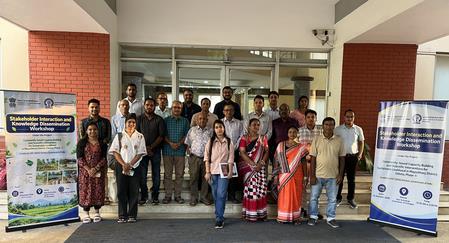
IIT Kharagpur To Strengthen Sustainable Livelihoods Among Odisha Tribal Communities


This was part of a collaborative project between the institute and the Department of Science and Technology (DST) through its Science for Equity Empowerment and Development (SEED) division.
Through this project, IIT Kharagpur translates research into meaningful societal impact, in an effort to build resilient, self-reliant rural communities. In the past, the institute has undertaken field-scale technology demonstrations, such as fluoride removal filter pilots in Bankura, West Bengal. The day's workshop commenced with an address by Prof Jayanta Mukhopadhyay, Dean (Strategy and Analytics).
It was organised by an interdisciplinary IIT Kharagpur team comprising Dr Sayak Roychowdhury, Prof Bhagirath Behera, Prof Soumya Kanti Ghosh, Prof Pulak Mishra, and Dr Pritha Datta.
The deliberations brought together Shri Sumit Kar, deputy director, Simlipal South Wildlife Division, various district officials, scientists, NGO representatives, grassroots entrepreneurs and community stakeholders.
Tribals make up nearly 58.58 per cent of the population in the Mayurbhanj district of Odisha. About 97.3 per cent of them live in rural areas. The Simlipal South Wildlife Division is a part of the Simlipal Tiger Reserve and Simlipal Biosphere Reserve.
In deep wildlife divisions like Simlipal South, with ranges like Pithabata North, Pithabata South, Nawana, Jenabil, Upper Barahkamuda, and Bhanjabasa, the resident population is 100 per cent tribal.
The major tribes include the Kolhas, Santhals, Bhumijas, Bathudis, Gondas, Mundas, Hos and Mahalis. The Particularly Vulnerable Tribal Groups in Simlipal South are the Hill Khadias and Mankirdias.
The Hill Khadias are semi-nomadic, inhabiting several forest villages. The Mankirdias are known for their traditional rope-making skills, using Siali fibre. They also gather non-timber forest products (NTFPs) like honey, arrowroot, and wild roots.
The management of the Simlipal South Division involves balancing tiger conservation and anti-poaching operations with forest rights, relocation processes, and sustainable livelihood support for the tribal population.
The workshop organised by IIT Kharagpur covered all aspects from indigenous knowledge and biodiversity conservation to mushroom cultivation, integrated farming, renewable energy and rural entrepreneurship.
It explored how scientific interventions can create sustainable economic opportunities while preserving local ecosystems. -

Legal Disclaimer:
MENAFN provides the
information “as is” without warranty of any kind. We do not accept
any responsibility or liability for the accuracy, content, images,
videos, licenses, completeness, legality, or reliability of the information
contained in this article. If you have any complaints or copyright
issues related to this article, kindly contact the provider above.


Comments
No comment