


Tampa Bay Rays, Moneyball's True Goal, Herd Behavior And Compounders


There was a piece on the Tampa Bay Rays in the WSJ about how they've tipped Moneyball upside down. They're bunting, stealing bases, hitting ground balls... basically playing old school small ball, with great success: they won 98 games and are now in the ALCS with a chance to move on to the World Series.
This“base hit” strategy (a team after my own heart) has surprised the baseball world. Tactics like sacrifice bunts and hitting for contact were no longer deemed optimal in the modern moneyball era.
But I think the Rays, and baseball generally, are a great example of how conventional wisdom and herd behavior can lead to market inefficiency.
For starters, Moneyball was never about maximizing on base percentage or any other metric, it was about buying runs at a discount. It was value investing:
3:24 PM · May 28, 2026
In some ways, baseball has forgotten this simple point. The focus is on paying up for players who hit the ball hard, and it has created a mispricing in players at the other end of the spectrum who hit for contact and are good base runners. Just like quality stocks with high ROIC might be a great investment at one price, if everyone starts optimizing for compounders, they no longer lead to great investment returns.
Market Inefficiency in Baseball
In the early 2000's, Billy Beane and the Oakland A's famously used“sabermetrics” (later called moneyball) to put together a 103 win team on one of the league's smallest payrolls. Their $42 million payroll was less than one-third of the Yankees'.
The A's built their winning team using statistics that other teams undervalued at the time. They stopped bunting because they realized that they had a better chance of scoring with a runner on first with no outs than a runner on second with one out. They stopped stealing bases because the risk of getting thrown out outweighed the reward of advancing a base.
Soon everyone began using“analytics” (which became a trendy buzzword) and technology led to an explosion of new statistics. A man with a hammer wants to use it, so we now measure“launch angles” and“exit velocity”, which are the parents of the sought after“barreled ball”1 (ideal contact).
The result is more home runs, more strikeouts, and lower batting average. MLB teams batted.270 and struck out 6.5 times per game in 2000, compared to.243 and 8.4 strikeouts per game in 2026. Only 7 players hit over.300 this season. Modern analytics shows that teams should pay up for hard hit balls.
But what happens if everyone starts doing the same thing?
Enter the Tampa Bay Rays.
They discovered that the base hit and the bunt have become value stocks. And lest we forget, the goal of moneyball is not maximizing any specific metric, it's to find value that translates into wins.
Take a look at the Rays' team rankings vs rest of the league.
Categories prized by modern analytics (Tampa Bay ranking out of 30 MLB teams)
-
Hard Hit Balls: 29th (second to last in MLB)
Launch Angle: 30th
Exit Velocity: 27th
“Barrels”: 29th
Home Runs: 22nd in MLB
Slugging %: 12th
OPS: 8th
Categorized diminished by modern analytics:
-
Strikeouts: 1st in MLB (fewest)
Batting Average: 1st
Singles: 1st
Sacrifice bunts: 1st
Stolen Bases: 2nd
Ground Ball Rate2: 3rd
Contact Rate3: 2nd
The Rays found a market inefficiency in the same tactics that Moneyball helped make obsolete.
“Never forget what it is you're trying to do” – Charlie Munger
There are a lot of similarities between baseball and investing. Both fields have talented, smart people with enormous resources and access to the same information. Both tend to optimize for the same metrics that conventional wisdom currently views as acceptable by the majority.
We humans are tribal people, and when our tribe (baseball, investing, our political party, etc...) tells us what is acceptable, human nature is to want to stay within those boundaries. In baseball, the current acceptable behavior is prioritizing hard hit balls. In investing, over the past decade, it has been to buy high ROIC compounders.
Often, the majority is right and trends can last for years, but the risk is when the pendulum swings too far.
The key to avoiding the pitfalls of herd behavior is to think independently, question conventional“wisdom”, and always remember what it is you're trying to do. In baseball, the goal is find players who can help win games, not to maximize exit velocity. In investing, the goal isn't to buy growth stocks or value stocks or large caps or small caps. It's to grow your capital over time.
The Problem With Growth/Quality Stocks
Many high quality compounders have taken it one the chin recently: some of these world class businesses traded at 40-50 P/E: stocks like CSU, LVMH, CPRT, ZTS, POOL, VRSK, ROL, AMT, INTU, and NKE are all down 50-80%. FICO might take the cake, reaching more than 100 P/E (now down 75% from its high). Many of these stocks still trade at 20-30 P/E. There's a massive air pocket in these stocks when the narrative breaks: growth investors no longer want them and they're still too expensive for value investors.
Some well-known fund managers have said that quality investing is no longer working. One even suggested that adding a momentum component to his strategy might be necessary, because buying dips no longer works. But there is nothing wrong with the strategy of investing in growing companies. The problem is simply that growth stocks became overvalued.
There are issues with many of these stocks, but all great businesses have hiccups. The main problem for these stocks is that there is no margin of safety at 40-50 P/E.
One thing I disagree with the late, great Charlie Munger on: with very rare exceptions, I think stocks at these levels should be sold. When the business hits that inevitable hiccup, you're looking at sizable losses, which violates a different Charlie Munger idea that I very much agree with: never interrupt compounding unnecessarily.
I've made plenty of my own mistakes holding great businesses too long (CPRT one such example among others in years past). This experience has led me to conclude that the risks to owning stocks at 40-50 P/E are not worth the reward. I don't feel comfortable trying to guess which one might end up becoming the next 10-bagger. That's not a strategy that I believe has positive expected value, at least not for my skillset.
Broken Markets?
I never buy into the idea that“markets are broken” or that value investing (or any other style) doesn't work anymore. Groups of stocks sometimes tend to get overvalued and stop performing well, but they may one day become the best opportunities in the market once again. These things have life cycles.
Buffett has brilliantly adapted to opportunity sets many times over his career. He never sat by and lamented about the“good old days” and how one style no longer works. He just kept looking (and finding) value for 50+ years: bargains like net nets, merger arb and community banks; world class businesses like AMEX, Disney and Coke; special situations like the Amazon junk bonds in 2002 or the bank preferred deals during the GFC, tech stocks like AAPL and GOOG, foreign stocks like PetroChina or the Japanese trading companies. He's said that size is an anchor for him, but I never once heard him suggest that his strategy no longer works. Investors sometimes lament changes, but the great ones adapt.
Tale of Two Markets
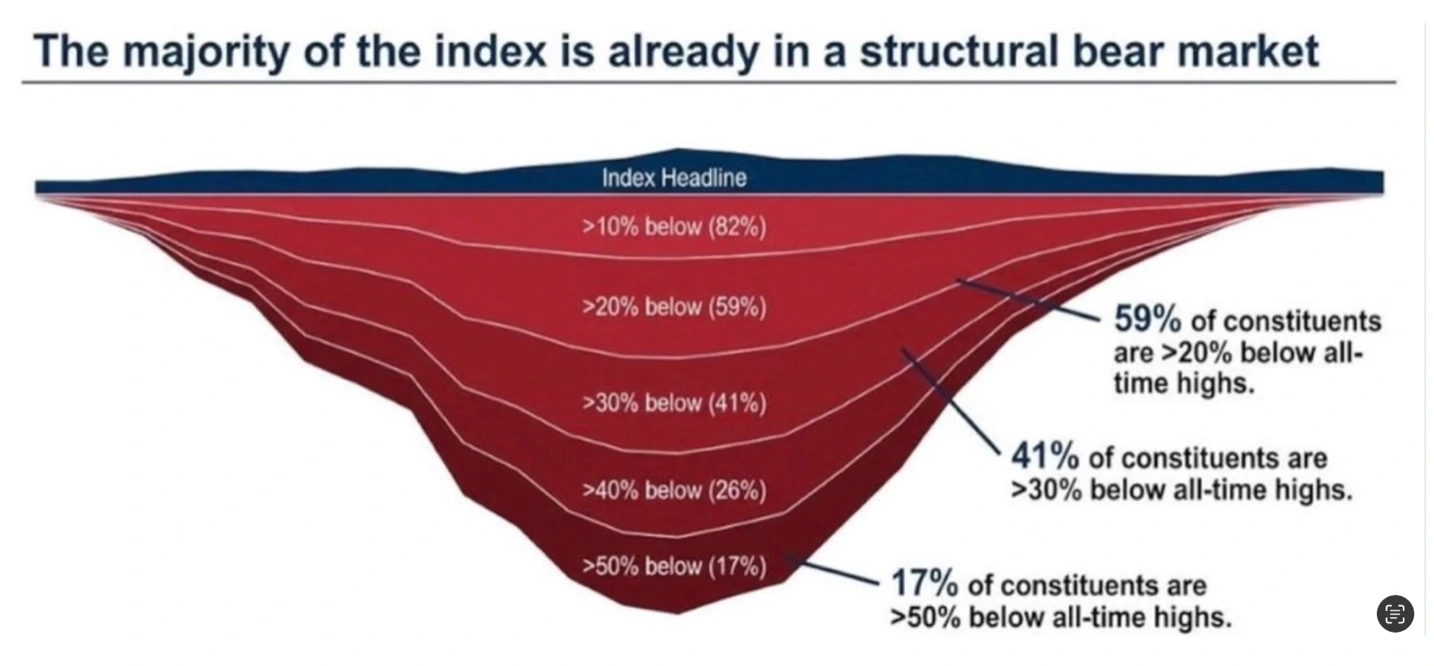
82% or this iceberg's mass is underwater...
My friend Jake Taylor sent me this chart, which does a nice job at illustrating the sheer number of stocks in major corrections, even as the S&P 500 hits all time highs with lower and lower market breadth. This is the type of market that occurred in the late 90's, and I think it presents a great opportunity for stock pickers over the coming years, just as it did then.
There is always something to do, to quote Peter Cundhill, who wrote my favorite investing book titled after this idea. Investors shouldn't become beholden to style boxes or predefined strategies. Like Buffett, John Neff, Peter Lynch and other greats, Peter Cundhill invested in a variety of different stocks. He would look for countries that performed the worst and go visit those countries looking for value. Today, sourcing ideas is much easier. The edge remains being willing to invest when others fear near-term losses. That edge is greater today than it ever has been. Technology and speed of information has increased, not decreased this behavioral edge.
I'm always amused when I see investors saying there is no edge in large caps. I've written a lot about how large cap stocks move around much more than intrinsic value, which provides opportunity for long-term investors (e.g. AAPL, NFLX, META, JPM and a few examples).
I also invest in Walter Schloss type bargains when they're available: thrift conversions, Japanese net nets, mineral royalties and a variety of small special situations. Both camps present lots of great opportunities at times.
I think the key to long-term success (in the front office or as the portfolio manager) is to not get caught up in what others view as accepted practice. The crowd is often right, but don't accept that it is right or wrong based on what conventional wisdom says. Make your own decisions. Don't outsource your thinking, even to others who might be smarter or more experienced than you. When everyone piles into the same idea, that idea may no longer offer you any advantage.
Managing a baseball team and an investment portfolio have these things in common.
Next few posts will contain some updates on a few past investment writeups, as well as some upcoming new ideas.
Thanks for reading!
John Huber is the founder of Saber Capital Management, LLC. Saber manages an investment fund modeled after the original Buffett partnerships.
John can be reached at [email protected].
Disclaimer:
John Huber and clients of Saber Capital own NFLX, GDOT, CPRT. This is not a recommendation. Our investments may change at anytime without further notice. This article is for educational purposes only. I enjoy writing about investments and exchanging ideas with readers, but nothing here should be considered a recommendation. I make mistakes and cannot make any warranties or guarantees about the performance or accuracy of anything on this site. We are long-term investors who are not concerned with near term results. Please conduct your own due diligence, take your time doing your research and only act when you have developed conviction based on your own understanding and your own work.
Please see full disclaimer here.
1 98+ mph exit velocity and a 26-30 degree launch angle
2 47% of balls in play were ground balls; usually not desirable, the Rays discovered ground balls in certain spots (opposite field) took advantage of modern defensive shift positioning
3 Rays made contact of 86% of pitches swung at inside the strike zone
[Source: Base Hit Investing.]

Legal Disclaimer:
MENAFN provides the
information “as is” without warranty of any kind. We do not accept
any responsibility or liability for the accuracy, content, images,
videos, licenses, completeness, legality, or reliability of the information
contained in this article. If you have any complaints or copyright
issues related to this article, kindly contact the provider above.


Comments
No comment