


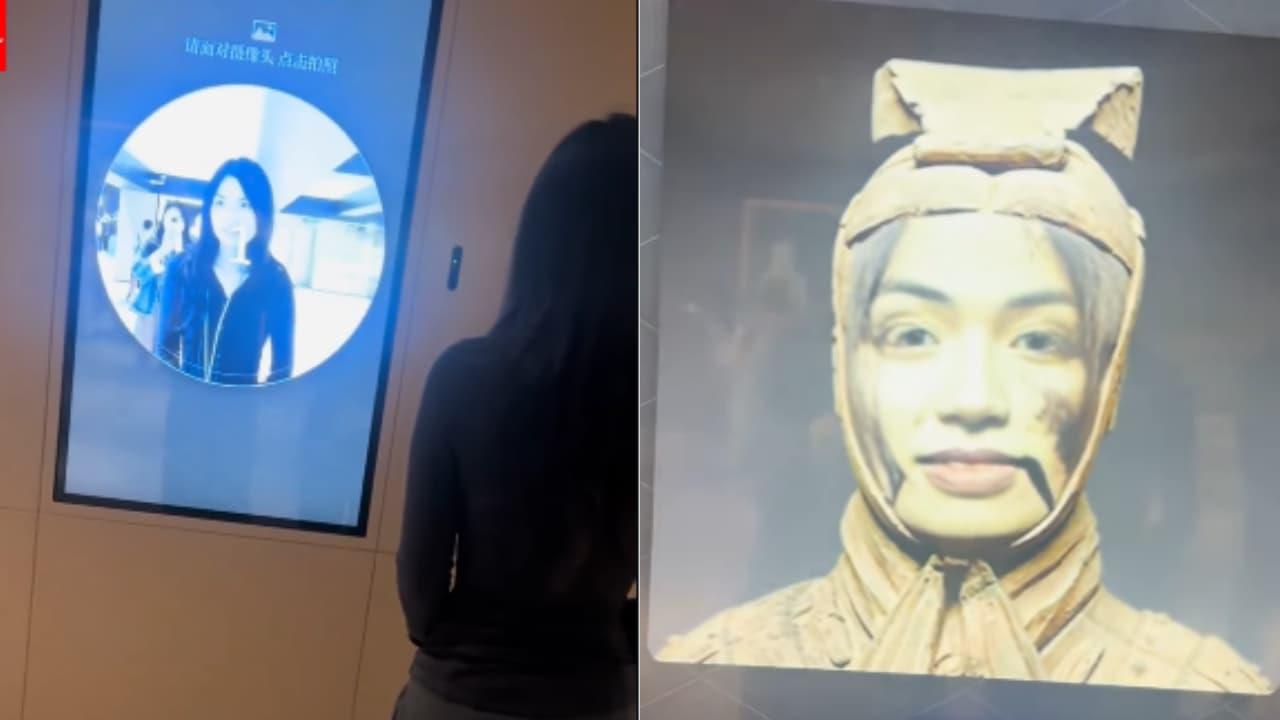
WATCH: Tourist Left In Stitches After China's Museum AI Transforms Her Face Into Clay Warrior


In what is being dubbed the most brutally honest museum filter on the internet, a tourist at the Terracotta Warriors Museum in Xi'an, China, has gone viral after an interactive AI exhibit turned her selfie into a devastatingly realistic 2,000-year-old clay soldier.
In a video that went viral on social media, a woman was seen standing in front of a massive digital display inside the Emperor Qingshihuang's Mausoleum Site Museum. As the built-in camera scanned her face, the interactive AI system went to work, attempting to mold her features into a historically faithful warrior from the Qin Dynasty.
Since China is known for its innovation and advanced technology, especially in Artificial Intelligence, the AI booth at the museum has gained immense popularity by blending historical authenticity with modern viral culture.
Also Read:101-Year-Old Chinese Man Loves Coke, Sprite And Seafood; His Lifestyle Amazes Internet
How AI Recreates Ancient Realism?
Emperor Qingshihuang's Mausoleum Site Museum, which is located in Xi'an, Shaanxi province, is home to the world-famous Terracotta Army, a collection of thousands of life-sized clay soldiers, horses, and chariots buried with China's first emperor to protect him in the afterlife.
Now, the museum has installed an interactive AI in order to engage with tourists in unprecedented ways, bridging ancient heritage with viral social media moments. One such recent tourist captured the internet's attention after trying the interactive facial-mapping booth.
In a video posted by China Insider on its Instagram handle, a woman who was captivated by the sheer accuracy of the software apparently burst into laughter after her face transformed into a stone-faced clay figure right before her eyes.
View this post on InstagramA post shared by China Insider (@chinainsider)
The integration of cutting-edge technology into historical preservation and tourist experiences highlights how artificial intelligence can bridge ancient heritage with viral internet culture. The Terracotta Warriors Museum has found a new way to immerse visitors, making ancient history remarkably personal, accessible, and shareable for audiences worldwide.
Since Emperor Qingshihuang's Mausoleum Site Museum continues to draw millions of visitors across the globe every year, interactive installations like this ensure that the legacy of China's First Emperor lives on in delightfully unexpected ways for generations to come.
When Did Emperor Qingshihuang's Mausoleum Site Museum Open?
The Qin Dynasty, or the Qin Shi Huang Mausoleum complex, has a rich history that began over two millennia ago, when construction on the Emperor's tomb started in 246 BC. Following the accidental discovery of the subterranean army by local farmers in 1974, the initial Museum of the Terracotta Warriors and Horses opened over Pit 1 in October 1979.
According to historical accounts, the farmers were digging a well during a drought in March 1974 when they excavated fragments of clay figures and bronze arrowheads, accidentally discovering the Terracotta Army, one of the most significant archaeological finds of the 20th century.
The discovery led to extensive excavations, retrieving thousands of life-sized warriors, horses, and chariots buried near the mausoleum of China's first emperor, Qin Shi Huang. This led to the eventual establishment of the Terracotta Army Museum, which officially opened to the public in 1979.
In 1987, the site was inscribed as a UNESCO World Heritage Site and recognised for its outstanding universal value as an archaeological site, preserving thousands of life-sized terracotta figures and offering insights into the military organization, craftsmanship, and burial practices of China's Qin Dynasty.
Also Read:Chinese Woman Travels To Antarctica After Cancer Diagnosis, Returns To Find Tumour Had Shrunk

Legal Disclaimer:
MENAFN provides the
information “as is” without warranty of any kind. We do not accept
any responsibility or liability for the accuracy, content, images,
videos, licenses, completeness, legality, or reliability of the information
contained in this article. If you have any complaints or copyright
issues related to this article, kindly contact the provider above.


Comments
No comment