


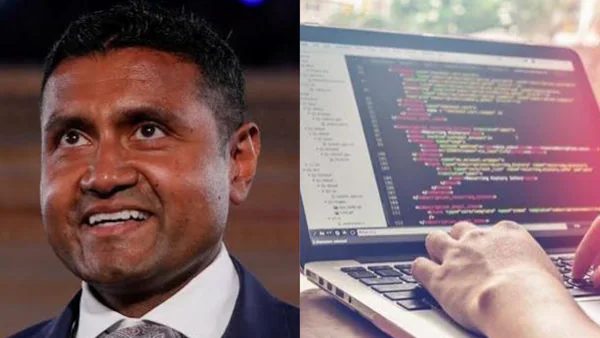
US Army Looking For Coders Within Its Ranks: Palantir CEO Shyam Sankar Reveals His Role As Lieutenant Colonel


Speaking to CBS News about his responsibilities in the Army, Sankar said his primary assignment was to work on human resource strategies within the military's G-1 department, with a particular focus on finding soldiers with exceptional coding abilities.
“My principal role is to help with Army human resourcing in the G-1 department here. So, strategies on how do we, you know, the Army is drowning in talent, what we would call green suiters who actually know how to code, and they're- they're- they're exceptional. How do we employ them? You know, they don't fit in the kind of industrial era model, the Napoleonic codes. Their skills are kind of rank blind,” he told CBS News.
He added, "You might have an E-4 who's an exceptionally good coder. There's not an obvious career path for them within the Army. The Army doesn't know how to manage that talent. So, how do we identify who these exceptional people are? How do we protect them? How do we put them on projects that fully utilize their skills and turn them into valuable assets for- for the military?"
Palantir CTO accuses China of using US AI firms' workSankar alleged that China has built a new generation of artificial intelligence models by using the work of Silicon Valley AI developers without authorisation, creating a potential economic challenge for the United States.
Also Read | Zoho cancels salary hike- Sridhar Vembu cites rising AI costs“These Chinese open source models are really the result of distillation attacks,” Sankar said during an interview with Bloomberg Television in July, on the sidelines of a defence innovation conference in Pennsylvania.“Most of this is just stolen American IP from frontier labs," he said.
Sankar's remarks reflect growing apprehension among leading US AI companies that Chinese competitors are exploiting a technique called distillation to develop rival models.
The process involves training one AI system using the outputs generated by another, allowing developers to replicate similar capabilities at a substantially lower cost. This can help newer models acquire the abilities of more advanced systems without having to undertake the same level of expensive training.
Also Read | Why Forward Deployed Engineers can earn up to ₹1.55 crore in IndiaSankar urged major US AI laboratories to strengthen safeguards around their intellectual property, arguing that protecting their technology was also in their own financial interest. He said such measures were necessary to prevent competitors from benefiting unfairly from their investments in AI development.
Who is Shyam Sankar?Shyam Sankar serves as the chief technology officer and an executive at Palantir Technologies. The son of Indian immigrants who operated a souvenir store in Orlando, he has risen to become a billionaire and a key figure at one of the world's most influential artificial intelligence companies.
Also Read | Will anybody use AI as much as coders?Born in Mumbai and brought up in Orlando, Florida, Sankar's background reflects the journey of an immigrant family that built its life in the United States. His father, who grew up in a mud hut in Tamil Nadu, was the first member of the family to pursue higher education. After spending some time in Nigeria, the family relocated to the US, where they ran souvenir and dry-cleaning businesses. Their dry-cleaning venture eventually went bankrupt.
In 2024, Sankar wrote a widely discussed paper advocating the dismantling of the dominance enjoyed by major military contractors. He noted that creating space for smaller, more agile and technologically advanced companies could help transform the defence industry.
He became part of the US Army Reserve's Executive Innovation Corps, an initiative aimed at bringing private-sector expertise into military and national security operations. The programme seeks to make the armed forces“leaner, smarter, and more lethal”.

Legal Disclaimer:
MENAFN provides the
information “as is” without warranty of any kind. We do not accept
any responsibility or liability for the accuracy, content, images,
videos, licenses, completeness, legality, or reliability of the information
contained in this article. If you have any complaints or copyright
issues related to this article, kindly contact the provider above.


Comments
No comment