


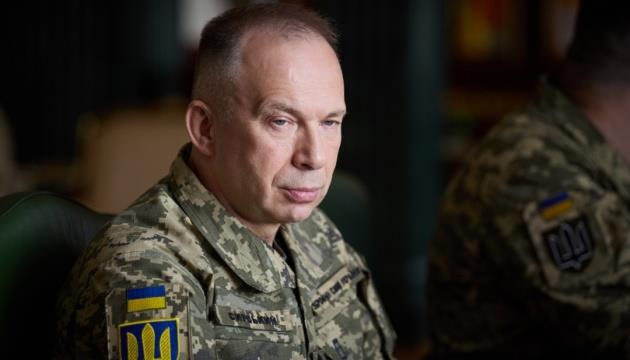
Syrskyi Says Redeploying Troops From Kursk Would Not Have Changed Situation Near Pokrovsk


"No, it would not have been better. The point is that in the Kursk sector, the offensive grouping consisted of only three understrength Air Assault Forces brigades and two assault battalions," he said in response to a question about whether the resources should instead have been directed toward defending the eastern front.
According to Syrskyi, only one brigade took part in the offensive at full strength. Two other brigades initially operated with two battalions each, while the 95th Brigade had just emerged from heavy fighting in the Toretsk sector before the operation.
Other units involved in the operation were tasked with consolidating and holding the captured territory. Their personnel strength stood at approximately 60–70% of full capacity.
"So, if they had been deployed in the Pokrovsk sector-and we consider the Pokrovsk sector to include two directions, Dobropillia and Pokrovsk-the Russians had nearly 100,000 troops concentrated there. Those two brigades, and then another brigade, would not have made any difference, given their technical condition," the former commander-in-chief explained.
He said Ukraine's military leadership chose the Kursk direction after assessing the entire front line.
In early summer 2024, Russia was advancing along 13 operational axes, with its forces enjoying a numerical advantage of between 4.5 and six to one in some areas. At the same time, Russian defenses in the Sumy region had weakened after troops were redeployed to the Kharkiv direction.
"But the defenses in the Sumy sector had been significantly weakened, and there were virtually no active troops there. That is precisely why I made the decision to launch the offensive operation, which was approved by the President of Ukraine," Syrskyi said.
Read also: Khmara introduces Drapatyi and Skybiuk to General Staff leadershipAccording to him, within a month, Ukrainian troops had taken control of 1,273 square kilometers of Russian territory.
Russia redeployed approximately 70,000 troops to the Kursk region, and its offensive operations came to a halt across all operational and strategic directions except Pokrovsk.
"This effectively gave us the opportunity to prepare reserves, give our troops a respite, and restore the combat effectiveness of units that had suffered losses in such intense fighting," Syrskyi said.
He added that Russian defenses in the Kursk sector had been weak. Border-guard units consisted primarily of conscripts and were spread thinly along the front, with individual positions separated by 10–12 kilometers.
After the Ukrainian offensive began, Russian forces redeployed units in a chaotic manner. Those units entered combat almost immediately and suffered significant losses.
According to Russian figures cited by Syrskyi, on some days the casualty ratio in the Kursk sector was one to five, unfavorable to Russian forces.
As previously reported, Ukrainian forces launched an operation in Russia's Kursk region on August 6, 2024, crossing the state border near the towns of Sudzha and Korenevo.
Photo: Office of the President of Ukraine

Legal Disclaimer:
MENAFN provides the
information “as is” without warranty of any kind. We do not accept
any responsibility or liability for the accuracy, content, images,
videos, licenses, completeness, legality, or reliability of the information
contained in this article. If you have any complaints or copyright
issues related to this article, kindly contact the provider above.


Comments
No comment