


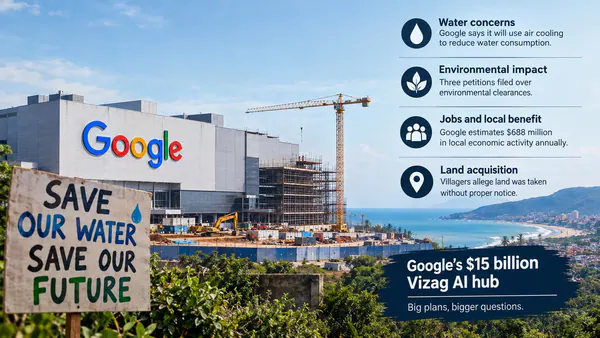
Google Defends $15 Billion Vizag AI Hub As Water Fears, Land Disputes And Protests Put Project Under Scrutiny


The project, described by the company as its largest AI hub outside the United States, has attracted protests from residents and environmental campaigners over water availability, land acquisition, ecological risks and the number of jobs likely to reach local communities.
Alexander Smith, Google's head of infrastructure and energy for Asia-Pacific, told Agence France-Presse (AFP) that the company had assessed the local watershed before selecting its cooling technology. The findings indicated pressure on local water resources, he said, prompting the decision to use air cooling.
Smith said Google conducts independent environmental assessments 12 to 24 months before a project begins, examining factors including power supply, grid stability, water risks, ecology and noise.
Also Read | Google Fitbit Edge tracker to launch on October 12: All you need to knowThe facility is expected to become operational in 2028 and forms part of Google's planned $15 billion investment in India over five years, from 2026 to 2030.
Water and environmental concerns persistGoogle's assurances have not ended opposition to the project. Residents fear that the data centre, alongside other proposed facilities in the region, could put additional pressure on electricity supplies, affect local ecosystems and worsen existing water shortages.
The company has pledged to replenish 120 per cent of the freshwater used for non-cooling needs across its operations by 2030. Smith also said Google would fund required power infrastructure upgrades and invest in additional clean-energy projects in Visakhapatnam.
However, environmental campaigners are seeking greater transparency over the project's potential impact. According to The Guardian, three petitions challenging its environmental clearances have been filed before the National Green Tribunal, alleging that assessments of environmental and water-related risks were inadequate.
Land acquisition has also become contentious. Some villagers in Tarluvada have alleged that land was taken without adequate notice and that promised benefits have not materialised. The Andhra Pradesh government has disputed claims of forcible acquisition, saying eligible residents received compensation.
Jobs and economic benefits under scrutinyEmployment is another point of disagreement. Google estimates that a development of this scale could generate around $688 million in local economic activity annually.
It says a typical data centre project employs about 4,200 construction workers a year during a three-to-five-year building period and supports hundreds of specialist on-site roles once operational.
The Andhra Pradesh government has projected 188,000 direct and indirect jobs from the development. Campaigners, however, question whether a capital-intensive industry will provide enough employment for residents who need work on a much larger scale.
Gutta Rohith of the Human Rights Forum told AFP that the region needed mass employment and labour-intensive industries rather than investments that generate comparatively fewer permanent jobs.
Also Read | TCS Q2 results 2026: Top 13 highlights from September quarterThe dispute reflects a wider question facing communities hosting large technology projects: whether the economic gains will be shared locally while residents bear the environmental and social costs.
Google has described the investment as a multi-decade commitment, pointing to Visakhapatnam's connectivity and access to international submarine internet cables as advantages for building an AI and digital infrastructure hub.
For now, the company's air-cooling pledge addresses one of the most prominent concerns, but questions over land, environmental clearances and employment remain unresolved. The project's progress will be watched closely as India expands its data centre capacity to meet growing demand for AI computing.

Legal Disclaimer:
MENAFN provides the
information “as is” without warranty of any kind. We do not accept
any responsibility or liability for the accuracy, content, images,
videos, licenses, completeness, legality, or reliability of the information
contained in this article. If you have any complaints or copyright
issues related to this article, kindly contact the provider above.


Comments
No comment