


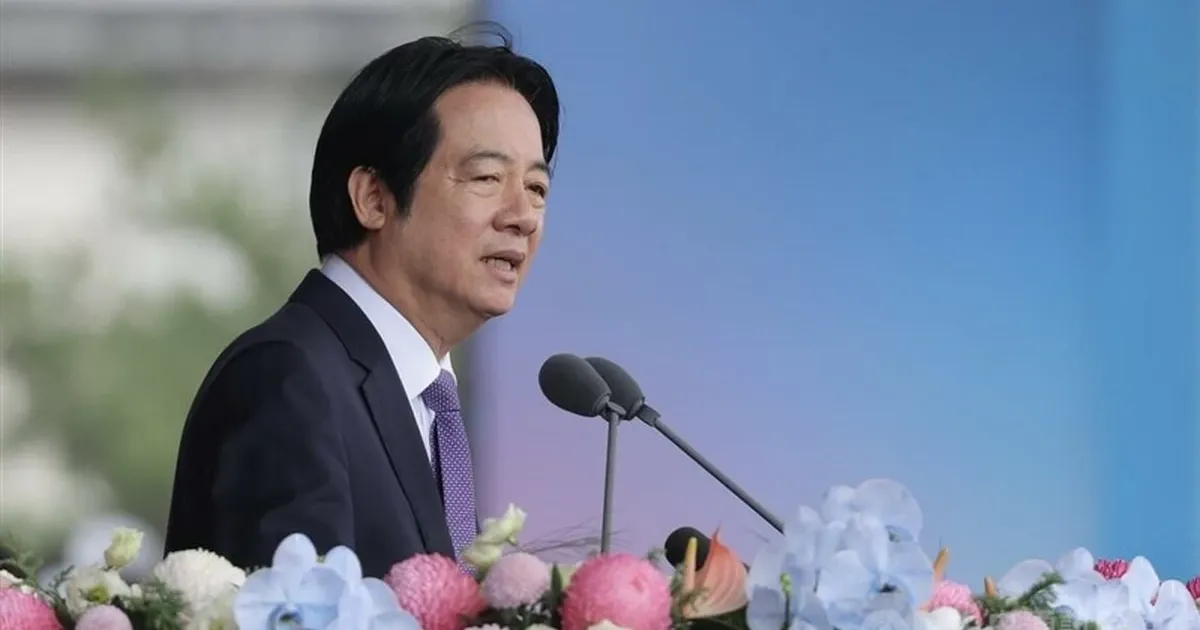
Lai Ching-Te Calls On Indo-Pacific Democracies To Safeguard Regional Stability, Stressing That Strengthening Taiwan's Defences Is Intended To Deter War, Not Provoke China


Speaking at a National Day ceremony outside the Presidential Office Building in Taipei, Lai said Taiwan was committed to peace but would not give up its freedom.
Taiwan was open to exchanges and communication, he added, but would not accept subordination.
Lai called on democracies across the Indo-Pacific to work together to preserve regional peace and stability, warning against any attempt to change the status quo across the Taiwan Strait by force. His remarks came as the island faces mounting military and political pressure from China, which considers Taiwan part of its territory.
The president said increased defence spending was not intended to provoke any party but to deter war. Strengthening Taiwan's self-defence, he argued, did not mean abandoning dialogue. Rather, it was intended to create conditions for negotiations on an equal footing that respected the dignity of all parties.
Lai said preserving regional security and stability required a proper understanding of history and respect for the right of Taiwan's people to exist and determine their own future. He stressed that military power should not override international rules and that stronger countries had no right to deprive other peoples of the ability to shape their own destinies.
Defence and security at the centre of Taiwan's political message
Lai devoted a substantial part of his address to the security challenges facing Taiwan, referring to continued Chinese pressure through military movements and activities he described as taking place in the grey zone, aimed at changing the status quo across the Taiwan Strait.
He said his administration would continue to reform Taiwan's defence system, develop asymmetric military capabilities and strengthen the domestic defence industry, drawing on the island's expertise in semiconductors, information and communications technology, and precision manufacturing.
The government's plans also include strengthening society's overall resilience during crises through coordination between the central government, local authorities and civil society. The aim is to ensure the continued operation of essential sectors, including energy, communications, transport, finance, food supplies and healthcare, during emergencies.
The president thanked the armed forces, reservists, police, firefighters, medical personnel, civil defence teams and citizens participating in preparedness exercises, describing advance planning as a key line of defence for peace.
On diplomacy, Lai welcomed efforts by the United States and China to manage their rivalry through dialogue and reduce the risk of conflict and war. However, he stressed that the status quo in the region must not be changed by force, urging Asian democracies to work together to safeguard stability.
Strong economic growth, but pressure to deliver benefits to citizens
On the economic front, Lai highlighted what he described as strong performance by Taiwan's economy. He said growth reached 14.15 per cent in the first half of 2026 and could exceed 11 per cent for the full year. If achieved, that would represent the highest annual growth rate in 39 years.
He projected that Taiwan's gross domestic product per capita would reach US$45,332 this year. He also said the benchmark stock index had surpassed 49,000 points, making Taiwan the world's fourth-largest stock market by market capitalisation, according to figures presented in his address.
Lai also pointed to Taiwan's improved standing in the global competitiveness rankings published by Switzerland's International Institute for Management Development, saying the island had reached fourth place worldwide, its highest position according to the figures he cited.
However, the president linked continued economic progress to the government's ability to improve living standards. He said national development should not be measured solely by production and exports, but also by higher wages, a lighter financial burden on families, better care for older people and greater confidence among young people that hard work can lead to a better future.
According to the address, the government intends to continue policies aimed at raising wages, reducing taxes, expanding social benefits and easing the cost of living. It also plans to support small and medium-sized enterprises and develop technology industries alongside traditional manufacturing.
Support for families, young people and older citizens
Lai outlined a series of social measures aimed at addressing declining birth rates, rising living costs and housing pressures, as well as the challenges associated with an ageing population.
He said the government planned to introduce monthly payments of NT$5,000 for every child from birth until the age of 18, beginning next year. The proposal forms part of a broader package covering maternity and childbirth support, expanded childcare services and social housing for newly married couples and families with young children.
Lai said families should not have to bear the full cost of raising children on their own, describing support for parents as an investment in Taiwan's future.
In healthcare, he highlighted plans to expand early cancer screening, smart healthcare services and home-based care, while improving working conditions for healthcare professionals and increasing the nursing workforce.
He also discussed the development of a long-term care programme designed to integrate health, social and technological services. The goal is to allow older people to receive care in familiar surroundings while reducing the pressure on families responsible for looking after both elderly parents and children.
On housing, Lai pledged to continue rental assistance programmes, increase the supply of social housing and expand affordable housing loans for young people and young families.
The president also addressed online fraud, drugs and drug-impaired driving, saying that protecting citizens' money and personal safety was part of the government's responsibility.
Semiconductors and artificial intelligence at the heart of Taiwan's growth strategy
Looking ahead, Lai said the government would continue developing 13 strategic industries, including semiconductors, artificial intelligence, defence and security industries, and next-generation communications.
Other areas highlighted in the address included quantum computing, robotics and silicon photonics, alongside biotechnology, healthcare, critical minerals, infrastructure, and cultural and creative industries.
Lai said the government would continue supporting small and medium-sized enterprises through a comprehensive financing and development plan covering training, digital transformation, carbon reduction and improved access to international markets.
He stressed the need to extend the benefits of technological progress to traditional industries and ensure that the overseas expansion of Taiwanese companies also strengthens domestic production and supply chains.
On financial and social policy, he referred to plans for a general cash payment of NT$10,000 per person next year, alongside additional social benefits for older people, farmers and vulnerable families, as part of what he described as an effort to ensure that citizens share in the benefits of economic growth.
A“city upon a hill” and Taiwan's message to the world
Lai titled his address“Taiwan's Future: A City upon a Hill, the Salt and Light of the World,” drawing on a well-known expression from Christian tradition to present his vision of Taiwan as a society built on democracy, innovation, equality and solidarity.
He said the concept was not intended as an exercise in self-praise, but rather reflected Taiwan's aspirations and responsibilities in a world facing wars, the expansion of authoritarian systems and rapid changes in the international order.
The president reviewed milestones in Taiwan's democratic development, noting that this year marks the 30th anniversary of the island's first direct presidential election. He said Taiwan's experience had demonstrated that democracy and economic development could coexist.
Lai also highlighted Taiwan's international relationships, citing cooperation with Eswatini in energy, agriculture, healthcare, education and culture, as well as Vice President Hsiao Bi-khim's visit to Palau to strengthen bilateral ties.
He said Taiwan sought to expand its international partnerships in healthcare, agriculture, energy, technology, education and sustainable development, and intended to share its experience with partners while contributing to solutions to common challenges.
At the end of his address, Lai urged Taiwanese citizens to preserve national unity despite political differences, particularly as local elections approach. He said competition between political parties and differences of opinion should not lead to divisions within society.
Taipei hosted National Day celebrations on Saturday, known as Double Ten Day, attended by Taiwanese officials, foreign guests and international delegations, including Eswatini's King Mswati III and a Japanese parliamentary delegation.
The annual occasion commemorates the 1911 uprising that led to the overthrow of China's last imperial dynasty and the establishment of the Republic of China, the official name still used by Taiwan.
This year's address comes as Taiwan seeks to balance the strengthening of its military capabilities, the preservation of communication channels with major powers and continued economic growth, amid persistent tensions with Beijing over the island's future and its position in the region.

Legal Disclaimer:
MENAFN provides the
information “as is” without warranty of any kind. We do not accept
any responsibility or liability for the accuracy, content, images,
videos, licenses, completeness, legality, or reliability of the information
contained in this article. If you have any complaints or copyright
issues related to this article, kindly contact the provider above.


Comments
No comment