


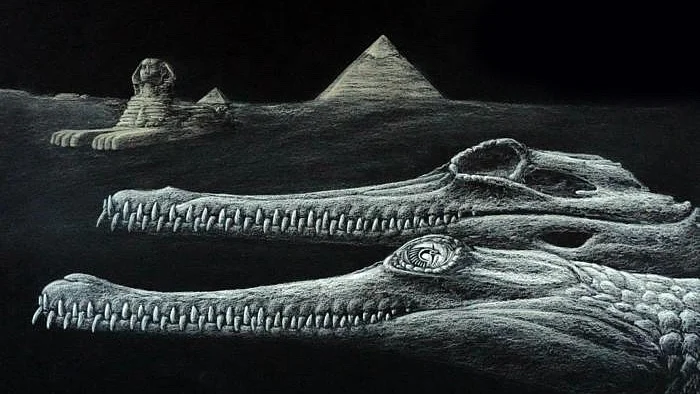
45-Million-Year-Old Crocodile Discovered In Egypt: What Did Scientists Find?


Scientists have identified the extinct animal as Herugavialis cairensis, a previously unrecognised genus of long-snouted crocodilian that once lived in the warm, shallow waters covering what is now northern Egypt.
Recommended For YouBut the discovery comes with an unusual connection to one of Egypt's most famous monuments. The fossil was found in the Mokattam Formation near Cairo, the same limestone formation whose rocks were used in the construction of the Great Sphinx of Giza.
And just like the Sphinx, the fossil crocodile is missing the tip of its nose. Here is what scientists discovered.
Stay up to date with the latest news. Follow KT on WhatsApp Channels. Where was the crocodile found?
The fossils were recovered from Gebel Mokattam, east of Cairo, during the 1920s. They included a nearly complete skull from the Mokattam Formation, a limestone formation dating to the Middle Eocene period around 45 million years ago.
At the time, northern Egypt looked very different from today. Much of the region was covered by warm, shallow marine waters connected to the ancient Tethys Ocean. These waters supported a variety of marine animals, including several types of crocodilians.
Why is it only being identified now?The fossil itself is not a new discovery. For almost a century, scientists believed it belonged to Tomistoma, the genus that includes today's false gharial, a long-snouted crocodilian found in Southeast Asia.
But researchers had increasingly questioned that classification. An international team from Egypt, the UK, Sweden and Germany returned to the fossil and examined it using modern techniques that were not available when it was first studied.
Researchers used CT scanning to look inside the skull and study features including its brain and nasal cavities. They then compared its anatomy with living and extinct relatives.
The analysis revealed several important differences, showing that the Egyptian fossil did not belong to Tomistoma. Scientists therefore placed it in a newly recognised genus, Herugavialis.
What did it look like?Herugavialis cairensis belonged to a group known as gavials, crocodilians known for their long, narrow snouts. The shape of the snout would have made the animal well suited to catching fish.
Only two gavial species survive today: the gharial and the false gharial, both found in Asia. But their fossil record tells a very different story.
Gavials once had a near-global distribution spanning more than 100 million years, and many ancient species lived in shallow marine environments rather than only freshwater habitats.
Why was it named after the Sphinx?The name Herugavialis refers to Heru, also known as Horus, the ancient Egyptian god associated by some scholars with the Great Sphinx. Researchers chose the name because the crocodile fossil came from the same geological formation used for the Sphinx.
There was also another coincidence. The fossil skull is missing the front of its snout, while the Great Sphinx is famously missing its nose.
Professor Philip Mannion of University College London, who co-led the study, said the similarity helped inspire the new name. The second part of its scientific name, cairensis, refers to Cairo.
Were crocodiles really swimming around Cairo?Yes, although the landscape would have been almost unrecognisable compared with modern Cairo. Around 45 million years ago, much of northern Egypt was covered by shallow marine environments.
Researchers say Herugavialis was not alone. At least two other gavial species lived in the region at around the same time. That suggests ancient Egypt supported a much greater diversity of crocodilians than exists there today.
The Mediterranean region continued to host various crocodilians for millions of years, with their diversity changing as global temperatures and sea levels shifted.
Crocodiles eventually disappeared from the Mediterranean region around six million years ago, around the time the Mediterranean experienced a major drying event known as the Messinian Salinity Crisis.
Why does the discovery matter?The finding helps scientists better understand how gavials evolved and spread around the world. Today, their surviving relatives are restricted to parts of South and Southeast Asia. Their fossils, however, have been discovered across a much wider geographical area.
By revisiting fossils collected almost a century ago with modern technology, researchers can correct earlier classifications and build a clearer picture of how these animals evolved.
The discovery also reveals another layer of Egypt's history. Long before the pyramids or the Great Sphinx were built, the rocks beneath modern Cairo were forming in a warm ancient sea where long-snouted crocodilians hunted for fish. Millions of years later, those same rocks would become part of one of the world's most recognisable ancient monuments.
ALSO READ- Brazil fossil lost for 20 years helps identify new reptile species from 240 million years ago No mouth or organ: 560-million-year-old animal fossil found in Norwegian sheep field Could Nefertiti be hidden beyond Tutankhamun's tomb? New scans revive mystery

Legal Disclaimer:
MENAFN provides the
information “as is” without warranty of any kind. We do not accept
any responsibility or liability for the accuracy, content, images,
videos, licenses, completeness, legality, or reliability of the information
contained in this article. If you have any complaints or copyright
issues related to this article, kindly contact the provider above.


Comments
No comment