


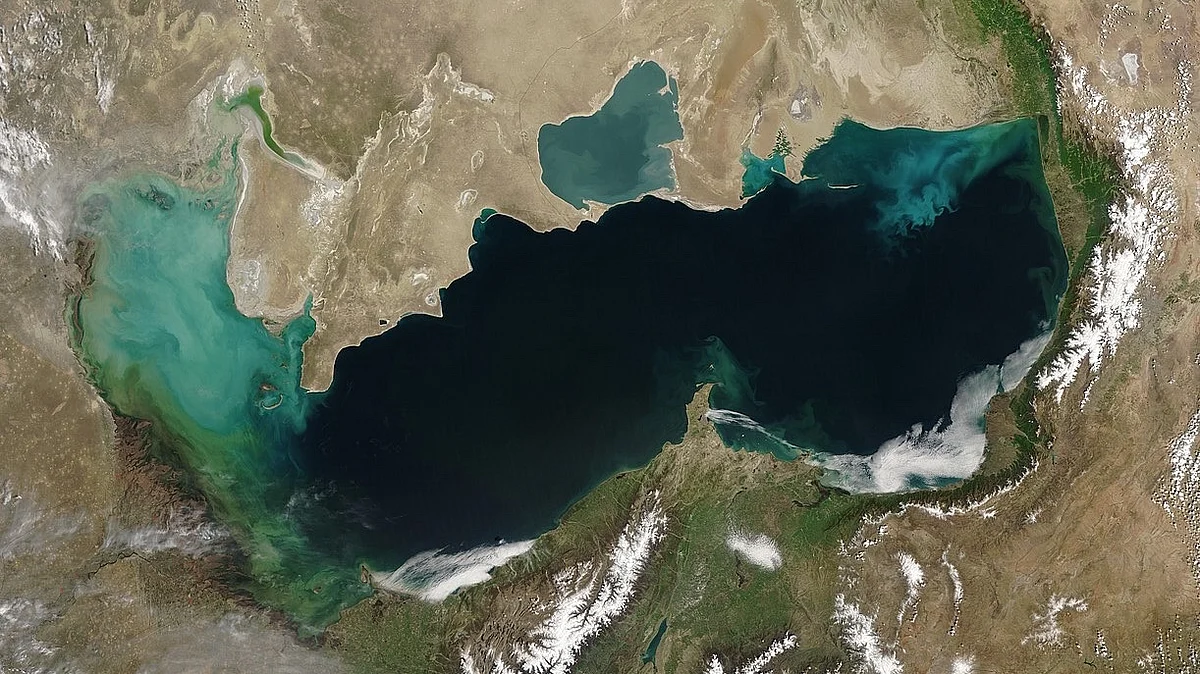
A New Island Has Appeared In Caspian Sea, But Scientists Say It's Bad News


The small island was spotted near Kulaly Island during a recent aerial survey of the northern Caspian, where falling water levels are exposing areas of seabed that were previously underwater.
Recommended For YouIt is not the only one. Several new islands have appeared in the area over the past four to five years, some stretching around one kilometre in length. Their emergence is one of the clearest signs of a much bigger problem: the Caspian Sea is shrinking.
So why is the world's largest inland body of water losing water, how quickly is it happening and could parts of it face a future similar to the Aral Sea?
Stay up to date with the latest news. Follow KT on WhatsApp Channels. Where did the new island come from?
The latest island was spotted near Kulaly Island along Kazakhstan's Caspian coast. Environmental activist Daniyar Akimzhanov, who was involved in the aerial survey, said it was actually one of the smaller newly exposed islands he had documented in recent years.
Some of the larger formations are around one kilometre long and between 200 and 300 metres wide. Wildlife has already begun reaching some of the newly exposed land, including wild boars and wolves.
But scientists say not every exposed area will necessarily remain an island. Waves, winds, the shape of the seabed and future changes in water levels could determine whether they survive, expand, reconnect with the mainland or disappear beneath the water again.
How quickly is the Caspian Sea shrinking?The decline is particularly visible in Kazakhstan's shallow northern and north-eastern Caspian.
According to observations cited by the Kazakh Research Institute of the Caspian Sea, water levels in the country's sector fell by about 2.45 metres between 1996 and 2025.
At the Kulaly Island monitoring station, the average level reached minus 29.42 metres in July 2026, the lowest recorded during the study period.
Because the northern Caspian is extremely shallow and its seabed has a gentle slope, even a relatively small vertical decline can push the shoreline back over a much greater horizontal distance.
Recent satellite research found that the shoreline retreated by more than 20 kilometres in some areas of Kazakhstan's north-eastern Caspian between 2016 and 2025.
Why is the Caspian Sea losing water?There is no single cause. The Caspian Sea is a closed basin with no natural outlet to the world's oceans. Water enters mainly through rivers and precipitation and leaves largely through evaporation.
The Volga River in Russia is especially important, providing most of the river water entering the Caspian. A 2026 study combining satellite observations with hydrological records found that total river inflow into the Caspian has declined significantly over recent decades, largely because of reduced flow from the Volga.
Climate change is adding another pressure. Higher temperatures increase evaporation from the sea, while human activity also affects how much river water eventually reaches it.
Dams, reservoirs, irrigation and other water use across the wider basin can alter river flows. Scientists therefore describe the decline as the result of a combination of climate and human pressures rather than one isolated factor.
Has the Caspian Sea changed like this before?Yes. The Caspian has naturally risen and fallen throughout its history. Its level dropped by around three metres between the 1930s and 1977 before rising again by about 2.5 metres over the following two decades.
It later began another period of decline. But researchers say the current retreat is increasingly being influenced by human activity and a warming climate, raising concerns that the decline could continue for decades.
Could it become another Aral Sea?Not entirely. The Aral Sea, once one of the world's largest lakes, dramatically shrank after rivers feeding it were diverted for irrigation.
Scientists do not expect the entire Caspian Sea to disappear in the same way because its central and southern sections are much deeper.
But the northern Caspian is different. Its shallow waters mean a continued fall in water level could expose huge areas of seabed.
Researchers warn that parts of this northern region could face conditions resembling what happened around the Aral Sea, with major shoreline retreat and the loss of aquatic habitats.
What does this mean for wildlife?The Caspian Sea is home to species found nowhere else, including the endangered Caspian seal. Its population has already fallen dramatically from historical levels.
Shrinking water is creating an additional threat by changing the islands and ice habitats seals use for resting, moulting and breeding. Some isolated islands used by seals have expanded as the water retreats and eventually connected with the mainland.
Once that happens, seals can lose the isolation that protects them from people and land predators. Warmer winters also threaten the stable ice used by Caspian seals to give birth. Sturgeon, wetlands and other species dependent on the Caspian ecosystem could also be affected as habitats move or disappear.
What about people living around the Caspian?The consequences extend far beyond wildlife. The Caspian is bordered by Kazakhstan, Russia, Azerbaijan, Iran and Turkmenistan and supports fisheries, shipping, energy infrastructure and coastal communities.
As shorelines retreat, ports and other infrastructure built for previous water levels may find themselves increasingly far from usable water.
Fisheries and wetlands can also be disrupted. A 2025 study warned that a decline of just five to 10 metres could severely disrupt important ecosystems and leave billions of dollars of civil and industrial infrastructure obsolete.
Can anything be done?Yes. The five countries surrounding the Caspian cannot completely prevent changes driven by a warming climate, but researchers say human decisions can influence how severe the decline becomes.
Better management of river water, particularly across the Volga basin, could help reduce additional pressure. Scientists have also called for stronger monitoring, data sharing and cooperation between the five Caspian states.
Kazakhstan is pushing for an interstate programme to preserve the Caspian's water resources, while regional governments are working on measures to improve monitoring and adapt infrastructure and ecosystems to changing water levels.
The newly emerged island near Kazakhstan may be small. But scientists say it is another visible sign of a transformation taking place across the Caspian, where every metre of disappearing water can reshape kilometres of coastline.
ALSO READ- Vast reserves, but little to drink: Tajikistan's water struggles UAE's heat-tolerant coral reefs face new threat as climate change intensifies Filipino typhoon survivors sue Shell over climate change

Legal Disclaimer:
MENAFN provides the
information “as is” without warranty of any kind. We do not accept
any responsibility or liability for the accuracy, content, images,
videos, licenses, completeness, legality, or reliability of the information
contained in this article. If you have any complaints or copyright
issues related to this article, kindly contact the provider above.


Comments
No comment