

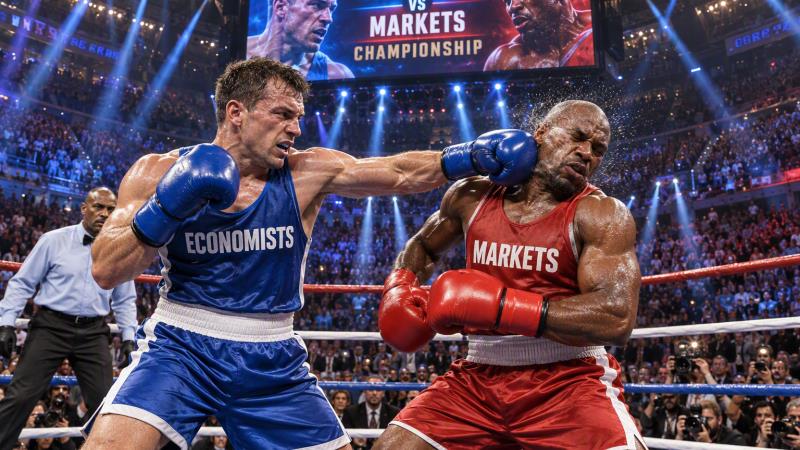
THINK Ahead: It's Economists Vs. Markets, And There Can Only Be One Winner


It won't have escaped your notice that, ever since the Iran War began, markets and economists have vehemently disagreed over the number of rate hikes we're going to get from central banks.
Markets are pricing in roughly three hikes from both the European Central Bank and the Federal Reserve by this time next year, whereas we're expecting just one from each. We're also expecting some modest rate cutting in late 2027 and 2028. Markets expect the opposite: higher rates in three years' time than in one.
It's the Herculean battle of our times (whoever said economists were dramatic?). So when will it get settled?
On the ECB at least, market pricing has been relatively accurate so far. Officials have largely behaved as investors expected, as the chart below shows. It's a very different story for the Bank of England, where markets have consistently priced hikes where there have (so far) been none. I think we'll call it 1-1 in the battle between economists and markets.
Markets have been about right on the ECB so far... Market expectations are interpolated from forward one-month swap dataSource: Macrobond, ING
">...while they've been completely wrong on the Bank of England Market expectations are interpolated from forward one-month swap dataSource: Macrobond, ING
">Who takes the upper hand next will depend heavily on energy markets. And frankly, the picture right now is confusing. Every day brings new headlines, both about the flood of oil seemingly going through the Strait of Hormuz, and an increasingly dangerous regional backdrop of tanker strikes and military threats. All the while, Brent crude is bouncing around US$100/bbl and natural gas remains worryingly high too.
What happens next matters for two reasons. First, swap rates, a proxy for central bank expectations, remain highly correlated to oil prices. Second, central banks believe the higher energy prices go, or the longer they stay high, the more likely we are to get second-round effects on inflation.
For us to be more right than markets on rate hikes, we either need energy prices to fall outright or the upside risks to be curtailed. Whether that requires another explicit deal between the US and Iran, or simply a few more weeks of the current status quo of decent oil flows, is an open question.
Central bank expectations have been highly correlated with oil prices Source: Macrobond, ING">
That's the first thing. The second is what the actual inflation data tells us. So far, there's very little sign, particularly in Europe, that the energy shock is broadening out into other areas of the inflation basket.
You can see that in“energy sensitive” prices, covering everything from airfares to cafés. These are the components most susceptible to higher oil and natural gas prices. So far, eurozone inflation for these goods and services hasn't risen at all.
That's not necessarily of huge comfort. My chart below shows these prices tend to lag direct energy costs by about six months, so it's only now that you should start seeing effects come through. That helps explain why the ECB hiked rates in September, while saying it couldn't see any second-round effects so far. It's an insurance policy for what could come next. Food inflation also started ticking up in September, albeit from a very low level.
Higher energy prices haven't spilled into other parts of the inflation basket – yet Energy sensitive inflation based on an ING calculation of a series proposed by the ECB after the 2022 energy shockSource: Macrobond, ING
">But the longer we go without any sizeable broadening of the energy shock, the more central bankers can relax. We already have a template from what happened here in the UK last year. Food prices drove inflation close to 4% in the autumn of 2025. The Bank of England turned more hawkish and rate cuts were delayed. But come February, the majority of BoE officials sounded the all-clear. Second-round effects had been averted.
We could see something similar in spring next year, even if energy prices haven't dipped much. Officials, particularly in Europe, could become more confident in calling the top of their rate hike cycles.
A lot will also depend on the broader financial backdrop. The surge in bond yields across Europe, led by France, has already led investors to price in around one less rate hike over the coming year. That makes sense: my eurozone colleagues reckon higher longer-term borrowing costs will have a similar impact on growth and inflation as one rate hike. And for all the focus on France, this is a global phenomenon, don't forget. The US 10-year yield has shot well past 5%.
For now, you'd imagine the ECB would prefer to deal with all this by adjusting its quantitative tightening programme over its more politically charged Transmission Protection Instrument. But in time, it's another reason for the ECB to tread more carefully on rate hikes.
Financial conditions are key for the Fed, too. This week's September minutes reminded us that some officials think conditions are too loose, pointing towards tight credit spreads and iron-clad stock prices. That tells us the Fed is hiking for slightly different reasons than the ECB, where it's almost singularly about energy. But it's also a reminder that a big stock-market correction next year, were one to happen, could quickly bring rate cuts back into play.
So, back to that original question: When will the debate between economists and markets get settled?
For my money, it's as we head through the first quarter of next year and into spring. By then, we'll (hopefully) have a better energy market situation. And our expectation is that inflation will remain calmer than some officials now fear. Plus, from early Q2, energy should become much less of a tailwind for headline inflation, as the early impact of the crisis drops out of the annual comparison.
Markets may well win a few more rounds before then. But come spring, we still think economists will win the fight. Not that I'm biased or anything, right?
James Smith
THINK Ahead in developed marketsUnited States (James Knightley)
-
September CPI (Wed): Financial markets are comfortable pricing in a 20% chance of a Federal Reserve interest rate hike at the October FOMC after central bank heavyweights Philip Jefferson, John Williams and Chris Waller all suggested that they are in no hurry to hike rates after the 25bp move in September. It would take an especially hot CPI report on 14 October to trigger a reaction. That is not beyond the realm of possibility given the sharp increase in gasoline prices and airline fares. Nonetheless, we still expect the Fed to wait until December before raising interest rates. Other data includes retail sales, where higher gasoline sales will be offset by weaker auto sales. Industrial production should rebound given strong manufacturing survey numbers after a surprise 0.3% drop in manufacturing output in August.
UK (James Smith)
-
August GDP (Thur): Output likely fell after two very strong readings across June and July. It's clear that AI has been a tailwind for UK activity recently, though we continue to emphasise that growth tends to be stronger in the first half of the year than the second. We expect energy prices to bite more noticeably too through the rest of the third and fourth quarters.

Legal Disclaimer:
MENAFN provides the
information “as is” without warranty of any kind. We do not accept any
responsibility or liability for the accuracy, content, images, videos,
licenses, completeness, legality, or reliability of the information
contained in this article. If you have any complaints or copyright issues
related to this article, kindly contact the provider above.
Comments
No comment