

403
Sorry!!
Error! We're sorry, but the page you were looking for doesn't exist.
Technology For Establishing A Permanent Seed Source For Small-Leaved Linden


(MENAFN- RCTT)
The Institute of Forest offers consumers a Technology for establishing a permanent seed source for small-leaved linden, comprising the definition of breeding and genetic assessment criteria, as well as the surveying and selection of trees and stands under a commercialagreement with technical assistance and is looking for partners to conclude a technical cooperation agreement.
Description
Importance and relevance of a permanent seed source for the small-leaved linden (Tilia cordata):
1. Ecological significance:
- The small-leaved linden plays a vital role in ecosystems by supporting biodiversity and serving as a food source for pollinating insects.
- It improves air and soil quality due to its phytoncide properties.
2. Economic value:
- It is used in the production of timber, pharmaceuticals, cosmetics, and honey.
- Linden forests are highly valued for recreational areas and landscaping.
3. Genetic resource conservation:
- A permanent seed source is essential for preserving the species' genetic diversity, which is particularly important in the face of climate change and anthropogenic impact.
4. Land reclamation and forest restoration:
- The small-leaved linden is actively used to rehabilitate degraded lands and establish resilient forest ecosystems.
Technologies employed to establish and manage the seed source:
1. Genetic selection and breeding:
- Use of molecular biology and genetics techniques to select the most resilient and productive trees.
- Establishment of clonal plantations and seed orchards.
2. Information technologies:
- Geographic Information Systems (GIS) for monitoring the condition of the seed source.
- Remote sensing to assess tree health and identify optimal planting sites.
3. Agrotechnical methods:
- Use of biological agents to enhance tree resistance to diseases and pests.
- Application of modern irrigation and fertilization systems to boost productivity. 4. Seed storage technologies:
- Establishment of specialized storage facilities with controlled temperature and humidity conditions for long-term seed storage.
5. Process automation:
- Use of drones for monitoring forest areas and assessing tree health.
- Application of robotic systems for planting and tending forest crops.
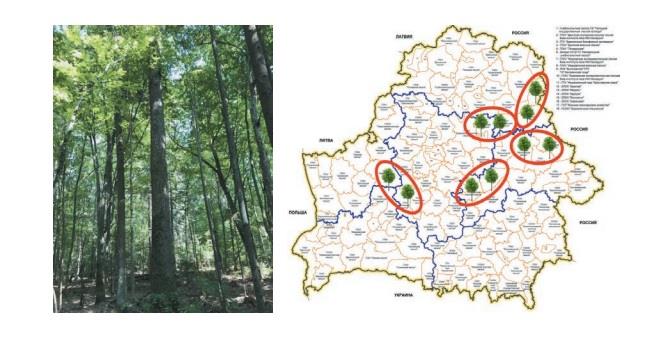
The Institute of Forest has developed a technology for establishing a permanent seed source base (PSSB) for small-leaved linden (Tilia cordata). This process involves defining criteria for breeding and genetic assessment, as well as surveying and selecting specific trees and stands for inclusion in the PSSB. A total of 144 "plus trees" and 14.4 hectares of "plus stands" have been certified and entered into the PSSB registry; this initiative improves the seed harvesting system for small-leaved linden while ensuring the preservation and sustainable use of its genetic and biological diversity. The small-leaved linden gene pool of greatest value for breeding purposes has been identified and selected, and methods and technologies for its effective conservation and reproduction have been developed.
This information is published in the catalog "100 Best Developments of the National Academy of Sciences of Belarus for the National Economy (2022–2023), pp. 175–176. Advantages and Innovations The Technology for establishing small-leaved linden clonal seed orchards makes it possible to obtain seeds with improved hereditary traits for the creation of highly productive and biologically resilient forest plantations. Stage of development Already on the market Comments regarding stage of development Permanent forest seed base sites for small-leaved linden have been established within Belarus's forest fund, and selected seeds are being collected for forest establishment and the expansion of the country's forest cover. Funding source State budged
Internal
IPR status Exclusive rights
Secret know-how
Comments regarding IPS status The Institute of Forest has been completed a R&D project "Conducting a breeding and genetic assessment of stands and identifying sites for a permanent seed source of small-leaved linden in Belarus."
The results were utilized in the development of the technology. Sector group Agrofood
Environment
Tourism and Cultural Heritage
Client information Type R&D institution Year established 1930 NACE keywords A.02.10 - Silviculture and other forestry activities
A.02.40 - Support services to forestry
M.72.11 - Research and experimental development on biotechnology
M.72.19 - Other research and experimental development on natural sciences and engineering
M.74.90 - Other professional, scientific and technical activities n.e.c.
Turnover (in EUR) 10-20M Already engaged in transnational cooperation Yes Additional comments The Institute of Forest of the National Academy of Sciences of Belarus is the leading and only specialized research institution driving the modern scientific, technical, and innovative development of the country's forestry sector.
The Institute possesses well-equipped facilities and instrumentation, enabling research to be conducted at a high scientific and methodological standard.
The Institute actively collaborates with research institutes and higher education institutions across the CIS and other countries.
Pilot-scale testing and implementation of the Institute's scientific and technical developments are carried out at its three experimental forest bases: Dvinskaya, Zhornovskaya, and Korenevskaya.
Areas of activity:
- research into the genetic, physiological, and biochemical mechanisms underlying forest productivity and resilience;
- refinement of the scientific principles for forest regeneration, sustainable use, and conservation;
- development of technologies for sustainable forest management and utilization;
- development of technologies for forest regeneration based on genetics and selective breeding, as well as for enhancing productivity, ecological resilience, and biodiversity conservation;
- development of methods, tools, and technologies for forest fire prevention and protection against harmful organisms;
- development of methods and technologies for the rehabilitation of anthropogenically disturbed forest lands;
- development of methods and technologies for the conservation and regeneration of non-timber forest products, and the application of biotechnology in industry, agriculture, medicine, and environmental protection.
The Republic's regulatory and technical framework for forestry operations was developed by the Institute or with its participation.
Official website of the Institute of Forest. Languages spoken English
Russian
Information about partnership Type of partnership considered Commercial agreement with technical assistance
Technical cooperation agreement
Type and role of partner sought Consumers interested in purchasing the Technology for establishing a permanent seed source for small-leaved linden, which includes defining breeding and genetic assessment criteria, as well as surveying and selecting specific trees and stands under a commercial agreement with technical assistance.
Partners interested in developing the technology for establishing a permanent seed source for small-leaved linden, which includes defining breeding and genetic assessment criteria, as well as surveying and selecting specific trees and stands under a technical cooperation agreement. Type and size of partner sought > 500
251-500
SME 51-250
SME 11-50
SME <= 10
R&D Institution
University
Sole proprietor
1. Ecological significance:
- The small-leaved linden plays a vital role in ecosystems by supporting biodiversity and serving as a food source for pollinating insects.
- It improves air and soil quality due to its phytoncide properties.
2. Economic value:
- It is used in the production of timber, pharmaceuticals, cosmetics, and honey.
- Linden forests are highly valued for recreational areas and landscaping.
3. Genetic resource conservation:
- A permanent seed source is essential for preserving the species' genetic diversity, which is particularly important in the face of climate change and anthropogenic impact.
4. Land reclamation and forest restoration:
- The small-leaved linden is actively used to rehabilitate degraded lands and establish resilient forest ecosystems.
Technologies employed to establish and manage the seed source:
1. Genetic selection and breeding:
- Use of molecular biology and genetics techniques to select the most resilient and productive trees.
- Establishment of clonal plantations and seed orchards.
2. Information technologies:
- Geographic Information Systems (GIS) for monitoring the condition of the seed source.
- Remote sensing to assess tree health and identify optimal planting sites.
3. Agrotechnical methods:
- Use of biological agents to enhance tree resistance to diseases and pests.
- Application of modern irrigation and fertilization systems to boost productivity. 4. Seed storage technologies:
- Establishment of specialized storage facilities with controlled temperature and humidity conditions for long-term seed storage.
5. Process automation:
- Use of drones for monitoring forest areas and assessing tree health.
- Application of robotic systems for planting and tending forest crops.
The Institute of Forest has developed a technology for establishing a permanent seed source base (PSSB) for small-leaved linden (Tilia cordata). This process involves defining criteria for breeding and genetic assessment, as well as surveying and selecting specific trees and stands for inclusion in the PSSB. A total of 144 "plus trees" and 14.4 hectares of "plus stands" have been certified and entered into the PSSB registry; this initiative improves the seed harvesting system for small-leaved linden while ensuring the preservation and sustainable use of its genetic and biological diversity. The small-leaved linden gene pool of greatest value for breeding purposes has been identified and selected, and methods and technologies for its effective conservation and reproduction have been developed.
This information is published in the catalog "100 Best Developments of the National Academy of Sciences of Belarus for the National Economy (2022–2023), pp. 175–176. Advantages and Innovations The Technology for establishing small-leaved linden clonal seed orchards makes it possible to obtain seeds with improved hereditary traits for the creation of highly productive and biologically resilient forest plantations. Stage of development Already on the market Comments regarding stage of development Permanent forest seed base sites for small-leaved linden have been established within Belarus's forest fund, and selected seeds are being collected for forest establishment and the expansion of the country's forest cover. Funding source State budged
Internal
IPR status Exclusive rights
Secret know-how
Comments regarding IPS status The Institute of Forest has been completed a R&D project "Conducting a breeding and genetic assessment of stands and identifying sites for a permanent seed source of small-leaved linden in Belarus."
The results were utilized in the development of the technology. Sector group Agrofood
Environment
Tourism and Cultural Heritage
Client information Type R&D institution Year established 1930 NACE keywords A.02.10 - Silviculture and other forestry activities
A.02.40 - Support services to forestry
M.72.11 - Research and experimental development on biotechnology
M.72.19 - Other research and experimental development on natural sciences and engineering
M.74.90 - Other professional, scientific and technical activities n.e.c.
Turnover (in EUR) 10-20M Already engaged in transnational cooperation Yes Additional comments The Institute of Forest of the National Academy of Sciences of Belarus is the leading and only specialized research institution driving the modern scientific, technical, and innovative development of the country's forestry sector.
The Institute possesses well-equipped facilities and instrumentation, enabling research to be conducted at a high scientific and methodological standard.
The Institute actively collaborates with research institutes and higher education institutions across the CIS and other countries.
Pilot-scale testing and implementation of the Institute's scientific and technical developments are carried out at its three experimental forest bases: Dvinskaya, Zhornovskaya, and Korenevskaya.
Areas of activity:
- research into the genetic, physiological, and biochemical mechanisms underlying forest productivity and resilience;
- refinement of the scientific principles for forest regeneration, sustainable use, and conservation;
- development of technologies for sustainable forest management and utilization;
- development of technologies for forest regeneration based on genetics and selective breeding, as well as for enhancing productivity, ecological resilience, and biodiversity conservation;
- development of methods, tools, and technologies for forest fire prevention and protection against harmful organisms;
- development of methods and technologies for the rehabilitation of anthropogenically disturbed forest lands;
- development of methods and technologies for the conservation and regeneration of non-timber forest products, and the application of biotechnology in industry, agriculture, medicine, and environmental protection.
The Republic's regulatory and technical framework for forestry operations was developed by the Institute or with its participation.
Official website of the Institute of Forest. Languages spoken English
Russian
Information about partnership Type of partnership considered Commercial agreement with technical assistance
Technical cooperation agreement
Type and role of partner sought Consumers interested in purchasing the Technology for establishing a permanent seed source for small-leaved linden, which includes defining breeding and genetic assessment criteria, as well as surveying and selecting specific trees and stands under a commercial agreement with technical assistance.
Partners interested in developing the technology for establishing a permanent seed source for small-leaved linden, which includes defining breeding and genetic assessment criteria, as well as surveying and selecting specific trees and stands under a technical cooperation agreement. Type and size of partner sought > 500
251-500
SME 51-250
SME 11-50
SME <= 10
R&D Institution
University
Sole proprietor

Legal Disclaimer:
MENAFN provides the
information “as is” without warranty of any kind. We do not accept any
responsibility or liability for the accuracy, content, images, videos,
licenses, completeness, legality, or reliability of the information
contained in this article. If you have any complaints or copyright issues
related to this article, kindly contact the provider above.
Comments
No comment