

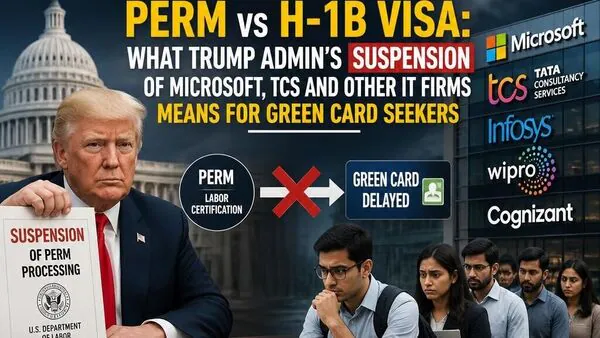
PERM Vs H-1B Visa: What Trump Admin's Suspension Of Microsoft, TCS And Other IT Firms Means For Green Card Seekers


The suspension, announced by the Trump administration on Thursday (October 8) bars the affected companies from submitting new PERM applications and stops the processing of pending applications, according to US officials. The administration has accused the companies of abusing the system to replace American workers with lower-paid foreign employees.
The eight companies named are Microsoft, Adobe, Cognizant, Infosys, Tata Consultancy Services (TCS), Wipro, HCL Technologies and Capgemini.
Quick answers to key questions
.5 QUESTIONS1What is the difference between PERM and an H-1B visa?⌵H-1B is a temporary, employer-sponsored work visa for eligible professionals. PERM is a labour certification that employers generally need for certain employment-based green-card applications.
2Which companies were suspended from the PERM programme?⌵The eight companies named are Microsoft, Adobe, Cognizant, Infosys, Tata Consultancy Services (TCS), Wipro, HCL Technologies and Capgemini.
3Does the PERM suspension cancel existing H-1B visas?⌵No. The suspension applies to PERM applications and does not, by itself, cancel existing H-1B visas.
4Why did the US suspend these companies from the PERM programme?⌵The Department of Labor cited multiple ongoing federal investigations. The administration has also accused the companies of using the labour-certification system to replace American workers with lower-paid foreign employees.
5Do all employment-based green-card applications require PERM?⌵No. PERM is an important step for many EB-2 and EB-3 applicants, but certain routes may be exempt, including some cases involving extraordinary ability or an EB-2 National Interest Waiver.
The move is part of the administration's broader crackdown on skilled foreign labour, following its efforts to impose higher fees on certain H-1B visa petitions. However, the PERM suspension and the H-1B programme serve different purposes, and the latest action does not, by itself, cancel existing H-1B visas.
Here's how the two immigration mechanisms differ and what the suspension could mean for foreign workers.
What is PERM?The Permanent Labour Certification programme, commonly known as PERM, is a process administered by the US Department of Labor (DOL) that allows eligible employers to sponsor foreign workers for employment-based green cards.
Introduced in 2005, PERM streamlined the earlier labour-certification system. It requires employers to demonstrate that there are not enough qualified and available US workers for the position and that hiring a foreign worker will not adversely affect the wages and working conditions of similarly employed American workers.
The process is initiated by the employer, not the foreign worker. After labour certification is approved, the employer can generally proceed with the relevant employment-based immigrant petition, followed by the worker's application for permanent residency when eligible.
PERM is an important step for many employment-based green-card applicants, particularly those seeking permanent residency through the EB-2 and EB-3 categories. However, not every employment-based green-card route requires PERM. Certain applicants, including some individuals with extraordinary ability and those eligible for an EB-2 National Interest Waiver, may qualify for exemptions.
What is the H-1B visa?The H-1B is a temporary, employer-sponsored US work visa that allows companies to employ foreign professionals in specialised occupations requiring relevant expertise and qualifications.
Technology companies are among the programme's biggest users.
H-1B status is generally available for an initial period of up to three years and can typically be extended to a maximum of six years, subject to applicable rules and exceptions.
Unlike PERM, the H-1B programme does not directly grant permanent residency. However, workers on H-1B visas may subsequently pursue employment-based green cards through employer sponsorship, often involving PERM labour certification.
This means the two processes can form part of the same worker's immigration journey: H-1B status permits temporary employment, while PERM can help establish the basis for an employer-sponsored green-card application.
Also Read | Big triggers for IT stocks today - TCS, Infosys, Wipro, HCL Tech | Experts' view Why has the Trump administration suspended the companies?Vice President JD Vance accused Microsoft and other companies of exploiting the labour-certification system to replace American employees with foreign workers.
Vance cited Microsoft's layoffs and immigration filings, claiming that the company had laid off 6,000 American workers last year while obtaining 6,300 H-1B visas and nearly 3,000 green cards.
He said companies sometimes advertise jobs in ways that make it difficult to attract applicants, then use the lack of responses to justify hiring foreign workers.
“Our message to Microsoft is: You're a great American company, but you've got to hire great American workers,” Vance said.
Microsoft disputed the implication that its H-1B filings primarily represented new foreign hires. The company said approximately 80% of the H-1B applications it submitted in the last fiscal year were to extend or change the status of existing employees.
The administration's move also comes amid a wider effort to tighten scrutiny of employment-based immigration. It has pursued a proposed $100,000 fee on certain new H-1B petitions, although the measure has faced legal challenges and court action.
Also Read | 'Deeply offensive': MEA on Vance's remark on H-1B workers
Legal Disclaimer:
MENAFN provides the
information “as is” without warranty of any kind. We do not accept any
responsibility or liability for the accuracy, content, images, videos,
licenses, completeness, legality, or reliability of the information
contained in this article. If you have any complaints or copyright issues
related to this article, kindly contact the provider above.
Comments
No comment