

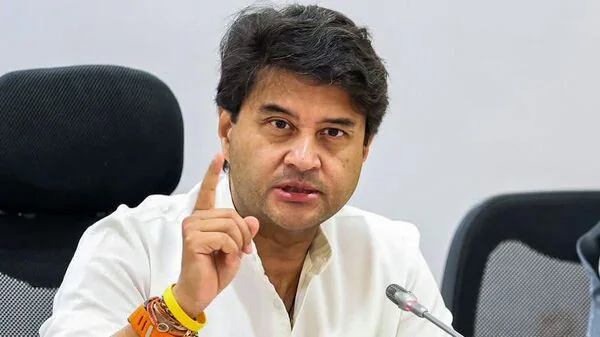
Scindia Says Satcom Security Clearance Rests With Home Ministry, Denies Bias


Comments from Scindia came after Starlink, in New Delhi on Wednesday, said it has built its operations specifically for India in recognition of Indian security requirements and other regulations, establishing controls at every layer for India and keeping Indian user data within India.
“I think the Government of India and the ministry of home affairs have to state that you have successfully shown compliance with the security requirements,” Scindia said in response to Mint's question at the India Mobile Congress in New Delhi.“That's when security requirements have been met. And as I said, that is something that comes under the ministry of home. That is a decision that will be taken by them.”
Quick answers to key questions
.5 QUESTIONS1Who decides whether Starlink meets India's satellite internet security requirements?⌵The Ministry of Home Affairs determines whether a satellite internet operator has met the security requirements. Communications Minister Jyotiraditya Scindia said the decision rests with that ministry.
2Why has Starlink not started commercial operations in India?⌵Starlink must complete security assessments and other regulatory milestones before it can launch services. The government says licensed operators must meet these requirements before beginning commercial operations.
3Does Starlink's licence mean it can already provide satellite internet in India?⌵No. Starlink has obtained a licence, but it still needs to meet security and operational requirements before starting commercial services.
4Do India's security clearance requirements apply only to Starlink?⌵No. The government says the requirements apply individually to all licensed satellite operators, including Starlink, Jio and OneWeb. It has said the security assessment is underway for all three.
5What must satellite internet companies do before launching services in India?⌵Each operator must demonstrate compliance with security requirements and complete the required regulatory milestones. The government has also said the revenue charges framework must be finalized.
Also Read | Mobile bills may rise again: 12–15% telecom tariff hike likely in 4–5 monthsScindia's comments assume significance, as over the last couple of days, SpaceX founder and chief executive officer Elon Musk alleged that delays in launching Starlink in India were due to a power play by“oligarchs”.
The ministry of communications came down strongly on these allegations on Thursday and refuted any suggestions of bias as“baseless and misconceived”.
“India does not allow a monopoly in any sector. and therefore even as Satcom (satellite communication) is concerned there is not a single licensee that has been chosen,” Scindia told reporters, adding that three companies-Jio, OneWeb and Starlink have got the license.
Amazon Leo is the fourth operator in the fray to procure the license.
Also Read | Tata Communications sees $1 bn opportunity in connecting data centres“Once the revenue charges system is finalized. Once each one of the parties (satellite internet companies)...all three individually based on their achievement of milestones with regard to security concerns and prerequisites, have fulfilled the requirements. Then obviously they can start operations. But that has to be a compliance that is done by each one of them individually,” Scindia said.
Comments from the minister assume significance as Elon Musk on Thursday evening posted on X:“Starlink is licensed in over 165 countries and has spent five years complying with every single law and requirement of the government of India, so why still no license? Is Ambani the real boss of India?”
To be sure, four years back, Bharti-backed Eutelsat OneWeb secured India's first satellite internet license in 2022, followed by Ji Satellite in October 2022, and Starlink in June 2025.
Reacting to the Musk controversy, Bharti Enterprises founder and chairman Sunil Bharti Mittal on Thursday said,“We (Eutelsat OneWeb) are waiting for our own approval...we hope to receive it soon.”
The delay stems largely from security concerns, particularly the fact that India's internet traffic exits India, often via foreign operators such as Elon Musk-owned Starlink and Amazon's Leo. Even though these companies have promised to comply with security rules and demonstrated how their systems work, the government remains cautious, Mint reported on 29 June.
Even as Scindia said the revenue charges system has to be finalized, in September 2026, the department of telecommunications decided that spectrum will be assigned administratively and approved a spectrum usage charge of 5% of adjusted gross revenue for satellite internet providers, including Starlink, Eutelsat OneWeb, and Jio Satellite. According to officials, this proposal is currently awaiting final cabinet approval.
Telecom spectrum auctionsWhen asked whether the government will conduct telecom spectrum auctions this financial year, Scindia said it will depend on demand, raising questions about whether it will take place this year.
“So, there is a fairly reasonable amount of spectrum that has already been distributed. We have had a very successful 5G round. The round before the last one, as and when requirements do come up, and as we move on towards 5G Standalone and then coming up to 6G, depending on the spectrum bands that are required. We will certainly hold the auction,” Scindia said.
“We do not have a surfeit of spectrum, but we also want to monitor when there is a desirable amount of demand, and then we will hold the auction. It's a very transparent process,” he added.
Also Read | Jio Platforms aspires to deliver India's biggest IPO, says Akash AmbaniIn the September 2021 reforms, the Union cabinet had approved conducting spectrum auctions annually.“Spectrum auctions to be normally held in the last quarter of every financial year,” the government had said in a release dated 15 September 2021. However, the government has missed the schedule and has not conducted the auction, even in the last financial year.
In 2021, a total of 855.6 megahertz(MHz) of spectrum, worth ₹77,820 crore, across the 800MHz, 900MHz, 1,800MHz, 2,100MHz, and 2,300MHz bands was auctioned. In 2022, a total of 72,097.85MHz of spectrum, worth ₹1.5 trillion, across the 700MHz, 800MHz, 900MHz, 1800MHz, 2100MHz, 2500MHz, 3300MHz, and 26GHz bands was auctioned.
After giving auctions a miss in 2023, the government collected ₹11,340.78 crore-the third-lowest since competitive bidding began in 2010-in the 2024 auction.

Legal Disclaimer:
MENAFN provides the
information “as is” without warranty of any kind. We do not accept any
responsibility or liability for the accuracy, content, images, videos,
licenses, completeness, legality, or reliability of the information
contained in this article. If you have any complaints or copyright issues
related to this article, kindly contact the provider above.
Comments
No comment