

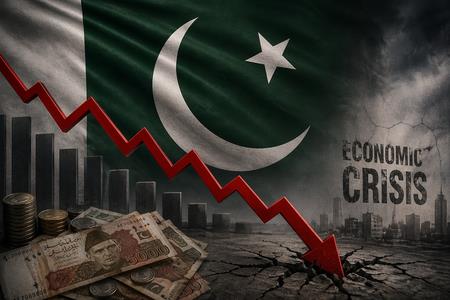
Economy 'Stabilisation' Measures Bring No Joy For Ordinary People In Pakistan: Report


The report from Colombo-based publication Asian News Post said the government of Shehbaz Sharif has emphasised avoiding default through IMF‐backed programmes, but that policy focus has prioritised short‐term fiscal order over long‐term investment and growth.
The majority of public expenditure was used for maintaining the existing system rather than building future economic capacity.
The report argued that Pakistan's successive stabilisation programs were designed to keep the economy afloat rather than delivering prosperity.
It pointed out the distinction saying that many Pakistanis mistook the word“stability” to mean that economic conditions have improved.
"Most spending was consumed by routine operations, debt obligations, transfers, and subsidies, while very little was invested in infrastructure, human capital, or long-term development," the report noted.
Total public expenditure over last four years totalled Rs 90 trillion, with roughly 33 per cent going to debt servicing, 28.2 per cent transferred to provinces under the NFC award, 9.1 per cent to defence, 7.4 per cent to pensions, 10 per cent covering state‐owned enterprise losses, 3.4 per cent to energy subsidies and 2.9 per cent to the Benazir Income Support Programme.
"Only around 4.6 per cent was allocated through the Public Sector Development Programme (PSDP), the government's primary development spending mechanism," the publication said.
Despite Pakistan having a growing population that requires new schools, hospitals, roads, water systems, public transportation, and energy infrastructure only a small fraction of total spending is directed to these purposes.
While government borrowing skyrockets, interest payments also rise, consuming larger portions of government revenue, leaving fewer resources available for development. Government debt rose from roughly Rs 47 trillion in 2022 to approximately Rs 83 trillion by 2026, the report noted.
State-owned enterprises running on huge losses, along with faulty taxation policy compounds the problem, it noted.
-IANS
aar/ag

Legal Disclaimer:
MENAFN provides the
information “as is” without warranty of any kind. We do not accept any
responsibility or liability for the accuracy, content, images, videos,
licenses, completeness, legality, or reliability of the information
contained in this article. If you have any complaints or copyright issues
related to this article, kindly contact the provider above.
Comments
No comment