


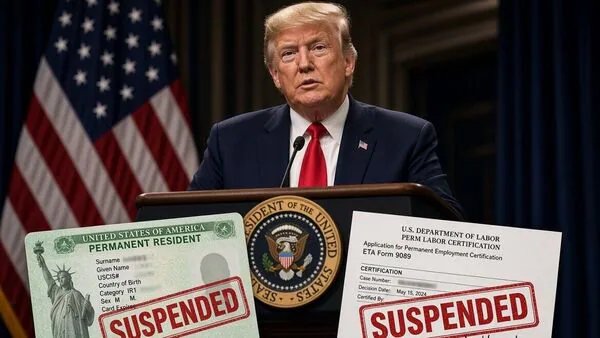
What Is PERM? Why Trump Suspended Microsoft And Indian IT Firms From Green-Card Programme


The programme, known as Permanent Labor Certification, or PERM, is an important step in the employment-based green-card process for many foreign workers. The US administration says some companies have abused the system to replace American workers with cheaper foreign labour.
Vice President JD Vance announced the move on Thursday (October 8), accusing companies of using foreign-worker programmes at the expense of US employees. The action comes as the Trump administration broadens its crackdown on skilled foreign labour and immigration programmes.
What is PERM?Quick answers to key questions
.5 QUESTIONS1What is PERM in the US green-card process?⌵PERM, or Permanent Labor Certification, is a US Department of Labor process through which an employer seeks certification to permanently employ a foreign worker. It is an important step in some employment-based green-card cases.
2How does the PERM labor-certification process work?⌵The employer identifies a permanent, full-time job, establishes its requirements and obtains a prevailing wage determination. After recruitment, the employer files a PERM application with the Department of Labor for review.
3Why did the US suspend companies from the PERM program?⌵The Trump administration said the companies had abused the system and used foreign workers to replace or undercut American workers. The Department of Labor said it would not accept new or process pending PERM applications involving the suspended firms.
4Which companies were suspended from the PERM program?⌵The named companies included Microsoft, Adobe, Cognizant, Infosys, Tata Consultancy Services, Wipro, HCL Technologies and Capgemini.
5Does PERM approval grant a green card, and how is it different from an H-1B visa?⌵No. PERM certification is a labor-certification step in the broader employment-based green-card process, not a green card itself. An H-1B is temporary work status, while PERM relates to permanent employment.
PERM stands for Permanent Labor Certification.
It is a process administered by the US Department of Labor that allows an employer to seek certification to permanently employ a foreign worker in the United States.
The process is initiated by the employer rather than the individual worker.
The basic purpose of PERM is to establish that there are not enough qualified and available US workers for a particular job and that hiring the foreign worker will not adversely affect the wages and working conditions of similarly employed American workers.
PERM was introduced in 2005, replacing the older paper-based labour-certification system known as Alien Employment Certification, with the aim of making the process more efficient.
How does PERM work?The process broadly involves several stages.
1. Employer identifies a permanent job
A US employer must have a permanent, full-time position that it wants to fill with a foreign worker.
The employer establishes the job's duties and minimum requirements, including education, experience and other qualifications.
2. Prevailing wage is determined
The employer generally obtains a prevailing wage determination from the Department of Labor.
This establishes the wage level for the particular occupation and location and is intended to ensure that employing a foreign worker does not depress wages for US workers.
3. PERM application is filed
After completing the required recruitment process, the employer files the PERM application with the Department of Labor.
The DOL reviews the application and, if satisfied that the requirements have been met, certifies it.
4. Green-card process follows
PERM approval does not itself grant a green card.
Instead, it is a labour-certification step in the broader employment-based immigration process. After PERM certification, the employer can generally proceed with the relevant immigration petition and subsequent green-card process, subject to other requirements and visa availability.
Not every employment-based green-card category requires PERM.
Also Read | US Green Card holder's mother denied B1/B2 visa, leaves her perplexed Why did Trump suspend the programme for these companies?The Trump administration says companies have been exploiting the system to replace American workers with foreign employees.
Vance specifically singled out Microsoft, arguing that the company had laid off thousands of American workers while obtaining thousands of H-1B visas and green cards.
“Our message to Microsoft is: You're a great American company, but you've got to hire great American workers,” Vance said.
He also described foreign H-1B workers as“foreign indentured servants”, arguing that their immigration status can make them dependent on their employers.
The administration's move targets Microsoft and Adobe as well as major IT and outsourcing companies including Cognizant, Infosys, Tata, Wipro, HCL and Capgemini.
The US government said that, for certain companies, it would not accept new PERM applications or process pending applications.
PERM vs H-1B: What's the difference?The two programmes are related but serve different purposes.
H-1B is a temporary work visa that allows foreign workers in qualifying specialty occupations to work in the US, generally for up to six years, subject to the applicable rules.
PERM, by contrast, is a labour-certification process connected to permanent employment and can be an important step towards an employment-based green card.
In simple terms:
H-1B = temporary work status
PERM = labour certification for permanent employment
Green card = permanent US residency
(With AP, Reuters inputs)
Also Read | Trump Admin proposes $70,000 OPT fee for F-1 visa students seeking jobs
Legal Disclaimer:
MENAFN provides the
information “as is” without warranty of any kind. We do not accept
any responsibility or liability for the accuracy, content, images,
videos, licenses, completeness, legality, or reliability of the information
contained in this article. If you have any complaints or copyright
issues related to this article, kindly contact the provider above.


Comments
No comment