


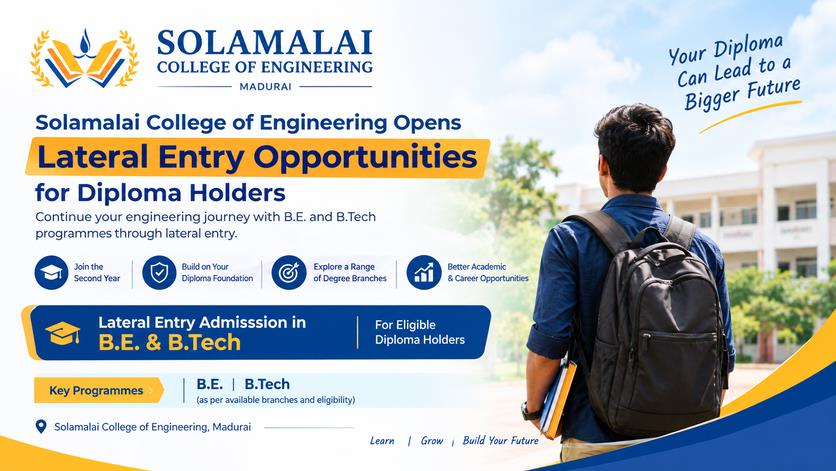
Solamalai College of Engineering Opens Lateral Entry Opportunities for Diploma Holders


(MENAFN- Solamalai College of Engineering) Students who have completed a Diploma in Engineering or Technology and are planning to continue their higher education can consider lateral entry into undergraduate engineering programmes. Solamalai College of Engineering, Madurai, provides an opportunity for eligible diploma holders to pursue B.E. and B.Tech through the lateral-entry route, subject to applicable admission requirements.
Lateral entry offers a different starting point from regular undergraduate admission. Instead of beginning the degree from the first year, eligible students generally enter the second year of the programme. This allows them to continue their academic progression while building on the technical foundation gained during their diploma studies.
A Different Route From Diploma to Degree
A Diploma in Engineering gives students exposure to technical subjects, practical work and basic engineering concepts. Some diploma holders may later decide that they want to pursue a bachelor's degree to deepen their knowledge or expand their academic and career options.
For such students, lateral entry can provide a structured transition into degree-level education. The move also brings a change in the nature of study. Students may encounter more advanced theory, laboratory sessions, engineering projects, technical assignments and greater independent learning.
Understanding this difference can help applicants prepare for the transition rather than viewing lateral entry simply as a shorter admission route.
Choosing a Degree That Matches Previous Study
One of the important decisions for a lateral-entry applicant is selecting the appropriate B.E. or B.Tech branch. A student's diploma specialisation, academic background, technical interests and future plans can all be relevant when considering available programmes.
A student with a strong interest in computing, for example, may explore relevant technology-oriented degree options, while another student may prefer areas connected with mechanical, civil, electrical or electronics engineering.
Students should verify whether their diploma qualification is eligible for the particular degree branch they are considering. Availability can vary according to current regulations and institutional admission provisions.
What Applicants Should Check Before Applying
Lateral-entry admission involves several practical details that students should understand before submitting an application. These include the required diploma qualification, minimum marks, eligible branches, available seats, admission procedure and important dates.
Applicants should also keep their academic certificates and other required documents ready. Information about fees, scholarships or concessions should be checked using the latest details provided by the institution.
Since admission regulations can change, students should confirm current requirements rather than relying on information from an earlier admission cycle.
Continuing Education at Solamalai College of Engineering
Solamalai College of Engineering in Madurai offers undergraduate programmes across several engineering and technology disciplines. For eligible diploma holders, lateral entry provides an opportunity to continue into degree-level engineering education.
The institution's academic environment includes classroom learning, laboratory work, projects and other activities that form part of undergraduate engineering study. Students joining through lateral entry can use their existing technical knowledge as a foundation while developing a deeper understanding of engineering subjects.
The college also provides information regarding applicable provisions for lateral-entry students. Applicants are advised to check the latest admission details directly with the institution before completing the admission process.
Preparing for Life After the Degree
The value of a degree programme extends beyond completing examinations. During their remaining years of study, lateral-entry students can use academic projects, practical assignments, internships, technical activities and other opportunities to strengthen their abilities.
They can also work on communication, teamwork, analytical thinking and independent learning. These skills can be useful when students move towards employment, higher studies or other professional opportunities after graduation.
For students who have already completed technical education at diploma level, the degree years can therefore become an opportunity to expand both subject knowledge and professional readiness.
An Option Worth Exploring After Diploma
The decision to pursue lateral entry should be based on a student's academic background, preferred engineering discipline and future plans. Understanding eligibility requirements and available programmes is an important part of making that decision.
For eligible Diploma in Engineering or Technology holders, lateral entry at Solamalai College of Engineering offers a route to continue their education through B.E. and B.Tech programmes. Students interested in this option can review the current admission requirements, available branches and application process before taking the next step.
Lateral entry offers a different starting point from regular undergraduate admission. Instead of beginning the degree from the first year, eligible students generally enter the second year of the programme. This allows them to continue their academic progression while building on the technical foundation gained during their diploma studies.
A Different Route From Diploma to Degree
A Diploma in Engineering gives students exposure to technical subjects, practical work and basic engineering concepts. Some diploma holders may later decide that they want to pursue a bachelor's degree to deepen their knowledge or expand their academic and career options.
For such students, lateral entry can provide a structured transition into degree-level education. The move also brings a change in the nature of study. Students may encounter more advanced theory, laboratory sessions, engineering projects, technical assignments and greater independent learning.
Understanding this difference can help applicants prepare for the transition rather than viewing lateral entry simply as a shorter admission route.
Choosing a Degree That Matches Previous Study
One of the important decisions for a lateral-entry applicant is selecting the appropriate B.E. or B.Tech branch. A student's diploma specialisation, academic background, technical interests and future plans can all be relevant when considering available programmes.
A student with a strong interest in computing, for example, may explore relevant technology-oriented degree options, while another student may prefer areas connected with mechanical, civil, electrical or electronics engineering.
Students should verify whether their diploma qualification is eligible for the particular degree branch they are considering. Availability can vary according to current regulations and institutional admission provisions.
What Applicants Should Check Before Applying
Lateral-entry admission involves several practical details that students should understand before submitting an application. These include the required diploma qualification, minimum marks, eligible branches, available seats, admission procedure and important dates.
Applicants should also keep their academic certificates and other required documents ready. Information about fees, scholarships or concessions should be checked using the latest details provided by the institution.
Since admission regulations can change, students should confirm current requirements rather than relying on information from an earlier admission cycle.
Continuing Education at Solamalai College of Engineering
Solamalai College of Engineering in Madurai offers undergraduate programmes across several engineering and technology disciplines. For eligible diploma holders, lateral entry provides an opportunity to continue into degree-level engineering education.
The institution's academic environment includes classroom learning, laboratory work, projects and other activities that form part of undergraduate engineering study. Students joining through lateral entry can use their existing technical knowledge as a foundation while developing a deeper understanding of engineering subjects.
The college also provides information regarding applicable provisions for lateral-entry students. Applicants are advised to check the latest admission details directly with the institution before completing the admission process.
Preparing for Life After the Degree
The value of a degree programme extends beyond completing examinations. During their remaining years of study, lateral-entry students can use academic projects, practical assignments, internships, technical activities and other opportunities to strengthen their abilities.
They can also work on communication, teamwork, analytical thinking and independent learning. These skills can be useful when students move towards employment, higher studies or other professional opportunities after graduation.
For students who have already completed technical education at diploma level, the degree years can therefore become an opportunity to expand both subject knowledge and professional readiness.
An Option Worth Exploring After Diploma
The decision to pursue lateral entry should be based on a student's academic background, preferred engineering discipline and future plans. Understanding eligibility requirements and available programmes is an important part of making that decision.
For eligible Diploma in Engineering or Technology holders, lateral entry at Solamalai College of Engineering offers a route to continue their education through B.E. and B.Tech programmes. Students interested in this option can review the current admission requirements, available branches and application process before taking the next step.

Legal Disclaimer:
MENAFN provides the
information “as is” without warranty of any kind. We do not accept
any responsibility or liability for the accuracy, content, images,
videos, licenses, completeness, legality, or reliability of the information
contained in this article. If you have any complaints or copyright
issues related to this article, kindly contact the provider above.


Comments
No comment