


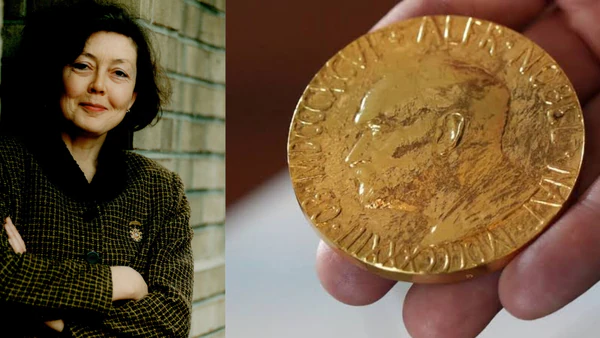
Who Is Anne Carson? Canadian Writer And Poet Wins 2026 Nobel Prize In Literature For Her 'Bold And Inventive Oeuvre'


Ingrid Carlberg, permanent secretary of the Swedish Academy, said the author was in Iceland“listening to the wind” when the academy contacted her to inform her about the win. The award was announced by the Swedish Academy in Stockholm.
The Nobel Priz carries a cash award of 12 million Swedish kronor this year, equivalent to around $1.2 million, whether it is awarded to an individual, a small group of laureates or an organisation.
Who is Anne Carson?Born in Toronto, Carson frequently draws inspiration from themes and narratives in ancient Greek and Roman literature, with her works often combining poetry, essays and fiction.
Also Read | Nobel Prize: How Suneel Kateriya helped lay groundwork for optogeneticsHer bibliography includes“Eros the Bittersweet,” which explores desire's pleasure and pain in ancient Greek literature; the verse novel“Autobiography of Red”;“Men in the Off Hours,” a poetry and prose collection that received Canada's Griffin Prize for poetry in 2001; and“Norma Jeane Baker of Troy,” which draws parallels between Marilyn Monroe and Helen of Troy.
Carson enrolled at St. Michael's College at the University of Toronto but left the institution twice, at the end of both her first and second years. Unhappy with the limitations of the curriculum, particularly a compulsory course on Milton, she briefly turned to graphic arts.
Also Read | Nobel Prize in Chemistry goes to Henri B Kagan, Kenso Soai; check discoveryShe later returned to the University of Toronto, earning her Bachelor of Arts in 1974, Master of Arts in 1975 and Ph.D. in 1981. Carson also spent a year at the University of St Andrews, where she studied Greek metrics and Greek textual criticism.
With an academic background in classics, Carson brings together influences from comparative literature, anthropology, history and the arts in her writing. Her work frequently revisits and reinterprets texts from Ancient Greek and Latin literature, drawing on authors such as Aeschylus, Catullus, Euripides, Homer, Sappho, Sophocles and Thucydides.
Also Read | Nobel Prize 2026 prize money: How much winners get, what happens when they shareShe also incorporates ideas and influences from a range of modern writers and philosophers, including Emily Brontë, Paul Celan, Emily Dickinson, Georg Wilhelm Friedrich Hegel, Martin Heidegger, Friedrich Hölderlin, Franz Kafka, John Keats, Gertrude Stein, Simone Weil and Virginia Woolf.
Rather than following a single literary form, Carson's books often move between poetry, prose, essays, criticism, translation, dramatic dialogue, fiction and nonfiction, combining several of these forms within the same work.

Legal Disclaimer:
MENAFN provides the
information “as is” without warranty of any kind. We do not accept
any responsibility or liability for the accuracy, content, images,
videos, licenses, completeness, legality, or reliability of the information
contained in this article. If you have any complaints or copyright
issues related to this article, kindly contact the provider above.


Comments
No comment