

China Rejects EU Request For Voluntary Curbs On Hybrid Car Exports As Trade Talks Begin In Beijing: What It Means


Earlier, the European Commission had asked China to voluntarily limit shipments of China-made hybrid vehicles to Europe, according to the report.
The development comes as EU Trade Commissioner Maroš Šefčovič travels to Beijing for two days of talks with Chinese Commerce Minister Wang Wentao.
The negotiations aim to address the EU's widening trade deficit with China, with Chinese exports of relatively low-cost electric and hybrid vehicles emerging as a key issue.
Why are hybrids becoming EU-China trade flashpoint?The EU has been increasingly concerned about the rapid growth of Chinese vehicle sales in the European market.
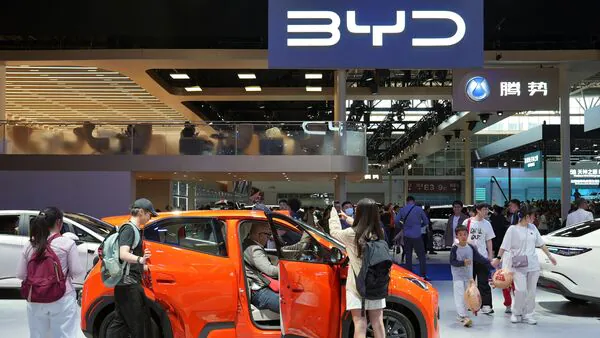
Chinese carmakers captured a record share of nearly 12% of Europe's new-car market in August and accounted for roughly one in three plug-in hybrid sales in the region, Bloomberg reported.
Therefore, the surge has put hybrid vehicles alongside electric cars at the centre of the EU's concerns over China's growing automotive exports.
The European Commission is now considering safeguard measures that could restrict imports following a surge in Chinese-made hybrids entering the European market.
One option under consideration is a tariff-rate quota, under which imports would be allowed up to a specified volume, while vehicles brought in above that threshold could face additional tariffs, Bloomberg reported.
The proposed restrictions would be time-limited, said the Bloomberg report.
Why did EU seek voluntary export curbs?The EU's initial approach was to seek a negotiated solution rather than immediately impose new trade restrictions.
The European Commission had sought China's agreement to voluntarily limit hybrid exports to Europe.
The Financial Times on 17 September 17 reported that Beijing could face higher tariffs if it did not agree to such restrictions.
The commission hopes to get Beijing to accept a unilateral EU mechanism to cap hybrid imports, rather than having China voluntarily restrict exports, according to FT.
What happens next?The issue is expected to feature prominently in the latest round of EU-China trade talks in Beijing, which are starting on Thursday.
Šefčovič and his team are scheduled to hold two days of negotiations with Chinese officials, with discussions aimed at reducing the trade imbalance without triggering a broader confrontation, according to The Guardian.
The outcome could influence whether the European Commission proceeds with its proposed safeguard measures.
The commission is also reportedly viewing hybrids as a potential test case. If the measures are effective, similar tools could potentially be considered for other sectors where the EU sees significant trade imbalances, according to Bloomberg.
Also Read | Under EU pressure, will UK impose tariffs on Chinese EVs? What we know so farFor the EU, the continued growth in Chinese vehicle exports is adding pressure to address concerns over an uneven trading relationship.
China has a large trade surplus with Europe, and the hybrid-car dispute could therefore risk becoming part of a broader trade dispute.

Legal Disclaimer:
MENAFN provides the
information “as is” without warranty of any kind. We do not accept any
responsibility or liability for the accuracy, content, images, videos,
licenses, completeness, legality, or reliability of the information
contained in this article. If you have any complaints or copyright issues
related to this article, kindly contact the provider above.
Comments
No comment