

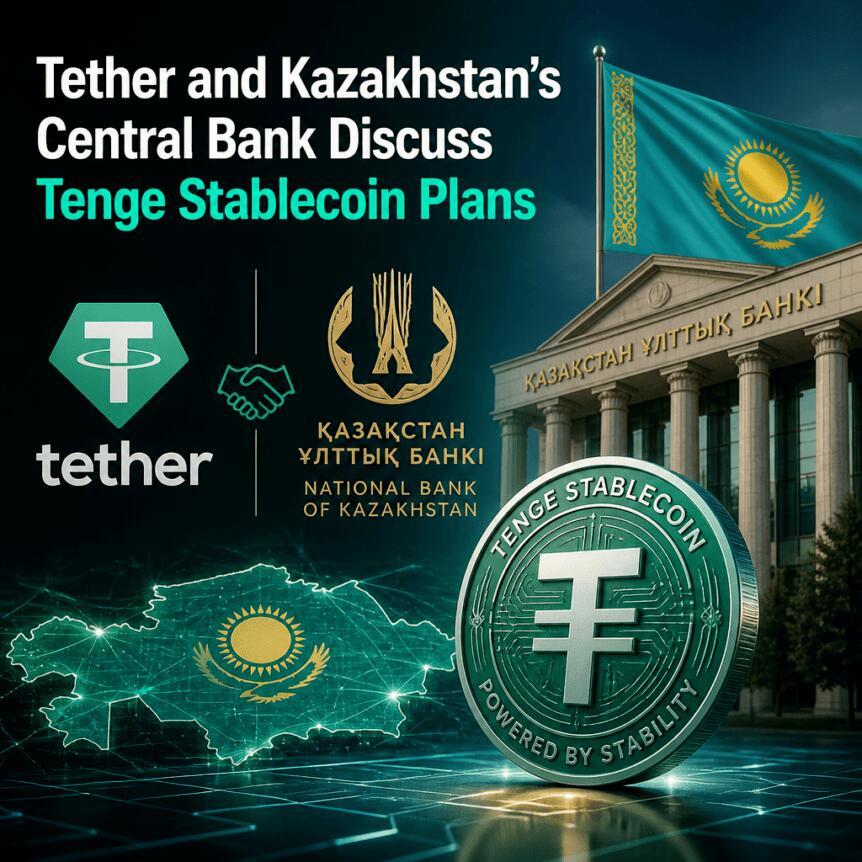
Tether And Kazakhstan's Central Bank Discuss Tenge Stablecoin Plans


Beyond the stablecoin concept, the agreement also contemplates building a framework for asset tokenization and running a pilot in Alatau that could leverage Tether's Hadron platform, according to the company.
Key takeaways- Tether is working with Kazakhstan's central bank and Alatau officials to study a tenge-backed stablecoin pilot alongside real-world asset tokenization. The memorandum focuses on reviewing international issuance models, reserve management concepts, and potential use cases before proposing a concrete plan. A tokenization framework is part of the agreement, including identifying suitable assets for potential tokenization. The broader rollout aligns with Kazakhstan's recent government action plan for digital assets spanning tokenization, payments, settlements, and mining. Kazakhstan has reported progress in its regulatory sandbox and a growing strategic crypto reserve, underscoring continued institutional involvement in crypto-related initiatives.
Under the memorandum of understanding, the participating parties will examine“international stablecoin issuance models” and work to identify potential use cases, Tether said in its announcement. The goal is to develop a proposal for a tenge-pegged stablecoin pilot, supported by an assessment of how issuance and reserves could be structured.
The agreement also calls for the development of an asset tokenization framework. That includes identifying assets that could be tokenized and setting the groundwork for a pilot project in Alatau. Tether said the Alatau pilot could use its Hadron platform.
In addition, the memorandum includes workshops and training programs aimed at stablecoin issuance, reserve management, and real-world asset tokenization-an emphasis on operational learning rather than only conceptual discussion.
Central bank priorities: stability, transparency, and investor protectionBinur Zhalenov, Deputy Governor of the National Bank of Kazakhstan, said the central bank intends to study international approaches to stablecoin issuance and tokenization while prioritizing financial stability, transaction transparency, and investor protection. This framing matters because it positions the effort as a controlled exploration-potentially meant to inform regulatory thinking-rather than a direct launch of a new token without oversight.
For market participants, the inclusion of reserve management training and a tokenization framework suggests the project is being treated as an institutional workstream. That could influence how stakeholders view the likelihood of a future pilot: investors and partners typically want clarity around reserve practices and governance before operationalizing stablecoin issuance.
Kazakhstan's wider digital asset push provides contextThis memorandum fits into Kazakhstan's broader push into digital assets that the country has accelerated this year. Tether's agreement highlights stablecoins and asset tokenization, while Kazakhstan's government-linked initiatives also extend to crypto payments and mining.
In September, Kazakhstan's government approved a 65-measure joint action plan across 10 areas to develop the digital assets industry. The plan includes measures intended to expand real-world asset tokenization, digital payments, international settlements, and crypto mining.
The government also tasked relevant ministries with developing a mechanism for using gas- and coal-fired power generation to supply mining centers. According to Kazakhstan's government, the country ranked among the world's top 10 for Bitcoin production in 2025.
Separately, Kazakhstan has reported that its National Strategic Crypto Reserve reached $700 million. The announcement also states that 34 digital asset projects have completed testing in the National Bank's regulatory sandbox.
On holdings, BitcoinTreasuries ranks Kazakhstan seventh among governments in its database for Bitcoin holdings, estimating 3,544 BTC worth about $294 million.
Why the tenge-pegged direction could matterA tenge-pegged stablecoin-if it ever progresses to a pilot-would represent a direct attempt to align a stablecoin design with a national currency framework. That can be important for two reasons: first, it may shape how local payments and settlement use cases are approached; and second, it typically raises specific regulatory questions around reserve assets, issuance controls, and redemption mechanisms.
In this memorandum, the emphasis on studying international issuance models and reserve management suggests the central concern is not simply whether a stablecoin can function technically, but whether it can be designed to meet stability and protection goals. It also signals that the tokenization workstream is meant to be more than a theoretical exercise: the agreement explicitly references identifying tokenizable assets and launching a pilot in Alatau, with Hadron as a possible tooling layer.
Still, the memorandum does not provide details on timelines for any actual launch. Readers should watch for follow-on disclosures from the National Bank or participating parties on pilot scope, reserve requirements, governance structure, and the specific asset categories targeted for tokenization.
For now, the key takeaway is that Kazakhstan's institutional involvement-evident in the regulatory sandbox activity and the strategic reserve-appears to be deepening alongside Tether's search for a locally relevant stablecoin and tokenization pathway. The next signal to monitor is whether this exploratory phase results in a defined pilot proposal and regulatory guidance that clarifies how a tenge-pegged stablecoin could operate in practice.
Risk & affiliate notice: Crypto assets are volatile and capital is at risk. This article may contain affiliate links.
Legal Disclaimer:
MENAFN provides the
information “as is” without warranty of any kind. We do not accept any
responsibility or liability for the accuracy, content, images, videos,
licenses, completeness, legality, or reliability of the information
contained in this article. If you have any complaints or copyright issues
related to this article, kindly contact the provider above.
Comments
No comment