

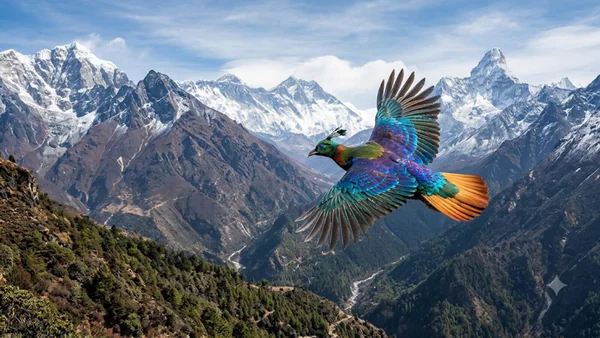
Human Activity Is Forcing This Himalayan Bird To Change Its 'Vocal Frequency And Address'


The Himalayan monal (Lophophorus impejanus), known for the striking green, blue and copper feathers of the male bird, is the state bird of Uttarakhand and the national bird of Nepal. Two separate studies conducted by researchers from Uttarakhand over five years have identified the growing pressure that infrastructure development, tourism and changing weather patterns are placing on the species.
The research suggests that monals are being pushed towards higher elevations as their natural habitats become increasingly crowded. The birds have also been found to alter their calls in response to rising levels of human-generated noise in busy mountain valleys.
Scientists say these changes are significant because the monal occupies a sensitive ecological zone between lower forested slopes and high-altitude alpine meadows. Such behavioural and habitat shifts could serve as an early warning of broader environmental stress across the northwestern Himalayas.
Also Read | The Himalaya is on the verge of an ecosystem collapse"These two studies give a useful warning for other more vulnerable species - if the monal is forced to change both its voice and its address, how are the more sensitive species responding?" Vishal Singh, an expert on ecology and climate issues in the Himalayas, said, as quoted by the BBC.
Monals raise pitch to overcome human noiseOne of the studies examined how Himalayan monals respond to different sound environments. Researchers from Hemvati Nandan Bahuguna Garhwal University, led by Dr Rajeev Lochan along with Dinesh Kumar Sharma and Anand Kumar, studied the birds' calls inside the Kedarnath Musk Deer Sanctuary in Uttarakhand.
Over the course of the study, the team collected and examined more than 700 vocalisations from two contrasting locations - Chopta Valley and Madmaheshwar Valley.
Also Read | Think Nepal: hydropower plans must bake in ever more complex climate risksThe analysis found a clear difference between birds living in quieter areas and those exposed to greater human activity. Monals in noisier surroundings produced calls with a higher peak pitch, apparently helping their voices stand out against low-frequency sounds from vehicles and conversations among visitors.
However, the researchers said this adaptation could have wider consequences. Changes in vocal patterns may influence the birds' ability to establish and defend territories or communicate with potential mates.
"This does not mean that the species has undergone a permanent or evolutionary change in its vocal frequency; rather, our findings suggest behavioural flexibility in response to different acoustic environments," Lochan said.
Climate change and human activity pushing birds uphillThe second study focused on how changes in climate and habitat could affect Himalayan monal populations over the coming decades. Researchers used climate and habitat modelling to assess the species' likely distribution through the end of the century across Uttarakhand and Himachal Pradesh.
The findings indicate that rising temperatures, along with growing human activity in alpine meadows, are forcing monals towards higher elevations. As the birds move further uphill towards isolated mountain peaks, the amount of suitable habitat available to them is expected to shrink.
"These birds are now slowly moving upwards in the Himalayas as the snow is melting and vegetation is growing, making the area accessible to them. They are anyway being pushed upwards as their natural habitats in alpine meadows are being encroached upon by humans," Lochan said.
The researchers' findings highlight how human development and climate change are affecting not just where Himalayan species can survive, but also how they behave and communicate.

Legal Disclaimer:
MENAFN provides the
information “as is” without warranty of any kind. We do not accept any
responsibility or liability for the accuracy, content, images, videos,
licenses, completeness, legality, or reliability of the information
contained in this article. If you have any complaints or copyright issues
related to this article, kindly contact the provider above.
Comments
No comment