

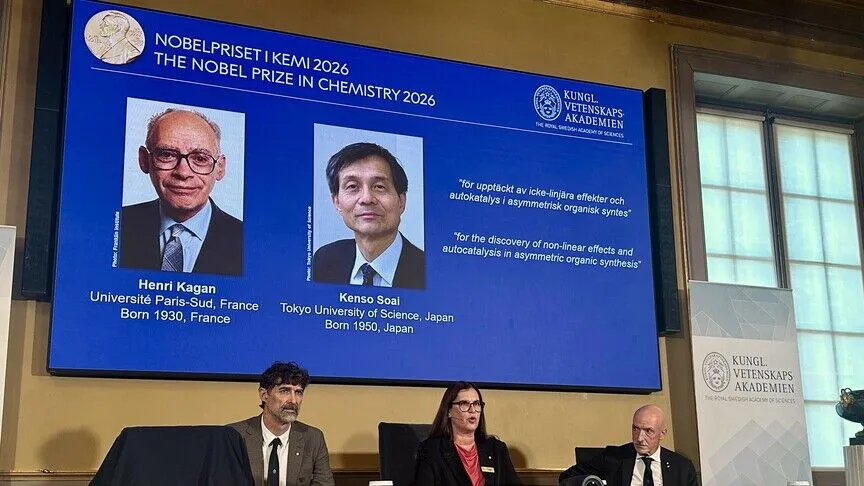
France's Henri Kagan, Japan's Kenso Soai Win 2026 Nobel Prize In Chemistry


The Royal Swedish Academy of Sciences announced the award on Wednesday, saying the two scientists had helped resolve a chemistry mystery more than a century old: how homochirality, the predominance of one molecular“handedness” in living systems, can emerge spontaneously.
Many molecules exist in two forms that are mirror images of each other, known as enantiomers. Like a person's left and right hands, the two forms may look similar but cannot be perfectly superimposed. In biological systems, however, many important molecules occur predominantly in only one of these forms. This difference is particularly important in pharmaceutical chemistry because mirror-image forms of a compound can interact differently with biological systems.
Kagan made a key breakthrough in 1986 when he demonstrated that the relationship between the purity of a chiral catalyst and the selectivity of a chemical reaction could be non-linear. His work showed that relatively small differences in the proportion of one molecular form could be amplified during a reaction, providing a framework for understanding how asymmetric chemical processes can favor one enantiomer over another.
Soai later built on this field by developing asymmetric autocatalysis. In an autocatalytic reaction, a product helps catalyze the formation of more of itself. Soai's research demonstrated that a very small initial imbalance between two mirror-image forms could be amplified dramatically, allowing one form to become overwhelmingly dominant. His work in the 1990s and early 2000s became a landmark example of how chemical processes could generate and amplify molecular asymmetry without biological intervention.
The research has important implications for pharmaceutical chemistry and the design of chemical reactions. The Nobel Committee said Kagan and Soai's discoveries have been decisive for chemists designing reactions used to manufacture pharmaceuticals. More broadly, their work has contributed to efforts to understand how the molecular handedness characteristic of living systems might have emerged before the evolution of life.
The issue of molecular handedness has long been important in medicine. The thalidomide tragedy in the 1950s and 1960s highlighted the dangers of stereochemistry in drug development, although the drug's chemistry is more complicated than a simple case of one enantiomer being safe and the other harmful because the two forms can interconvert in the body. The episode nevertheless reinforced the importance of understanding molecular structure and biological activity when developing medicines.
Kagan, 95, is affiliated with Université Paris-Sud in Orsay, France, while Soai is affiliated with the Tokyo University of Science in Japan. They will share the 2026 Nobel Prize in Chemistry award of 12 million Swedish kronor, with the medals to be presented in Stockholm on December 10.

Legal Disclaimer:
MENAFN provides the
information “as is” without warranty of any kind. We do not accept any
responsibility or liability for the accuracy, content, images, videos,
licenses, completeness, legality, or reliability of the information
contained in this article. If you have any complaints or copyright issues
related to this article, kindly contact the provider above.
Comments
No comment